
Last Updated: October 26, 2026
Quick Summary
Use DISC assessments in talent management by defining two or three target outcomes first, then choosing a validated behavioral instrument with clear reports and facilitator support. Prepare employees with a clear purpose and scheduled debrief, and weave results into manager one-on-ones, development plans, and team norms.
- More than one million people use the DiSC assessment each year for teamwork, communication, and productivity.
- Define two or three target outcomes and the metric you will watch before evaluating any assessment option.
- Set the debrief date before the assessment opens so results have a home.
- Revisit DISC results at role changes, new team formation, and annual planning.
- Capture baseline scores, run a 90-day check, and review again at six months.
Table of Contents
- What DISC Assessments Measure and Why They Matter for Talent Management
- How to Choose and Implement a DISC Assessment
- Using DISC Assessment for Employee Development
- DISC Assessment Onboarding Examples That Set New Hires Up for Success
- How to Communicate with Different DISC Styles
- DISC Assessment Team Workshop Activities That Build Collaboration
- Adapting Leadership Styles and Coaching with DISC Insights
- Ethical Use, Limitations, and Measuring Outcomes
- Take the Next Step with Your Life’s Path
- Frequently Asked Questions
What DISC Assessments Measure and Why They Matter for Talent Management
DISC assessments measure how people prefer to act, communicate, and approach work. According to DiSC Profile’s overview of the assessment, more than one million people use the DiSC assessment each year for teamwork, communication, and productivity. That scale tells you something important: this is not a fringe tool.
Talent management is the practice of attracting, developing, and keeping the right people in the right roles. DISC gives that practice a shared language for behavior. Instead of guessing why a manager and a new hire keep clashing, you get a framework.
The Four Behavioral Styles: Dominance, Influence, Steadiness, and Conscientiousness
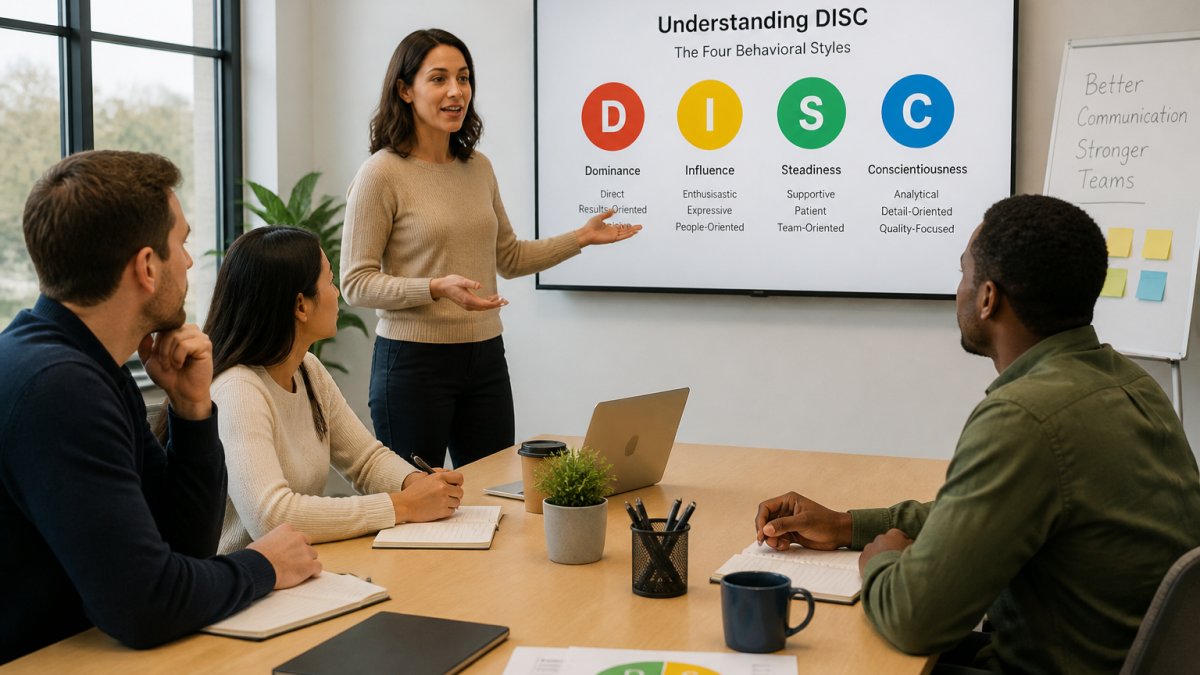
Each person leans toward one or more of four behavioral styles:
- Dominance (D): direct, decisive, results-first
- Influence (I): outgoing, enthusiastic, people-focused
- Steadiness (S): calm, patient, team-oriented
- Conscientiousness (C): precise, analytical, quality-focused
Most people show a blend. The value is in the pattern, not a single label.
How to Choose and Implement a DISC Assessment
Start by defining what you want DISC to change. Better communication? Stronger delegation? Smarter role assignment? Write down two or three target outcomes and the metric you will watch for each before you evaluate any option. For a step-by-step walkthrough, see how to choose a DiSC assessment provider. That single step keeps the decision grounded in outcomes rather than features.
Criteria for Choosing a Validated Assessment
- Behavioral focus. The assessment should measure how people prefer to act and communicate, not skill, intelligence, or worth. Look for statements about preferences and tendencies rather than pass/fail scoring.
- Validation and reliability. Ask for evidence that the instrument has been tested for consistency over time and that results are comparable across teams and roles.
- Report clarity. A strong report explains the person’s pattern in plain language and offers practical tips for working with others, not just a label.
- Facilitator support. Confirm whether guided debriefs, group sessions, and follow-up resources are available so results turn into conversation.
- Accessibility and privacy. Check how profiles are stored, who can see them, how long they are retained, and whether accommodations are available for employees who need them.
- Integration. Ask how results can be referenced in manager workflows, development plans, and HR systems without creating a separate silo.
Your Life’s Path offers official Everything DiSC® assessments with certified partner support and easy-to-administer digital tools.
Preparing Employees Before the Assessment
Preparation shapes how people show up. A short message before the assessment goes a long way:
- Explain the purpose in one sentence: this is about how we work together, not about ranking anyone.
- Clarify who will see results and how they will be used.
- Invite questions and confirm that participation is about development, not evaluation.
- Set the debrief date before the assessment opens so results have a home.
Interpreting Reports and Avoiding Labels
A profile is a snapshot of preferences, not a fixed identity. Read reports for patterns and context: how someone tends to communicate under pressure, what environment helps them do their best work, and where they may flex. Encourage employees to describe their own results in their own words and to name situations where they adapt. That habit keeps profiles useful and prevents them from hardening into labels.
Integrating Results into Manager Workflows
Make DISC part of the rhythm of management rather than a one-time event:
- Reference profiles in one-on-one agendas and development-plan conversations.
- Use style language in team charters and meeting norms.
- Revisit results at natural milestones such as role changes, new team formation, and annual planning.
- Keep a simple record of how insights were applied so you can review what worked.
Using DISC Assessment for Employee Development
- Strength to build on: [one behavior the profile highlights]
- Stretch area: [one behavior to practice]
- Partner: [a colleague with a complementary style]
- Check-in date: [30 or 60 days out]
DISC Assessment Onboarding Examples That Set New Hires Up for Success
- Day-one profile review. The new hire reads their report with their manager and names one communication preference.
- Manager matching. The manager shares their own style and agrees on how feedback will flow.
- Buddy pairing. The new hire is paired with a colleague whose style complements theirs. For a deeper walkthrough, read how to add DISC training into employee onboarding.
How to Communicate with Different DISC Styles
Communication improves when you adjust your delivery, not your intent. Here is how to communicate with different DISC styles in practice:
- With D: lead with the bottom line, then offer details
- With I: open with energy, then confirm next steps in writing
- With S: slow down, invite input, avoid surprises
- With C: bring data, allow time to review
DISC Assessment Team Workshop Activities That Build Collaboration
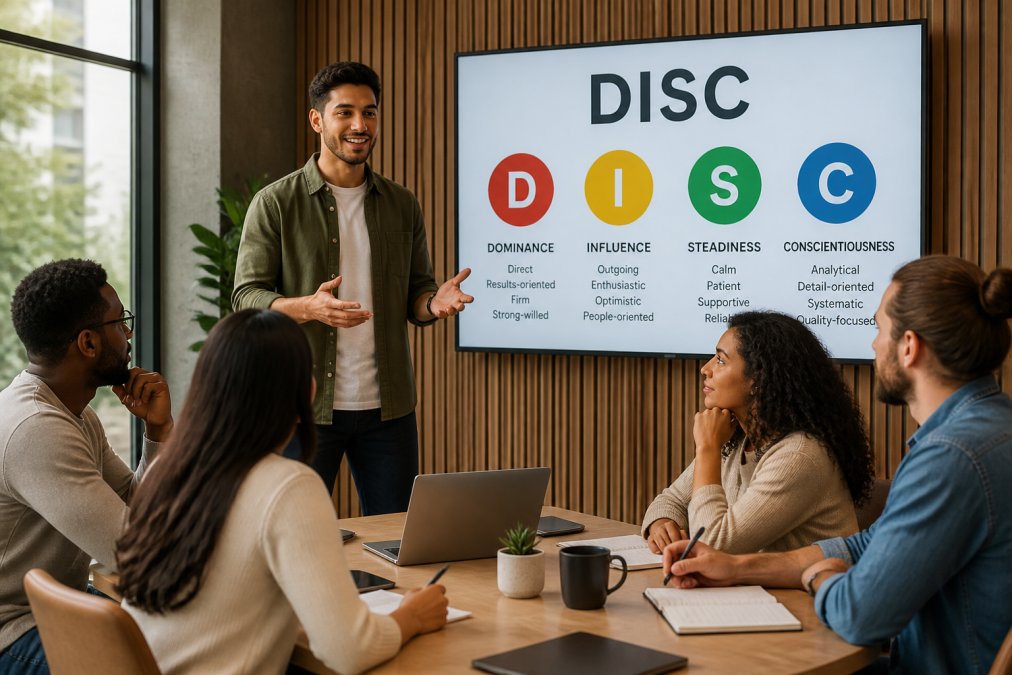
Infographic of a talent management process using sticky notes and whiteboard diagrams to visualize team collaboration.
Style mapping. Post the four styles on a wall. Each person places a sticky note where they see themselves, then explains one preference.
Pair-and-practice. Two colleagues with different styles role-play a real workplace conversation, then swap.
Take The Official DiSC® Assessment Online Now! →
Team grid. The group maps its combined strengths and names one gap to cover. Explore best practices for DiSC assessment team workshops to run these sessions effectively.
Adapting Leadership Styles and Coaching with DISC Insights
This is where leadership development becomes practical. One leader, four styles, four ways to lead.
Ethical Use, Limitations, and Measuring Outcomes
DISC describes behavior preferences. It does not measure skill, intelligence, or worth. Keeping that distinction front and center is what makes a DISC program trustworthy and durable. This section maps the responsible-use guardrails, the limitations to respect, and a practical way to measure whether your program is working.
Responsible Use Across the Employee Lifecycle
Use DISC to open conversations, not to close doors. A few principles keep the program on solid ground:
- Development first. Use results for coaching, teaming, and communication. Treat them as one input among many in hiring, promotion, or role-change decisions, never as the sole basis.
- Fairness and accessibility. Offer accommodations so every employee can complete the assessment comfortably, and review results in context rather than against a single template.
- Privacy and consent. Tell people what is collected, who can see it, how long it is retained, and how they can ask questions. Get consent before sharing profiles beyond the individual and their manager.
- Consistency. Apply the same process to every participant so no group is assessed more heavily or judged more strictly.
- No permanent labels. Profiles describe tendencies, not ceilings. Encourage employees to describe where they flex and how context changes their behavior.
When hiring, separate what the job requires from how a person prefers to work. guidance on using DISC in hiring makes this distinction clearly, and it should shape how you read any candidate’s results.
Limitations to Respect
Behavior is context-dependent. People adapt under pressure, in new teams, and across roles, so a single profile captures a moment rather than the whole person. Assessment results are also self-reported, which means they reflect how someone sees themselves today. Use profiles as conversation starters and pair them with performance data, manager judgment, and direct observation. That combination is far more reliable than any single report.
A Practical Measurement Plan
- Baseline. Before the first session, capture current scores for communication effectiveness, team feedback, and retention trends.
- 90-day check. Revisit the same signals and ask managers what changed in their one-on-ones and team meetings.
- Six-month review. Look for movement in time to productivity for new hires, engagement scores, and team effectiveness ratings.
- Qualitative input. Collect short stories from managers and employees about how style language changed a real conversation.
Distinguish correlation from causation. If engagement rises after a DISC rollout, note other changes that happened in the same window and avoid claiming the assessment alone caused the shift. A measured, honest story is more credible and more useful than an inflated one. Learn how to measure long-term behavioral change from DiSC workshops.
Take the Next Step with Your Life’s Path
Your Lifes Path makes that easier with official Everything DiSC® assessments, certified partner support, and easy-to-administer digital tools. Our EPIC Sub-Account access and Catalyst platform give facilitators flexible ways to run sessions.
Get started with Your Lifes Path.
Frequently Asked Questions
How can DISC assessments support talent management?
DISC assessments give you a shared language for understanding behavioral tendencies across your workforce.
Can DISC assessments be used in hiring decisions?
DISC results can inform hiring when you use them carefully. Distinguish the behaviors a job requires from the way a candidate prefers to work, and interpret results in relation to job demands rather than as a standalone decision-maker. Use DISC to structure interview questions and check role fit, but pair it with skills assessments, references, and structured interviews. This keeps your process fair and legally responsible.
How can managers use DISC styles to improve team communication?
Managers can adapt their communication style to each team member’s preferences. A Dominance style often wants direct, bottom-line updates; an Influence style responds to enthusiasm and collaboration; a Steadiness style values consistency and reassurance; a Conscientiousness style prefers detail and accuracy. Share profiles openly, agree on communication norms, and revisit them in team meetings. This reduces friction and builds trust across the group.
How often should employees revisit their DISC profile?
Most organizations revisit DISC profiles annually or when someone changes roles, joins a new team, or takes on leadership responsibilities. Behavioral tendencies are relatively stable, but context shifts how people apply them. A yearly refresh keeps the language current, supports onboarding, and ties back to development goals. Pair each review with a coaching conversation and a specific action step so the insight leads to measurable change.
