
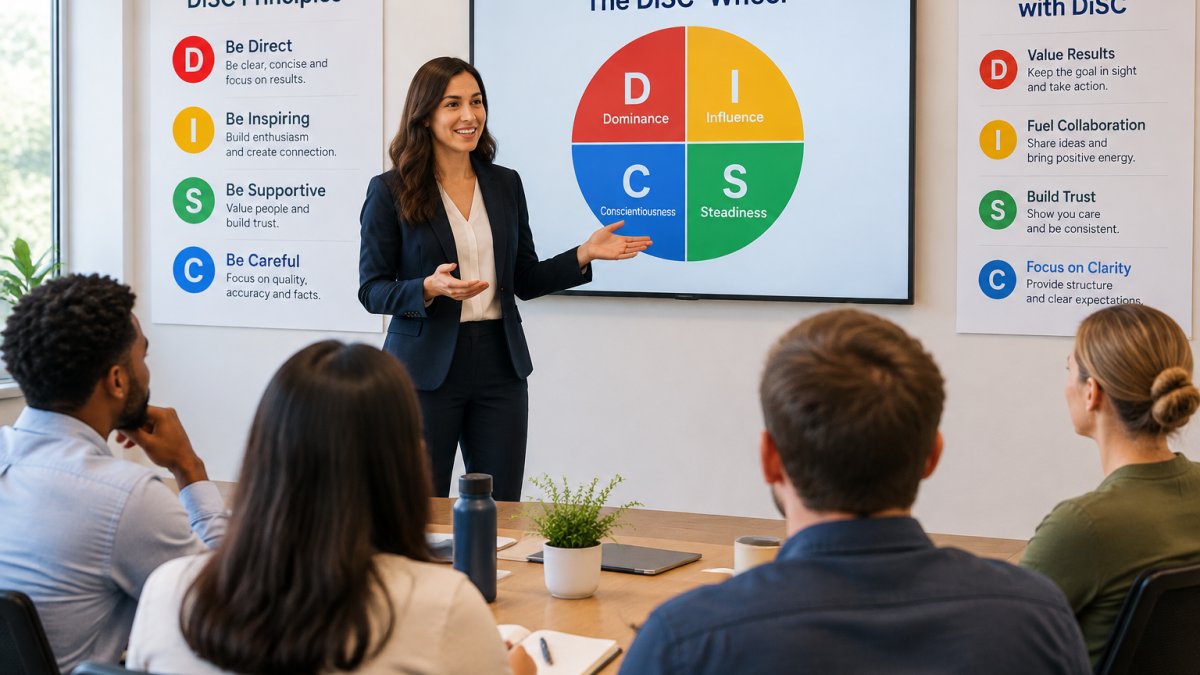
Last Updated: November 13, 2026
Quick Summary
DiSC team building uses official Everything DiSC assessments to give teams a shared language for how they communicate, decide, and handle pressure. Run a half-day session with style mapping and role-play, then keep learning alive using the DiSC Workplace profile with Catalyst.
- A half-day session runs about three and a half hours, from welcome and overview to Catalyst walkthrough.
- Plan tables of four to six, mixing D, i, S, and C styles on purpose at each table.
- Send the assessment link a week ahead so results are ready before the session.
- DISC Bingo takes 15 minutes and works well as a low-pressure warm-up for new teams.
- Set up a free EPIC sub-account to manage assessments and results in one place.
Table of Contents
- Why DiSC Team Building Works Better Than Generic Icebreakers
- A Quick Overview of the Four DiSC Behavioral Styles
- What You’ll Need Before the Session Starts
- Step 1: Choose DiSC Workshop Activities That Match Your Team’s Need
- Step 2: Run DiSC Activities for Small Groups
- Step 3: Facilitate DiSC Role-Play Scenarios That Feel Real
- Step 4: Adapt the Exercises for Virtual DiSC Team Building
- Step 5: Keep DiSC Alive After the Session With Catalyst
- Step 6: Measure What Changed and Reinforce It
- Book Your DiSC Team Building Workshop With Your Lifes Path
- Frequently Asked Questions
Why DiSC Team Building Works Better Than Generic Icebreakers
Generic icebreakers get a laugh, then get forgotten by lunch. DiSC team building works differently: it gives people a shared language for how they communicate, decide, and handle pressure, so the learning keeps paying off after the room clears. Teams that use official Everything DiSC® assessments can turn a single session into lasting behavior change.
The core idea is simple. People do not need to be fixed. They need to be understood.
A good DiSC session surfaces behavioral differences early. It shows why one teammate wants the bottom line while another wants the details. It makes those preferences safe to talk about. That is the difference between a fun hour and a session that reshapes how a team works together.
Here is what we will cover: the four styles, a complete facilitator run-of-show, small-group activities, role-play scenarios, virtual adaptations, and a way to keep DiSC alive long after the workshop ends. The activities outlined here can be adapted to teams of many sizes.
A Quick Overview of the Four DiSC Behavioral Styles
The DiSC model maps behavior across four styles: Dominance, Influence, Steadiness, and Conscientiousness. Every person blends all four, but most people lean on one or two. DiSC is a behavioral assessment, meaning it describes how someone tends to act, not what they are capable of.
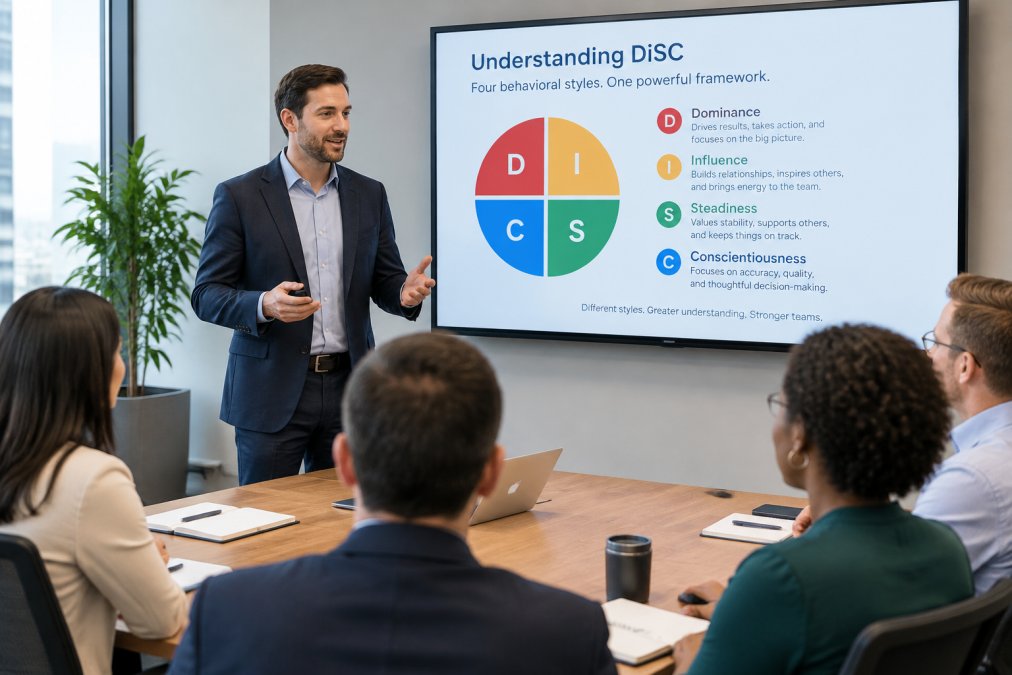
Facilitator explaining the four-quadrant DiSC model during a DiSC team building workshop in a bright office.
Dominance (D): Direct, Decisive, Results-Focused
D-style teammates move fast and want the headline, not the history. They thrive on challenge and ownership. In a workshop, they will push for the “so what” early. Give them clear goals and they will drive a group forward.
Influence (i): Enthusiastic, Collaborative, Expressive
i-style teammates bring energy and connection. They think out loud and rally people around ideas. They shine in group discussion and role-play. Pair them with a quiet S or C partner and you get balance.
Steadiness (S): Calm, Supportive, Consistent
S-style teammates value stability and follow-through. They listen carefully and keep the team cohesive. They may need a moment before speaking up in a fast exercise, so build in reflection time.
Conscientiousness (C): Analytical, Precise, Systematic
C-style teammates want accuracy and logic. They ask good questions and catch what others miss. Give them the framework and the details, and they will help the group avoid sloppy conclusions.
What You’ll Need Before the Session Starts
Prep work separates a smooth workshop from a scramble. The goal is a session that runs itself, so you can facilitate instead of troubleshoot. Here is the full preparation picture, including the materials, group sizes, and timings that make a DiSC team building exercise land.
Materials to Gather
- Official Everything DiSC® assessment results for each participant, printed or accessible on a device
- A printed one-page summary of the four styles for each table
- A whiteboard or flip chart with markers in four colors, one per style
- Name tents showing each person’s style letter
- Sticky notes in four colors for style mapping
- A timer visible to the room
- A run-of-show with timings, printed for you and shared with co-facilitators
- A shared notes doc for virtual or hybrid groups
Group Size and Room Setup
Plan for tables of four to six, mixing styles on purpose so each table holds a spread of D, i, S, and C preferences. For a group of 20 to 40, that means four to eight tables and one facilitator plus a co-facilitator if you can arrange it. Seat people so every table can see the whiteboard, and leave wall space for the style-mapping sheet. For virtual sessions, confirm breakout rooms are pre-assigned and test screen sharing and the whiteboard tool a day ahead. With the room and breakout logistics settled, you can carry the same deliberate mix of styles into an outdoor session with Salted City Sports.
A Sample Run-of-Show
A half-day session of about three and a half hours works well for most teams:
|
Segment |
Time |
|---|---|
|
Welcome and DiSC overview at the whiteboard |
20 min |
|
DISC Bingo warm-up |
15 min |
|
Style mapping at tables |
30 min |
|
Break |
10 min |
|
Role-play scenarios in small groups |
40 min |
|
Debrief and team commitments |
30 min |
|
Catalyst walkthrough and next steps |
20 min |
Time
Adjust the totals for a 90-minute virtual version by keeping the overview, one activity, and the debrief, and moving role-play to a follow-up session.
Timing and Logistics
Send the assessment link a week ahead so results are ready, and confirm the room setup two days before. Share the agenda in advance so D-style teammates know the payoff and S-style teammates know what to expect. Build in reflection time after each activity, because quieter teammates often need a moment before they speak up.
Watch out: running the session before results are in forces people to guess their style, which undercuts trust in the whole process.
Step 1: Choose DiSC Workshop Activities That Match Your Team’s Need
Match the activity to the problem you actually want to solve. A team with friction needs communication exercises. A team that plans poorly needs decision-making scenarios. A new team needs low-pressure icebreakers first.
Use this quick selection guide:
|
Team Need |
Best Activity |
Time |
|---|---|---|
|
New team, low trust |
DISC Bingo warm-up |
15 min |
|
Communication friction |
Style mapping |
30 min |
|
Handling tough conversations |
Role-play scenarios |
40 min |
|
Remote or hybrid team |
Virtual breakout exercises |
30 min |
|
Planning and decisions |
Group problem-solving scenario |
35 min |
For a fuller walkthrough of structuring the day, see how to conduct a DiSC workshop for employees.
Step 2: Run DiSC Activities for Small Groups
Small groups lower the pressure and raise the honesty. Break the room into tables of four to six, mixing styles on purpose. Two activities do most of the early work.
DISC Bingo: A Low-Pressure Warm-Up
Hand each person a bingo card with style-based prompts like “prefers a quick answer” or “thinks before speaking.” People mingle and find a teammate who matches each square. It gets everyone talking, and it surfaces behavioral differences without anyone feeling put on the spot. Fifteen minutes is plenty.
Style Mapping: Seeing the Team at a Glance
Draw the four DiSC quadrants on a large sheet. Each person places a sticky note with their name where they think they sit. The team then discusses clusters, gaps, and what the mix means for how work gets done. This is team mapping at its most visual, and it opens a rich group discussion about team strengths.
Step 3: Facilitate DiSC Role-Play Scenarios That Feel Real
Role-play works only when the scenario feels like Tuesday, not a textbook. Pull real situations from the team: a tense status meeting, a missed deadline, a client pushback. Assign roles and let people try a style different from their own.
Set the scene in one sentence, give each player their style, and run it for three minutes. Then debrief with two questions: what worked, and what would you try next time?
A common mistake is skipping the debrief. The debrief is where the learning lands. For facilitation best practices that make these scenarios click, read best practices for DISC workplace facilitation.
Step 4: Adapt the Exercises for Virtual DiSC Team Building
Virtual sessions can work just as well when you design for the screen. Keep segments short and use breakout rooms for small-group work.
- Send digital bingo cards and style-mapping templates in advance
- Use breakout rooms of three to four for role-play
- Ask people to rename themselves with their style letter
- Build in a five-minute break every 45 minutes
- Capture notes in a shared doc so nothing gets lost
Virtual DiSC team building actually has an advantage: quieter teammates often engage more in chat and small rooms. For specific tactics, see how to improve remote team communication using DiSC. We also offer virtual teambuilding workshops built for exactly this format.
Step 5: Keep DiSC Alive After the Session With Catalyst
The workshop is the start, not the finish. This is where most programs fade, and where the right tools change the outcome. Pairing the DiSC Workplace profile with the Catalyst platform helps the learning stay in front of people every day.
What Catalyst Adds Day to Day
Catalyst gives teams a way to keep DiSC in view between sessions, helping people refer back to their learning as they work together.
Set Up a Free EPIC Sub-Account
Set up a free EPIC sub-account to manage assessments and results in one place. Once it is live, add each participant, send the assessment link, and confirm results are in before the session.
A 30-Day Reinforcement Routine
- Week 1: Open team meetings with a one-minute style tip drawn from Catalyst
- Week 2: Rotate a style spotlight, with one teammate sharing how their style shows up at work
- Week 3: Use Catalyst comparisons before a big project kickoff
- Week 4: Revisit one role-play scenario and debrief what changed
Virtual Teambuilding That Keeps the Thread
Virtual sessions can work just as well when you design for the screen. Keep segments short, use breakout rooms of three to four for role-play, and ask people to rename themselves with their style letter. Virtual DiSC team building can work well for quieter teammates who engage in chat and small rooms. Explore virtual teambuilding workshops for this format.
For guidance on sustaining engagement, see using Catalyst for DISC workplace facilitation, and explore Catalyst for groups to see how it fits your team.
Watch out: treating assessment results as fixed labels rather than a conversation starter can make people defensive, so remind the team that DiSC describes behavior, not limits.
Step 6: Measure What Changed and Reinforce It
Measure before and after so you can show what changed. Start with a short pulse survey before the workshop: how well does the team communicate, resolve conflict, and share feedback? Repeat it 60 to 90 days later.
Then reinforce the learning:
- Open team meetings with a one-minute style tip
- Rotate a “style spotlight” each week
- Revisit role-play scenarios quarterly
- Use Catalyst comparisons before big projects
Track a few simple signals: fewer miscommunications, faster decisions, smoother conflict. For a deeper method, see how to measure long-term behavioral change from DiSC workshops. Treat assessment results as a conversation starter, not a label, and remind people that DiSC describes behavior, not limits.
Book Your DiSC Team Building Workshop With Your Lifes Path
A strong DiSC session gives your team a shared language and a practical way to work together. The teams that get the most from it are the ones that keep using it after the room clears.
Your Lifes Path provides official Everything DiSC® assessments with certified partner support, a free EPIC sub-account, and the Catalyst platform for flexible facilitation.
Ready to build a team that communicates with confidence? Get started with Your Lifes Path and turn one workshop into lasting change.
Frequently Asked Questions
How long should a DiSC team building session last?
A focused session runs 90 minutes to three hours. That gives time for a short DiSC model overview, one warm-up activity, a small-group exercise, and a debrief. For deeper work, such as role-play scenarios and team mapping, plan a half-day. Keep the first session shorter and follow up with Catalyst micro-activities so the learning continues without overwhelming the calendar.
Can DiSC team building exercises be done virtually?
Yes. Virtual DiSC team building works when you shorten activities, use breakout rooms for small-group discussion, and share the DiSC model on screen. Send profiles in advance, run a quick poll to map styles, and debrief in the main room. Catalyst makes it easy to assign follow-up activities between virtual sessions so the momentum carries forward.
How can a team keep using DiSC after a team building session?
Pair the Everything DiSC Workplace profile with Catalyst, a flexible platform for facilitation that helps keep DiSC in front of your team. Set up a free EPIC sub-account to manage assessments and results in one place.
What are examples of DiSC role-play scenarios?
Try a D-style manager giving blunt feedback to an S-style teammate who needs context, or an i-style presenter pitching to a C-style analyst who wants data. Other useful scenarios include a cross-style deadline negotiation and a conflict between a fast-moving D and a detail-focused C. Debrief each role-play by asking what each style needed and how the other person could adapt.
