Last Updated: November 13, 2026
Quick Summary
The best DiSC assessments for corporate team development center on Everything DiSC Workplace on Catalyst, which pairs individual profiles with a live facilitator-led group map. Wiley’s DiSC assessment is the official instrument behind it, giving teams consistent, credible results across the organization.
- The DiSC model maps four styles: Dominance, Influence, Steadiness, and Conscientiousness.
- The DiSC wheel shows team clusters, gaps, and opposite styles that need translation.
- Plan four phases: assessment, workshop, follow-through, and reinforcement.
- Match profiles to roles: Workplace for teams, Management for managers, Sales for sales.
- Keep the shared language alive in everyday meetings to make learning stick.
Table of Contents
- Why Corporate Teams Choose DiSC Assessments for Development
- What the DiSC Wheel Reveals About Your Team
- The DiSC Assessment for Teams That Delivers Group-Level Insight
- How DiSC Communication Styles Improve Collaboration
- DiSC Team Building Activities That Make the Learning Stick
- How Long a DiSC Assessment Duration Really Takes
- Choosing the Right Profile for Every Role on Your Team
- Start Your Team’s DiSC Journey with Your Lifes Path
- Frequently Asked Questions
Why Corporate Teams Choose DiSC Assessments for Development
DiSC assessments give corporate teams a shared language for something that usually stays invisible: how each person prefers to communicate, decide, and move through a workday. At Your Lifes Path, we work with HR leaders and trainers who use official Everything DiSC® profiles to turn that awareness into better meetings, smoother handoffs, and stronger collaboration. DiSC assessments give teams a practical model, results that are easy to apply, and a conversation that starts with behavior rather than labels.
What the DiSC Model Shows
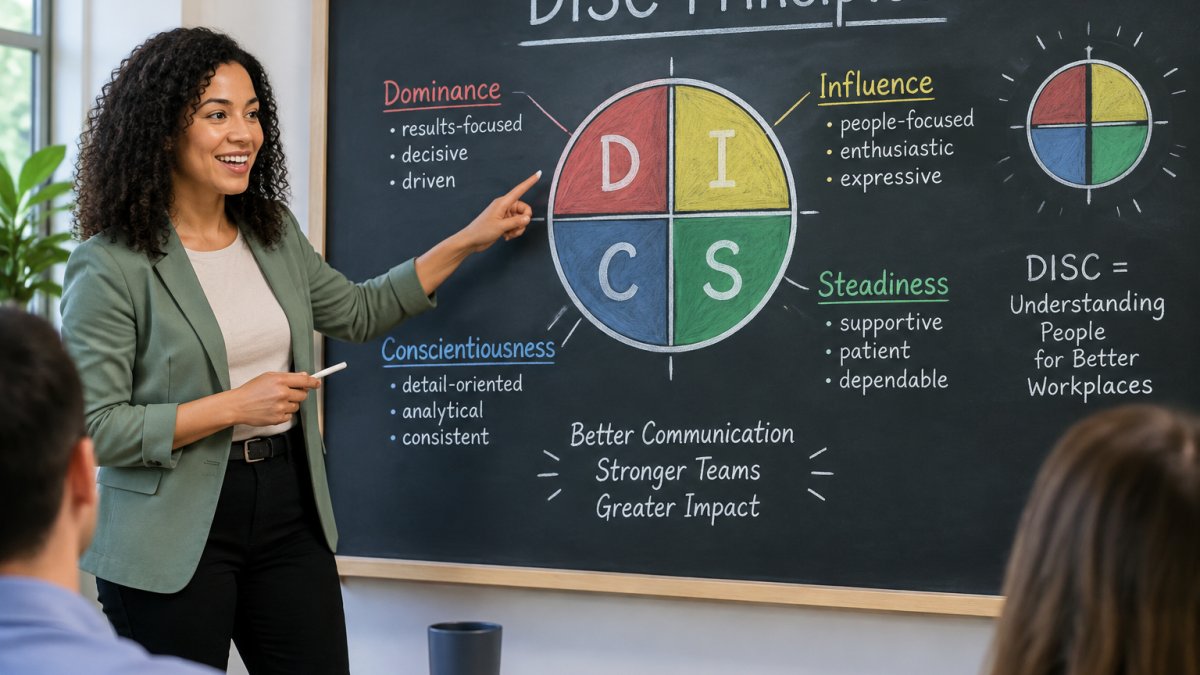
The DiSC model maps four behavioral tendencies: Dominance, Influence, Steadiness, and Conscientiousness. It is not a measure of intelligence or skill. It shows how someone tends to respond to pace, people, and procedure.
Most people display a blend of styles with one or two dominant preferences. That blend explains why a direct, fast-moving teammate and a careful, methodical one can both be effective and still frustrate each other.
The Four DiSC Communication Styles
Each style brings a distinct communication pattern to the table:
- Dominance: direct, decisive, results-first
- Influence: enthusiastic, collaborative, persuasive
- Steadiness: calm, patient, dependable
- Conscientiousness: precise, analytical, quality-focused
A common mistake is treating these as fixed boxes. In practice, most people flex their style depending on the situation, and a DiSC assessment for teams simply makes that flexing visible and intentional.
What the DiSC Wheel Reveals About Your Team
The DiSC wheel places all four styles around a circle, with adjacent styles sharing more traits and opposite styles sitting furthest apart. Seeing the wheel is often the moment a team stops treating differences as personality clashes and starts seeing them as predictable friction points.
Here is how we read a team’s wheel:
- Clusters: a team heavy on one style may move fast but miss detail, or analyze thoroughly but stall on decisions
- Gaps: missing styles reveal where the group may need to borrow a behavior deliberately
- Opposites: styles on opposite sides of the wheel need the most translation between them
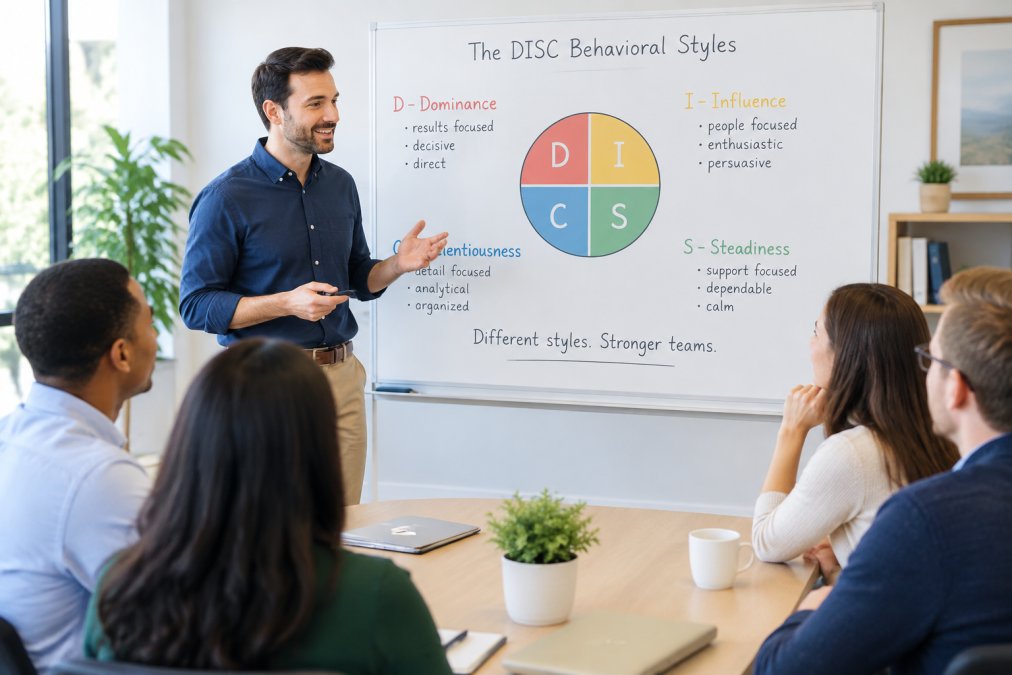
Colleagues discussing a DiSC assessments wheel handout at a meeting table
The wheel is a map, not a verdict. It tells you where the team naturally lands and where it may need to stretch.
The DiSC Assessment for Teams That Delivers Group-Level Insight
For group-level insight, we recommend the Everything DiSC Workplace on Catalyst platform. It combines individual profiles with a facilitator-led group experience, so the team sees its own patterns rather than just reading four separate reports.
Catalyst lets a facilitator run the session live, pull up the group map, and guide the conversation in the moment. Wiley’s DiSC assessment is the official instrument behind it, which matters when you need consistent results across a large organization.
If you are facilitating the session yourself, using Catalyst for DISC workplace facilitation covers how to lead the group discussion with confidence.
How DiSC Communication Styles Improve Collaboration
Collaboration improves when people adjust how they communicate, not just what they communicate. A high-D colleague wants the headline first; a high-C colleague wants the reasoning. A high-S teammate needs time to process before committing. Once a team knows its DiSC communication styles, those adjustments become routine rather than personal.
In practice, this can mean clearer emails, more focused meetings, and more confident decisions.
When styles do clash, a practical guide to resolving team conflict with DiSC walks through how to reset the conversation. And if you want a structured rollout, nine steps to use DiSC for effective team collaboration turns the concept into a repeatable process.
DiSC Team Building Activities That Make the Learning Stick
The assessment is the starting line, not the finish. DiSC team building activities are what convert insight into habit. A common approach is to pair each person’s style with a real, upcoming work scenario and rehearse the adjusted approach before the meeting happens.
Three activities we see work well:
- Style swap: two teammates with opposite styles plan a task using each other’s preferences
- Meeting audit: the team reviews a recent meeting and names where each style helped or slowed things down
- Preference pairs: colleagues interview each other about what they need to do their best work
For a fuller menu, DiSC assessments for team building exercises gives you ready-to-run options that fit a workshop or a standing team meeting. If you would rather have the session led for you, our Virtual Teambuilding Workshops bring the facilitated DiSC experience to remote and distributed teams.
How Long a DiSC Assessment Duration Really Takes
Completion time varies by participant, and the real time investment sits in the facilitated workshop, sized to team size and goals.
Plan for four phases, not three:
- Assessment: completed online before the session
- Workshop: facilitated discussion, sized to the team
- Follow-through: short check-ins over the following weeks
- Reinforcement: recurring use of the shared language in everyday meetings
Follow-through and reinforcement help keep the learning in use, so it is worth building follow-up into the plan from the start.
A practical rollout looks like this:
- Pre-work. Send the assessment link and a short note explaining that results describe behavior, not skill or worth.
- Facilitated session. Use Catalyst to display the group map live. Walk through the four styles, then the team’s own clusters, gaps, and opposites. Let people self-identify rather than labeling each other.
- Scenario practice. Pair opposite styles and have them plan a real upcoming task using each other’s preferences. This is where the learning becomes concrete.
- Follow-up check-ins. Periodically ask each person to name one adjustment they made and what changed. Short, specific, and tied to real work.
- Reinforcement. Keep the language alive in meetings, “let’s hear the C perspective” or “who’s holding the S view here?”, so the model stays in use rather than in a drawer.
The facilitator’s role matters throughout. A trained facilitator can pace the session, draw out quieter styles, and keep the conversation behavioral rather than personal. If you are facilitating yourself, using Catalyst for DISC workplace facilitation covers how to lead the group discussion with confidence.
Choosing the Right Profile for Every Role on Your Team
Different roles call for different profiles, and matching them well is what separates a useful program from a forgotten one. The Everything DiSC® family is built so each profile answers a different team-development question, and the right choice comes down to three criteria: who the learner is, what behavior the team needs to change, and whether a facilitator will lead the debrief.
Here is a selection guide organized by those criteria:
|
Role focus |
Recommended profile |
Best for |
Facilitation |
|---|---|---|---|
|
General team communication |
Everything DiSC Workplace |
Cross-functional teams, project groups, intact departments |
Facilitator-led or self-guided |
|
People managers |
Everything DiSC Management |
New and seasoned managers building coaching skills |
Facilitator-led recommended |
|
Sales teams |
Everything DiSC Sales |
Adaptive selling and customer-reading skills |
Facilitator-led recommended |
|
Senior leaders |
Everything DiSC Work of Leaders |
Leadership development and vision-to-execution alignment |
Facilitator-led |
|
Group facilitation |
Everything DiSC on Catalyst |
Live team sessions with a group map |
Facilitator-led |
Use the criteria, not the label, to decide:
- Who the learner is. Workplace is the default for individual contributors and mixed teams. Management fits anyone who directs others. Sales fits customer-facing roles. Work of Leaders fits people setting direction for the organization.
- What the team needs to change. If the goal is day-to-day communication, Workplace is the right starting point. If the goal is coaching conversations, Management gives managers the language. If the goal is strategic alignment, Work of Leaders connects style to vision, alignment, and execution.
- Whether a facilitator will lead. Catalyst is the platform for live, facilitator-led group sessions because it surfaces the group map in the moment. Self-guided teams can still use Workplace profiles, but the group conversation is where the insight lands.
Selection also depends on team size and development goal:
- Small teams (under 10). A single Workplace session with a facilitator is usually enough to create shared language. Keep the group small so each person’s style gets airtime.
- Large organizations. Standardize on Workplace for the broad population, then layer Management and Work of Leaders for managers and leaders. Consistency across profiles makes the language portable between teams.
- Remote and distributed teams. Catalyst’s live group map works well when the team meets on video, because the facilitator can share the map and guide the conversation in real time.
- Specific goals. For onboarding, Workplace gives new teammates a fast shared vocabulary. For conflict management, Workplace plus a facilitated debrief on opposite styles is the practical pairing.
Before you commit, it helps to know what makes an Everything DiSC assessment official so you choose a credible profile for each role. Certified partner support can help you choose the right profile for your team.
Watch out: choosing a profile based on fit for the role, rather than how it sounds, helps ensure the results are relevant.
Start Your Team’s DiSC Journey with Your Lifes Path
Teams that get the most from DiSC treat it as an ongoing practice, not a one-time event. They assess, workshop the results, and keep the shared language alive in everyday conversations.
Your Lifes Path provides official Everything DiSC® assessments with certified partner support, free EPIC sub-account setup, and the Catalyst platform for flexible facilitation. Whether you are running a single team workshop or an enterprise-wide leadership program, we help you match the right profile to each role and keep the learning going long after the session ends. Get started with Your Lifes Path and build a team that communicates with clarity and confidence.
Frequently Asked Questions
What is the DiSC model and how does it apply to corporate teams?
The DiSC model maps four behavioral styles: Dominance, Influence, Steadiness, and Conscientiousness. Each person leans toward one or a blend of these, which shapes how they communicate, decide, and work with others. For corporate teams, DiSC assessments give everyone a shared language for those differences. Instead of reading a colleague’s directness as rudeness, a team member can recognize a D style and adjust. That shared understanding reduces friction and helps groups collaborate more smoothly on daily work.
How long does a DiSC assessment take to complete?
Completion time varies by participant. The questions are statements about workplace behavior, and participants answer at their own pace. This makes it practical to run a team through the assessment ahead of a facilitated workshop session.
How can managers apply DiSC insights to team development?
Managers can use DiSC results to adapt how they delegate, give feedback, and motivate each person. A manager leading a team of DiSC assessments can see where styles cluster and where they clash, then plan meetings and tasks accordingly. For example, a Conscientiousness-heavy team may want detailed agendas, while an Influence-heavy group thrives on open discussion. The Everything DiSC Management profile gives managers a structured way to apply these insights to real situations rather than leaving the report on a shelf.
What makes an official Wiley DiSC assessment different from a free quiz?
An official Wiley DiSC assessment is the official instrument for this model. Official assessments through Your Lifes Path include access to the Catalyst platform, certified partner support, and profiles for workplace, management, sales, and leadership goals.
