
Last Updated: November 16, 2026
Quick Summary
Customizing DISC training materials starts with reading your team’s group report, then setting two or three behavior-focused learning objectives, and finally matching activities to the styles in the room. This reading-first workflow lets you shape DISC training around the team you are actually serving instead of generic content.
- Read the group report first and note style distribution, outliers, and spread before touching a slide.
- Set two or three behavior-focused objectives; more than that and the session loses focus.
- Match activities to dominant styles: debate for high-D, storytelling for high-i, pair work for high-S, data cases for high-C.
- Build facilitator guides with five parts: objectives, group summary, activity instructions, discussion prompts, and debrief script.
- Keep participant workbooks under 15 pages and include a commitment page for one behavior to try.
Table of Contents
- Start With Your Team Profile Before You Customize Anything
- A Practical Workflow for Customizing DISC Team Workshops
- Choosing DISC Training Activities That Fit Your Group
- What Belongs in a DISC Assessment Facilitator Guide
- Building a DISC Training Workbook People Actually Use
- Adapting Materials for D, i, S, and C Learners
- Customizing Examples for Sales, Leadership, and Nonprofit Teams
- Facilitating the Conversation When Results Are Shared
- Measuring Whether the Training Changed Team Behavior
- Handling Assessment Data Responsibly and Accessibly
- Frequently Asked Questions
Start With Your Team Profile Before You Customize Anything
Customizing DISC training materials starts with reading your team profile, not with opening a slide deck. The most effective workshops begin with the group report, so facilitators can shape materials around the team they are actually serving.
DISC training is the practice of using the four behavioral styles, Dominance, Influence, Steadiness, and Conscientiousness, to build self-awareness and better teamwork. The materials only work when they mirror the actual mix of styles in the room.
A team profile changes what you build. A group heavy in D and i styles wants pace, debate, and short bursts of activity. A group heavy in S and C styles wants context, structure, and time to think. Same content, very different delivery.
Here is the core argument of this guide: customization is a reading exercise, not a design exercise. Read the group report first, and the materials almost write themselves.
Wiley’s overview of the Everything DiSC model describes how the four styles interact in workplace settings.
A Practical Workflow for Customizing DISC Team Workshops
Customizing DISC team workshops follows three steps: read the group report, set two or three learning objectives, then match materials to the mix. Skip any step and you end up with generic content that lands flat.
Below, we walk through each step with the specific decision points that matter. The whole process takes a few focused hours, not weeks.
Step 1: Read the Group Report
Start with the group report, not the individual profiles. Look for three things: the style distribution, the outliers, and the spread within each style.
- Distribution: Which styles dominate? That shapes your pacing.
- Outliers: Who sits alone in a style quadrant? They need extra care in discussion.
- Spread: How wide is the range within each style? A narrow spread means simpler examples.
Write down your observations before you touch a single slide.
Step 2: Set Two or Three Learning Objectives
Two or three objectives is the sweet spot. More than that and the session loses focus. Good objectives name a behavior, not a concept.
- Weak: “Understand the four styles.”
- Strong: “Practice adapting tone when giving feedback to a high-D colleague.”
Strong objectives tell you exactly which activities to keep and which to cut.
Step 3: Match Materials to the Mix
Now match your materials to what you found. A D-heavy team needs fast, competitive exercises. An S-heavy team needs pair work and reflection. A mixed team needs both, sequenced carefully.
Here is how the steps map out:
|
Step |
Time |
Output |
|---|---|---|
|
Read the group report |
45-60 min |
Style distribution notes |
|
Set learning objectives |
20-30 min |
2-3 behavior-focused goals |
|
Match materials to the mix |
60-90 min |
Final activity list |
Time
For a deeper walkthrough of running the session itself, see our guide on how to conduct a DiSC workshop for employees.
Choosing DISC Training Activities That Fit Your Group
DISC training activities should match the group’s dominant styles and stretch the group’s weaker ones. The best activity mix balances comfort and growth: enough familiar ground to keep people engaged, enough challenge to make it stick.
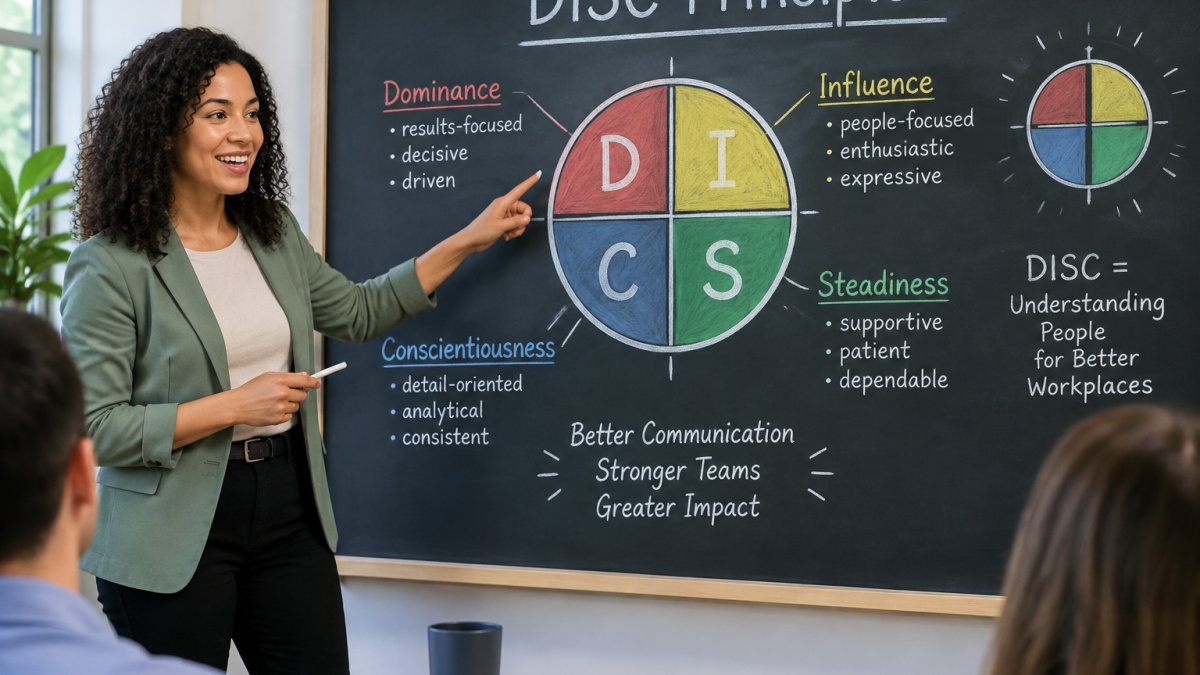
Facilitator sketching DISC training quadrants on a whiteboard for a team in a conference room
Match activities to the room:
- High-D group: Debate-style case studies, timed challenges, direct feedback rounds.
- High-i group: Group storytelling, role-play with movement, share-out circles.
- High-S group: Pair interviews, quiet reflection prompts, small-group discussion.
- High-C group: Data-driven case analysis, written exercises, structured checklists.
A mixed group needs a sequence. Start with a pair activity to lower the temperature, then move to a full-group exercise. That rhythm works for almost any blend.
If you want ready-made exercise ideas, our article on DiSC assessments for team building exercises has concrete options you can adapt.
What Belongs in a DISC Assessment Facilitator Guide
A DISC assessment facilitator guide should contain five parts: session objectives, the group report summary, activity instructions, discussion prompts, and a debrief script. Each part serves a different moment in the workshop.
The guide is your safety net. When a discussion stalls or a participant pushes back, you flip to the right page and keep moving.
Build these five sections:
- Objectives page: One page, two or three goals, visible to you only.
- Group summary: The style distribution and what it means for pacing.
- Activity instructions: Step-by-step, with timing for each block.
- Discussion prompts: Three to five questions per activity, written in plain language.
- Debrief script: A short closing that ties behavior back to the workplace.
For a full walkthrough of building and running a facilitator guide, our DISC facilitation guide for managers covers the practical details.
Building a DISC Training Workbook People Actually Use
A DISC training workbook works when it is short, specific, and tied to the participant’s own results. Most workbooks fail because they are 40 pages of theory with two pages of personal application.
Flip that ratio. Make the workbook mostly about the person holding it.
Include these pages:
- My style snapshot: A one-page summary of their own results.
- Style comparison: How their style reads to each of the other three.
- Scenario prompts: Three workplace situations with space to write a response.
- Commitment page: One behavior they will try in the next two weeks.
The commitment page matters most. It turns a workshop into a plan.
Keep the workbook under 15 pages. People fill in short workbooks and skim long ones.
Adapting Materials for D, i, S, and C Learners
Adapting materials for each style means changing how content is delivered, not what is delivered. The same learning objective can be taught four different ways.
Here is how we adapt the same “giving feedback” module for each style:
- D learners: Lead with the outcome. “Here is the result you get.” Skip the background.
- i learners: Lead with a story. “Here is what happened when a team tried this.” Keep it social.
- S learners: Lead with reassurance. “This approach protects the relationship.” Go slow.
- C learners: Lead with the evidence. “Here is why this works.” Show the logic.
Same objective, four entry points. A mixed room needs all four built into the session, sequenced so no style feels sidelined.
The mistake we see most often is building one version and calling it universal. It never is.
Customizing Examples for Sales, Leadership, and Nonprofit Teams
Customized examples should come from the team’s own work, and the fastest way to get there is to build a small library of sample materials you can adapt rather than write from scratch. A sales team needs selling scenarios. A leadership group needs people-management scenarios. A nonprofit team needs mission-driven scenarios. Below are three example structures you can adapt, each covering the agenda, the DISC-anchored exercise, and the handout adaptation for that context.
Example 1: A newly formed sales team (mixed D and i heavy).
- Agenda (90 minutes): 10-minute framing on the four styles, 20-minute pair interview using the “How I sell, how I buy” prompt, 25-minute role-play where a high-D rep pitches to a high-S buyer and then swaps, 20-minute share-out on what each style needs from a handoff, 15-minute commitment round.
- Exercise adaptation: Keep the role-play timed and competitive for the D half of the room, and give the i half a storytelling frame (“tell the story of a deal that stalled and why”). Pair a D with an i so each experiences the other’s pace.
- Handout adaptation: Replace the generic “communication tips” page with a one-page buyer-style grid: what a high-D buyer wants in the first 30 seconds, what a high-i buyer wants, and so on. Add a blank column for the rep to write their own last three buyer interactions.
Example 2: A leadership group (S and C heavy).
- Agenda (half day): 15-minute framing, 30-minute review of the group report with a focus on the S/C spread, 45-minute delegation case study worked in trios, 30-minute feedback practice using a structured script, 30-minute action planning, 15-minute close.
- Exercise adaptation: Lead with context and evidence before any activity. Give the group a written case with data (a missed deadline, a quality dip) and let them analyze it in silence for five minutes before discussion. That five-minute silent start is the single biggest engagement lever for C-heavy rooms.
- Handout adaptation: Swap the open-ended reflection prompts for a structured worksheet with columns for “situation, style observed, alternative approach, next step.” S and C learners fill structured pages and leave open ones blank.
Example 3: A nonprofit team (values-driven, often i and S heavy).
- Agenda (2 hours): 15-minute framing tied to the mission, 25-minute values-and-style exercise where participants map their style to a team value, 30-minute volunteer-coordination scenario worked in small groups, 25-minute share-out, 25-minute commitment and close.
- Exercise adaptation: Anchor every example in mission language. Instead of “a client escalation,” use “a volunteer who stopped showing up.” The behavioral content is identical; the framing is what makes it land.
- Handout adaptation: Add a page that connects each style to how that person tends to show up for the mission, and a page for how they prefer to receive recognition. Nonprofit teams respond to recognition framing more than performance framing.
Pull real examples from the team before the session. Ask a manager for anonymized situations and rewrite them into the exercise format above, since team-specific scenarios usually land better than generic case studies.
Watch out: it is tempting to reuse one agenda across all three contexts with only the examples swapped. The agenda structure itself has to change, because a 90-minute sales session and a half-day leadership session fail in different ways when the pacing is wrong for the dominant styles.
For the style language behind these adaptations, our DiSC Sales profile and DiSC Work of Leaders profile give you the vocabulary to frame each scenario accurately.
Facilitating the Conversation When Results Are Shared
Facilitation during results-sharing sets the tone for the entire session. The goal is curiosity, not diagnosis. Participants should leave understanding their style, not defending it.
Three rules keep the conversation healthy:
- No style is better. Say this out loud, early, and often.
- Describe behavior, not identity. “I tend to move fast” beats “I am a D.”
- Invite questions. The best debriefs are 60% participant talk.
Watch for two common problems. First, a high-D participant may dominate the share-out. Second, a high-S participant may stay silent. Plan for both by using pair work before group discussion.
For a deeper set of facilitation best practices, see our guide on DISC workplace facilitation best practices.
Measuring Whether the Training Changed Team Behavior
Measuring behavior change starts before the workshop, not after. You need a baseline to compare against, and you need to pick behaviors that are observable by someone other than the participant. Without both, you are guessing.
Step 1: Pick two or three observable behaviors tied to the DISC objectives. Choose behaviors a manager or peer could count or rate without knowing anyone’s style. Good candidates:
- Feedback frequency: How many times per week does each team member give a peer specific feedback? A simple tally in a shared doc works.
- Meeting participation: Who talks, and how evenly? A rough estimate of talk-time share per person, recorded by the facilitator or a rotating note-taker.
- Conflict handling: How quickly do disagreements get resolved? Track the number of days between a raised disagreement and a documented resolution.
- Adaptation moments: How often does someone explicitly adjust their approach for a colleague’s style (“I’ll send you the summary in writing since you prefer that”)? This is the most direct DISC indicator and the one most teams skip.
Step 2: Collect a baseline two weeks before the session. Use two instruments: a short pulse survey (five to seven Likert items, one per behavior) sent to the team, and a manager observation sheet where the manager rates the same behaviors on a simple frequency scale. Keep both under five minutes to complete. Heavy measurement can discourage participation, so keep surveys brief.
Step 3: Collect again four to six weeks after the session. A follow-up window of several weeks helps separate lasting habit change from the short-term enthusiasm that often follows a workshop.
Step 4: Compare and attribute carefully. Put the pre and post numbers side by side and look for movement in the behaviors you targeted. Then ask the honest question: did anything else change in that window (a new project, a reorg, a busy season)? If yes, note it. You are looking for a pattern, not proof. A common pattern is that feedback frequency rises first, meeting participation shifts next, and conflict handling moves last, because it depends on the other two.
Step 5: Feed the results back into the next round of customization. The post-session data is the best input for your next group report read. If adaptation moments stayed flat, that tells you the materials emphasized awareness over practice, and the next round needs more role-play and less discussion.
Watch out: do not measure only the participants’ self-ratings. Self-report is the easiest data to collect and the least useful for behavior change, because people rate themselves against their intentions rather than their actions. Pair every self-rating with a manager or peer observation.
For a deeper method, our article on measuring long-term behavioral change from DiSC workshops walks through the full approach, including how to build the observation sheet.
Handling Assessment Data Responsibly and Accessibly
Responsible assessment use means three things: clear consent, limited access, and accessible materials. All three protect participants and make the training more effective.
Start with consent. Tell participants what the assessment measures, who sees the results, and how long data is stored. Get written agreement before the session.
Limit access. Only the facilitator and the participant should see individual results. Group reports should be anonymized where possible.
Make materials accessible:
- Language: Offer plain-language summaries alongside the full report.
- Format: Provide large-print and screen-reader-friendly versions.
- Cultural fit: Adapt examples to the team’s actual context, not a generic corporate setting.
These steps are not optional. They build the trust that makes DISC training work.
Customizing DISC training materials is a reading exercise first and a design exercise second. Read the group report, set two or three behavior-focused objectives, and match every activity to the styles in the room. That sequence turns a generic workshop into one your team actually uses.
At Your Lifes Path, we support that work with official Everything DiSC® assessments, certified partner support, and the Catalyst platform for flexible facilitation. Our free EPIC sub-account setup makes it easy to administer profiles and pull the group reports your materials depend on.
Take The Official DiSC® Assessment Online Now!
Frequently Asked Questions
How do you customize DISC training for different teams?
Start with the group report rather than a generic deck. Read the team profile to see which styles dominate, then set two or three learning objectives tied to that mix. A team heavy in D and i styles usually wants fast, interactive exercises and short discussions; a team weighted toward S and C styles responds better to longer reflection time and written prompts. From there, swap in examples from your own industry and adjust the pace, group sizes, and discussion prompts so the DISC training lands where the team actually is.
What DISC activities help teams understand D, i, S, and C styles?
Four activities cover the styles well. A style sort asks participants to place behavior cards under the four headings before they see results, which surfaces assumptions. A paired interview has each person describe a recent conflict and a partner guess which style drove the reaction. A timed build task shows how D and i styles push for speed while S and C styles push for accuracy. A working agreements exercise closes the loop by having the group write three communication rules everyone will follow. Keep each activity under 15 minutes so energy stays high.
What should a DISC facilitator guide include?
A strong facilitator guide carries the session plan with timings, the learning objectives, scripted transitions between activities, discussion prompts sorted by style, and notes on what to do when a conversation gets stuck. Add a short section on reading the group report, a list of materials and handouts, and a debrief outline for the final 20 minutes. Build in a page of backup activities in case a segment runs short. The guide should let a certified facilitator run the workshop without improvising.
How long should a DISC team workshop be?
A half day, roughly three to four hours, fits most teams. That gives enough time to share results, run two or three activities, and write working agreements without draining the group. Virtual sessions work better split into two 90-minute blocks on separate days, because screen fatigue cuts engagement fast. If you only have 90 minutes, focus on results sharing and one activity, then send the workbook home for follow-up. Pair the workshop with a 30-day check-in so the DISC training carries into daily work.
