
Last Updated: October 27, 2026
Quick Summary
Build a DISC onboarding workshop by setting two or three observable goals, having every new hire complete the DISC Workplace Profile, and following a two-hour agenda that teaches the four styles, applies them to the team, and ends with commitments. Pair new hires of different styles for communication practice, then extend the results with Catalyst after the session.
- A two-hour agenda is the standard format, with activities and a Guide to Me draft.
- Keep each DISC team-building activity under twenty minutes, including the debrief.
- A one-hour version covers the model and profile reading only for large groups.
- New hires draft a Guide to Me using four prompts on how they work best.
- Measure new-hire confidence, manager ratings, ninety-day retention, and Guide to Me use.
Table of Contents
- Why a DISC Onboarding Workshop Accelerates New-Hire Success
- Step 1: Set Clear Workshop Goals and Audience Fit
- Step 2: Choose the DISC Workplace Profile for Every Employee
- Step 3: Build Your DISC Onboarding Workshop Agenda
- Step 4: Plan DISC Team-Building Activities for New Employees
- Step 5: Decide Your DISC Onboarding Workshop Duration
- Step 6: Help New Hires Create Their Guide to Me Profile
- Step 7: Coach Managers to Adapt Communication by DISC Style
- Step 8: Use Catalyst for Ongoing DISC Learning After Onboarding
- Step 9: Measure Outcomes and Keep the Workshop Growing
- Frequently Asked Questions
Why a DISC Onboarding Workshop Accelerates New-Hire Success
A DISC onboarding workshop is a structured session that uses the DISC model to help new hires understand their own behavioral style and how it shapes the way they communicate, decide, and collaborate. Readers who want the big-picture case for adding DISC to onboarding can go deeper into how DISC training fits into employee onboarding.
A certified DISC instructor can facilitate a DISC workshop.
Below is a step-by-step guide to building a DISC onboarding workshop.
Step 1: Set Clear Workshop Goals and Audience Fit
Start by writing down what the workshop should achieve. Pick two or three outcomes you can observe.
Strong goals for a new-hire session include:
- Each participant can name their DISC style and describe it in plain words
- New hires can spot a teammate’s communication preference and adapt to it
- Managers leave with a plan for how to support each person’s working style
Then check audience fit. A group of five new sales reps needs a different session than forty new hires across departments.
Match the content to who is in the room.
Step 2: Choose the DISC Workplace Profile for Every Employee
Every new hire can complete a DISC assessment before the workshop.
We recommend the DISC Workplace Profile for employees.
A reader deciding which profile to use for new hires can find deeper guidance in choosing the right DiSC assessment for business success.
Step 3: Build Your DISC Onboarding Workshop Agenda
A DISC onboarding workshop agenda can balance teaching, activity, and reflection.
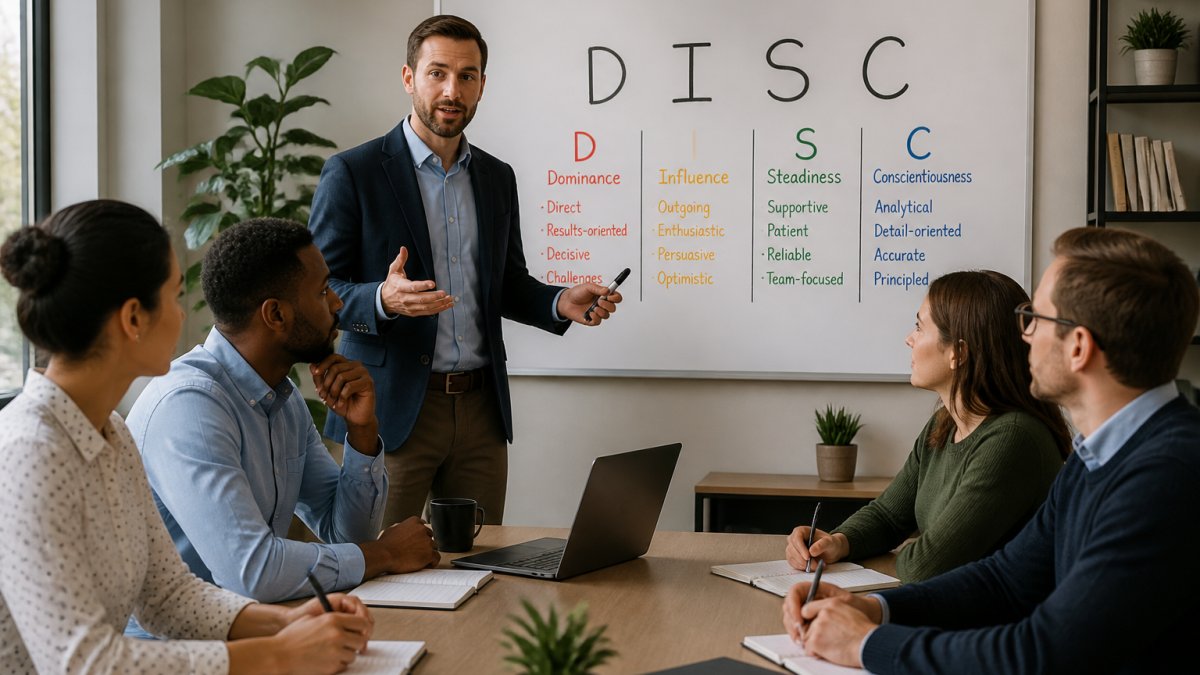
Build the agenda around three phases: learn the model, apply it to the team, and commit to next steps. Keep the DISC model visible throughout. The four styles are D (Dominance), I (Influence), S (Steadiness), and C (Conscientiousness), and every activity should tie back to them.
Sample Two-Hour Agenda With Timings and Facilitator Instructions
|
Time |
Segment |
Facilitator Instructions |
Materials |
|---|---|---|---|
|
0:00-0:10 |
Welcome and goals |
Open with a warm welcome. State the three outcomes: name your style, spot a teammate’s preference, commit to one habit. Ask each person to share one word for how they like to start a new job. |
Name tents, printed agenda, flip chart |
|
0:10-0:30 |
The four DISC styles |
Teach D, I, S, and C with everyday examples. Use a story about a project kickoff and show how each style might respond. Ask the group to guess which style they lean toward before revealing profiles. |
Slide deck or flip chart with the four styles |
|
0:30-0:50 |
Read your profile |
Hand out DISC Workplace Profile results. Give five minutes of quiet reading, then pair shares: “What surprised you? What felt accurate?” Circulate and answer questions. |
Printed DISC Workplace Profile reports |
|
0:50-1:10 |
Communication exercise |
Pair new hires with a different style. Give each pair a short workplace scenario (a deadline change, a feedback conversation). Ask them to practice a style-based message, then debrief as a group. |
Scenario cards, timer |
|
1:10-1:30 |
Team culture discussion |
Connect styles to working norms. Ask: “What does our team do well for each style? What could we adjust?” Capture ideas on a flip chart and keep them for the team charter. |
Flip chart, markers |
|
1:30-1:50 |
Guide to Me draft |
Each person writes their working-style profile using four prompts (see Step 6). Provide a one-page template. Invite volunteers to share one line. |
Guide to Me template, pens |
|
1:50-2:00 |
Commitments and close |
Each person names one habit to try in their first thirty days. Close with a round of appreciation: each person thanks a teammate for one insight. |
Commitment cards |
Facilitator Script Prompts
Use these short prompts to keep the session moving and to model the language of DISC:
- Opening: “Today is about giving you a shared language for how you work best, so you can start strong and help your team understand you.”
- During profile reading: “Your profile describes preferences, not limits. It is a starting point for conversation, not a box.”
- During the communication exercise: “Try the other person’s approach on purpose. Notice what feels natural and what feels like a stretch.”
- At close: “Pick one habit you can try this week. Small experiments build confidence.”
Materials Checklist
- Printed DISC Workplace Profile reports for each participant
- Name tents and markers
- Flip chart or whiteboard with the four DISC styles posted
- Scenario cards for the communication exercise
- Guide to Me templates
- Commitment cards
- Timer
Adapting the Agenda to Your Group
For a group of five to ten new hires, allow more discussion time and extend the communication exercise to twenty-five minutes. For larger groups of twenty or more, keep activities in pairs and use a co-facilitator to manage time. If your onboarding schedule only allows one hour, combine the welcome and model teaching into fifteen minutes, shorten the profile reading to ten minutes, and replace the Guide to Me draft with a five-minute commitment round.
Facilitators who want a fuller playbook can use a DISC facilitation guide for managers to run the session with confidence.
Step 4: Plan DISC Team-Building Activities for New Employees
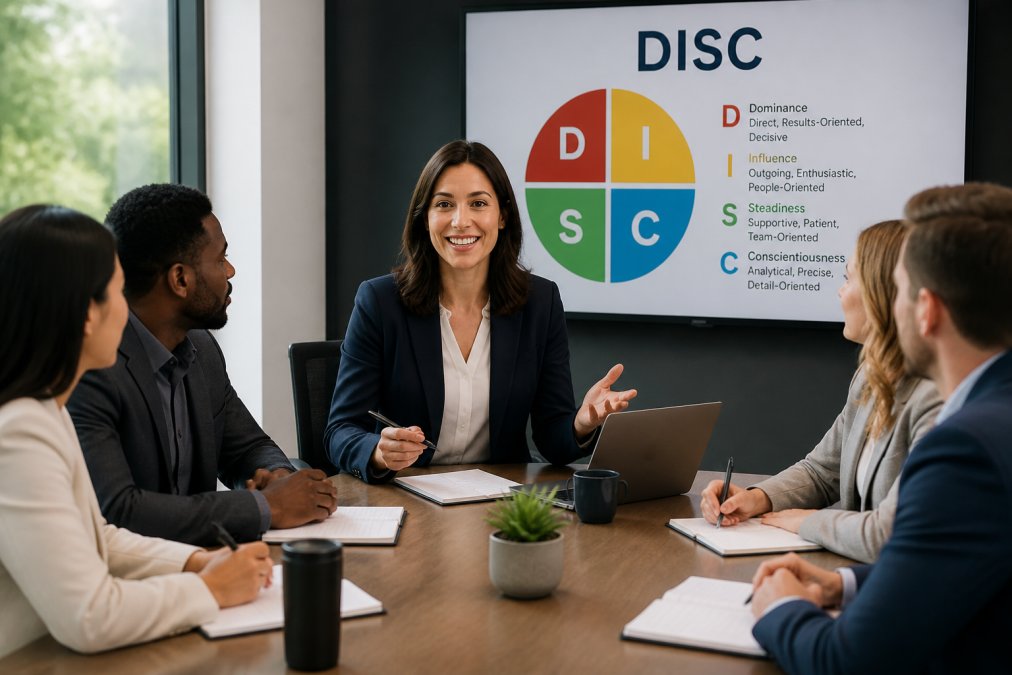
New employees collaborating during a DISC onboarding workshop in a bright, modern conference room.
DISC team-building activities for new employees can focus on communication and practicing adaptation to different styles.
Three DISC activity examples with scripts and debrief questions:
Activity 1: Style Pairs Role-Play (15 minutes)
Setup: Pair each new hire with someone of a different style. Give each pair a short workplace scenario card, such as “A project deadline moved up by a week” or “A teammate’s draft needs significant revision.”
Instructions: Ask each person to play themselves first, then swap and try the other person’s approach. Give five minutes per round.
Take The Official DiSC® Assessment Online Now! →
Debrief questions:
- What felt natural in your own style?
- What felt like a stretch when you tried your partner’s approach?
- What did you learn about how the other style prefers to receive information?
Activity 2: Preference Sort (15 minutes)
Setup: Write ten common workplace tasks on cards, such as “Lead a brainstorming session,” “Review a contract for errors,” “Onboard a new teammate,” and “Present results to leadership.”
Instructions: In small groups, sort the tasks by which DISC style tends to enjoy them most. There are no perfect answers; the goal is discussion.
Debrief questions:
- Which tasks did your group disagree on, and why?
- How could you use this sort to divide work on your team?
- Which tasks would stretch you, and how could a teammate support you?
Activity 3: Communication Swap (15 minutes)
Setup: Give each person a blunt one-line message, such as “This report is late. Fix it.”
Instructions: Ask each person to rewrite the message in a style different from their own, then share with a partner. For example, a D-style rewrite might be direct and solution-focused, while an S-style rewrite might acknowledge the person and offer support.
Debrief questions:
- How did the message change when you shifted style?
- Which version would you prefer to receive, and why?
- What is one situation this week where you could try a style shift?
Facilitation Tips
- Keep each activity under twenty minutes, including the debrief.
- Protect the debrief time. The learning lives in the discussion, not the exercise itself.
- Use a timer and give a two-minute warning before each debrief.
- For remote or hybrid groups, run the activities in breakout rooms and use a shared document for the preference sort.
- For multilingual groups, provide scenario cards in plain language and allow extra processing time.
A certified DISC instructor can model the debrief questions and help facilitators practice the activities before the session. That rehearsal is often the difference between a smooth workshop and a rushed one.
Step 5: Decide Your DISC Onboarding Workshop Duration
Adjust based on your situation:
- One hour: Covers the model and profile reading only. Good for large groups with limited time
- Two hours: The standard format, with activities and a Guide to Me draft
- Half day: Adds deeper team exercises and manager coaching, best for small cohorts
Step 6: Help New Hires Create Their Guide to Me Profile
Ask each new hire to fill in four prompts:
- Here is how I like to receive information
- Here is how I handle stress and deadlines
- Here is how to give me feedback
- Here is what helps me do my best work
Step 7: Coach Managers to Adapt Communication by DISC Style
A quick reference for managers:
- D style: Be direct, get to the point, offer clear choices
- i style: Bring energy, invite discussion, recognize effort publicly
- S style: Allow processing time, explain the why, keep changes gradual
- C style: Provide detail, back claims with data, allow careful review
Step 8: Use Catalyst for Ongoing DISC Learning After Onboarding
A workshop can be followed by Catalyst to extend the results for team members beyond the onboarding workshop.
We recommend Catalyst for extending results beyond the onboarding workshop.
Readers ready to extend DISC learning past the workshop can explore using Catalyst for DISC workplace facilitation.
Step 9: Measure Outcomes and Keep the Workshop Growing
Useful measures include:
- New-hire confidence in understanding their own style, from a short survey
- Manager ratings of how quickly new hires adapt to team communication
- Retention through the first ninety days
- Team feedback on whether the Guide to Me is being used
For a deeper look at proving the workshop’s value, see measuring the ROI of DiSC training programs.
Your Lifes Path provides official Everything DiSC® assessments, certified partner support, free EPIC Sub-Account setup, and Catalyst for extending results beyond the onboarding workshop. Take The Official DiSC® Assessment Online Now!
Frequently Asked Questions
How long should a DISC onboarding workshop be?
Pair the workshop with the DISC Workplace Profile for employees.
What activities can you include in a DISC onboarding workshop?
Start with a style-spotting exercise where pairs guess each other’s DISC style from a short scenario. Follow with a communication preferences round, where each person shares how they like feedback and meetings to run. Add a build-a-guide-to-me activity so new hires leave with a one-page summary for their manager. Close with a team norm-setting discussion. A certified DISC instructor can facilitate a DISC workshop.
How can DISC help new employees communicate with their teams?
DISC gives new hires a shared language for behavior. The DISC Workplace Profile is available for employees. Catalyst can extend results beyond the onboarding workshop.
How can managers reinforce DISC insights after onboarding?
Managers can use DISC in everyday moments. Catalyst can extend results beyond the onboarding workshop. A certified DISC instructor can facilitate a DISC workshop.
