
Table of Contents
- How DISC Behavioral Models Build Emotional Intelligence
- What the DISC Model Measures
- What Emotional Intelligence Actually Is
- Where DISC and Emotional Intelligence Meet
- Step 1: Start With a DiSC Assessment for Individuals
- Step 2: Recognize Emotional Cues in Each Behavioral Style
- Step 3: Practice Adapting Your Communication
- Improving Workplace Communication With DiSC
- Agile EQ for Teams: Building Emotional Agility Together
- Using DISC Responsibly: Limits and Best Practices
- How to Measure Progress and Keep Growth Going
- Conclusion: Your Next Step Toward Emotional Intelligence
- Frequently Asked Questions
Last Updated: October 9, 2026
How DISC Behavioral Models Build Emotional Intelligence
Emotional intelligence DISC work starts with a simple idea: you cannot manage an emotion you have never noticed. At Your Lifes Path, we see this play out in workshops every week. People discover their behavioral style, and suddenly the moments that used to trip them up make sense.
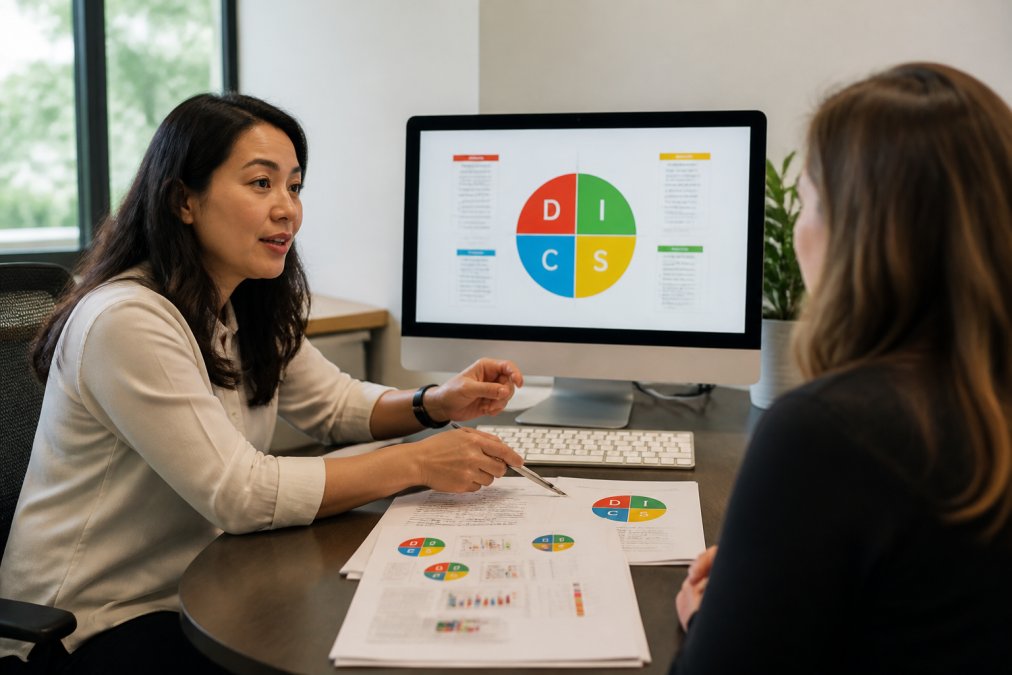
The DISC model is a framework that describes four behavioral styles: Dominance, Influence, Steadiness, and Conscientiousness. It shows how you prefer to move, decide, and talk with others.
Emotional intelligence is the ability to notice emotions in yourself and others, then respond well. The two fit together neatly. DISC gives you the map. Emotional intelligence gives you the steering.
Below, we break down a step-by-step plan for enhancing emotional intelligence with DISC behavioral models. You will get style-specific cues, a practice routine, and honest limits to watch for.
What the DISC Model Measures
The DISC model measures behavioral preferences, not personality, IQ, or emotional health. It shows how you tend to act at work when you are being yourself.
Each style has its own pace and priorities:
- Dominance: moves fast, wants results, hates wasted time
- Influence: talks it out, builds energy, seeks connection
- Steadiness: stays calm, supports the team, avoids sudden change
- Conscientiousness: checks details, values accuracy, plans ahead
Most people show a blend. One or two styles usually lead.
A DISC assessment for individuals takes about 15 to 20 minutes and produces a profile you can actually use. That profile is a starting point, not a verdict. It describes habits, and habits can grow.
What Emotional Intelligence Actually Is
Emotional intelligence is the ability to recognize, understand, and manage emotions in yourself and in others. It is often called EQ, short for emotional quotient.
EQ has four common parts:
- Self-awareness: noticing what you feel and why
- Self-management: choosing your response instead of reacting
- Social awareness: reading the room and picking up emotional cues
- Relationship management: handling conflict, feedback, and trust well
Here is a point worth noting. DISC can help you build emotional intelligence, but it does not measure it. That distinction keeps expectations honest. DiSC supports EQ growth without being an EQ test itself. Agile EQ can also be used in team emotional intelligence workshops with a certified DiSC instructor from Your Life’s Path. DiSC and EQ combined make an excellent starting point for individual and team development.
Where DISC and Emotional Intelligence Meet
DISC and emotional intelligence meet at self-awareness. That is the hinge.
Your behavioral tendencies shape how you show emotion at work. A fast-moving D may sound sharp when stressed. An S may go quiet. A C may get distant and analytical. None of that is a flaw. It is a pattern.
Once you can name the pattern, you can interrupt it. That is where emotional intelligence DISC training earns its keep.
Step 1: Start With a DiSC Assessment for Individuals
Begin with a DiSC assessment for individuals, because guesses about your own style are often wrong. We see this constantly: people assume they are one style and the profile shows another.
The process is simple:
- Take the assessment and read your full profile
- Highlight the three habits that felt most familiar
- Ask two coworkers which habits they see in you
- Write down one moment this week where your style showed up under pressure
That last step matters most. A profile you read once fades. A profile you connect to a real moment sticks.
Your Lifes Path offers official Everything DiSC® assessments with certified partner support, so you get a valid profile and a person to help you read it. For individuals building self-understanding and awareness at work, that support is the difference between a report and a habit. The DiSC Workplace Profile is a great place to start, giving you a clear picture of your style and practical strategies for improving communication and interactions with the people around you.
Step 2: Recognize Emotional Cues in Each Behavioral Style
Recognizing emotional cues means learning what stress looks like in each style, and then knowing what to say next. The signals differ, and misreading them causes most workplace friction.
Here is what to watch for:
- D under pressure: shorter sentences, faster speech, impatience with detail, interrupting to push the decision forward
- I under pressure: overpromising, scattered focus, talking over others, enthusiasm that outruns the plan
- S under pressure: silence, withdrawal, quiet agreement that is not real, sudden over-accommodation
- C under pressure: cold tone, nitpicking, retreating into analysis, asking for more data as a way to slow things down
None of these are personal attacks. They are stress responses, and each one tells you what that person needs from you in the next thirty seconds.
What Each Style Needs When Emotions Run High
Match your response to the style in front of you:
|
Style |
Stress Signal |
What Helps |
A Phrase That Lands |
|---|---|---|---|
|
D |
Impatience, blunt tone |
Get to the point, offer options |
“Here are two paths, which do you want?” |
|
I |
Scattered, overpromising |
Slow down, confirm details |
“I love the energy, let’s lock the first step.” |
|
S |
Silence, withdrawal |
Ask gently, allow time |
“No rush. What’s your honest read?” |
|
C |
Cold, critical tone |
Give facts, remove pressure |
“Here’s the data. What’s missing for you?” |
Use this table in the moment, not after.
Four Scenarios You Will Recognize
The D who cuts you off in a status meeting. You are three slides into context and the D says, “Just tell me the ask.” That is not rudeness, it is a D telling you the pace is wrong. Emotional intelligence here means skipping to the bottom line, then offering a choice. “We can ship Friday with the current scope, or Monday with the extra testing. Which do you prefer?” You have respected their need for speed and given them control.
The I who promises the room a miracle. Mid-meeting, the I commits the team to a deadline nobody has scoped. The instinct is to correct them publicly. The better move is to protect the relationship and the plan at once: “I’m excited about that too, can we grab ten minutes after to map the steps?” You keep the I’s energy intact and pull the details back to earth in private.
The S who agrees but does not mean it. You ask if the new process works, and the S says, “Sure, whatever’s easiest.” Their tone is flat and their eye contact dropped. That is an S protecting harmony, not endorsing the plan. Slow down and ask an open question: “If something about this felt off, what would it be?” Then wait. S styles often need a few seconds of silence before the real answer arrives.
Take The Official DiSC® Assessment Online Now! →
The C who asks for one more round of data. You need a decision today; the C wants another analysis. The C is not stalling, they are managing risk the only way that feels safe. Give them the facts, name the trade-off, and take the pressure off the person: “The data we have supports option A. Waiting two days costs us the launch window. What would make you comfortable deciding today?”
Why This Works
Each response does the same thing: it reads the emotional signal, names what the style needs, and adapts your delivery without abandoning your message. That is emotional intelligence in action, and DISC is what tells you which lever to pull. Practicing one scenario per week builds the pattern faster than memorizing all four at once. Deepening your understanding of these behavioral nuances often requires the perspective found in books for emotional growth, which provide the necessary context to refine your interpersonal mastery.
Step 3: Practice Adapting Your Communication
Adapting your communication means adjusting pace, tone, and detail to fit the other person’s style. It is a skill, and like any skill it improves with reps.
Pick one relationship this week and try one adjustment:
- With a D, lead with the bottom line
- With an I, add warmth and a little energy
- With an S, slow down and reassure
- With a C, bring data and clear steps

Flowchart showing steps to practice emotional intelligence DISC by adapting communication in one-on-one meetings.
Improving Workplace Communication With DiSC
Improving workplace communication with DiSC starts with one shift: assume difference, not defiance. Most conflict comes from mismatched styles, not bad intent.
Try these habits:
- Ask “how do you prefer updates?” in your next one-on-one
- Repeat back what you heard before you respond
- Name the style you are talking to before you speak
- Pause before reacting when a message lands wrong
Active listening does more for team dynamics than any script. When people feel heard, trust builds, and trust is what makes feedback land.
Agile EQ for Teams: Building Emotional Agility Together
Agile EQ for teams turns individual insight into a shared language. Instead of one person reading a profile alone, the whole group learns to read each other.
Our Agile EQ for teams program helps teams build emotional agility together. Members learn to recognize their own reactions and adjust to the moment. The result is a team that handles pressure without falling apart.
Here is what changes when a team works on EQ together:
- Conflict gets named early, before it grows
- Feedback sounds like help, not attack
- Remote and cross-cultural calls get clearer
- High-stress weeks feel manageable
Agility is the goal. Not perfection. Teams that practice together recover faster.
Using DISC Responsibly: Limits and Best Practices
DISC is a tool, not a label. Used well, it opens conversation. Used poorly, it boxes people in.
Keep these limits in mind:
- DISC describes behavior, not worth or potential
- It is not a clinical or diagnostic tool
- Styles shift with context, role, and stress
- Never use style as an excuse (“that’s just how I am”)
Responsible use means treating the profile as a mirror, not a cage.
How to Measure Progress and Keep Growth Going
Most articles stop at “be more self-aware.” That is not measurable. Emotional intelligence grows when you can point to specific behaviors that changed, and DISC gives you a clean way to track them, because each style has predictable habits you can watch shift over time.
Measure progress by behavior, not by feeling. Feelings fade; habits show up in the calendar.
Observable Indicators by Style
Pick the two or three that match your profile and track them for 90 days:
- If you lead with D: Are you pausing before you respond when a message lands wrong? Are colleagues bringing you problems earlier instead of after they have grown? A D who is growing gets fewer surprises, not more.
- If you lead with I: Are you confirming details before you commit the team? Are your follow-through notes showing up without a reminder? An I who is growing has fewer dropped threads.
- If you lead with S: Are you voicing disagreement in the meeting instead of after it? Are you saying no without over-apologizing? An S who is growing shows up in the decision, not just the support role.
- If you lead with C: Are you sharing a draft before it is perfect? Are you naming the emotional stakes in a conversation, not just the data? A C who is growing moves decisions forward instead of reopening them.
Three Measures That Cut Across Every Style
- Conflict recovery time. How long does it take for a tense exchange to return to normal? If it used to take a day and now takes an hour, that is measurable EQ growth.
- Listening behavior. Count how often you repeat back what you heard before responding. This is the single most reliable indicator of social awareness, and it is easy to track in a notebook or a running note.
- Colleague feedback. Ask one trusted coworker every 30 days: “What is one thing I do that makes conversations with me easier, and one thing that makes them harder?” Write down the answer. Patterns emerge by month three.
A 90-Day Practice Rhythm
- Days 1-30: Revisit your DISC profile weekly. Note one interaction that went well and why, tie it to a style.
- Days 31-60: Add one deliberate adaptation per week. Choose a person whose style differs from yours and adjust your pace, tone, or detail to match.
- Days 61-90: Ask for honest input from two coworkers and compare it to your own notes. Where they align, you have real change. Where they diverge, you have your next focus.
Why This Beats a One-Time Workshop
A single training day creates a spike in awareness that fades within weeks. Small, steady reps tied to your DISC profile compound instead. The goal is not to become a different style, it is to widen your range so you can meet people where they are, even under pressure.
Growth is not a finish line. It is a practice, and DISC gives you a way to see it happening.
Conclusion: Your Next Step Toward Emotional Intelligence
The hardest part of emotional intelligence is not learning the concepts. It is applying them when a meeting gets tense and your old habits take over. That gap is exactly where DISC helps most.
Your Lifes Path gives you official Everything DiSC® assessments, certified partner support, and the Catalyst platform for flexible facilitation. You get profiles for management, sales, and leadership that turn insight into daily practice.
Take the official DiSC® assessment online now and start building emotional intelligence that lasts.
Frequently Asked Questions
How does DiSC relate to emotional intelligence?
DISC maps your behavioral preferences, while emotional intelligence covers how well you recognize and manage emotions in yourself and others. DISC gives you a shared language for those preferences, so you can notice when a teammate’s Dominance, Influence, Steadiness, or Conscientiousness style is shaping a reaction. Used together, enhancing emotional intelligence with DISC behavioral models turns abstract self-awareness into specific, observable habits you can practice at work.
How can individuals use DiSC to improve workplace communication?
Start with a DiSC assessment for individuals to see your own style clearly. Then practice small adjustments: give a D-style colleague the bottom line first, offer an I-style teammate room to talk ideas through, give an S-style coworker time to process before asking for a decision, and share details and context with a C-style colleague. These adjustments build communication flexibility, which is one of the most practical outcomes of improving workplace communication with DiSC.
What is the difference between DiSC and Agile EQ?
DiSC describes your behavioral preferences: how you tend to act, decide, and interact. Agile EQ goes a step further by focusing on emotional agility, the ability to read a situation and choose the most effective response rather than defaulting to habit. Agile EQ for teams builds on the DISC foundation, helping groups stretch beyond their comfort zones when a situation calls for a different emotional response.
How do teams benefit from Everything DiSC Agile EQ assessments?
Teams gain a shared vocabulary for both behavior and emotion. When everyone knows their DISC style and their emotional comfort zones, conversations about conflict, feedback, and trust get more direct and less personal. Leaders can spot where a team defaults under pressure and coach specific responses instead. The result is stronger relationship management and a workplace culture where people adapt to each other rather than expecting everyone to communicate the same way.