
Table of Contents
- How Personality Differences Create Workplace Conflict
- Examples of Personality Clashes at Work
- Understanding DISC Personality Assessment for Teams
- How to Adapt Communication Styles at Work
- Best Practices for Managing Diverse Behavioral Styles
- Building a Conflict-Resilient Team Culture
- Conclusion
Last Updated: August 5, 2026
How Personality Differences Create Workplace Conflict
Personality differences cause workplace conflict more often than most teams realize. When colleagues operate from fundamentally different behavioral styles, misunderstandings accumulate quickly. A direct communicator perceives a thoughtful colleague as slow. A detail-oriented team member sees a big-picture thinker as careless. Neither is wrong, they simply process information and interact through different lenses.
Understanding why personality differences workplace conflict emerges is the first step toward preventing it. The DISC model provides a practical framework for recognizing these differences before they escalate into tension. By learning how the four behavioral styles, Dominance, Influence, Steadiness, and Conscientiousness, interact, teams can transform potential friction into collaboration.
At Your Lifes Path, we’ve observed that teams equipped with DISC awareness handle conflict more effectively. They recognize that style differences are natural, not personal attacks. This shift in perspective changes everything about how teams communicate and resolve disagreements.
The most productive teams aren’t those without personality differences, they’re the ones that understand and respect them. DISC assessments give teams a shared language for these differences, turning potential conflict into competitive advantage.
Examples of Personality Clashes at Work
Real workplace conflict rarely announces itself as a personality clash. Instead, it emerges through repeated friction that feels personal even when it’s purely stylistic. Recognizing these patterns helps teams address the root cause rather than treating symptoms.
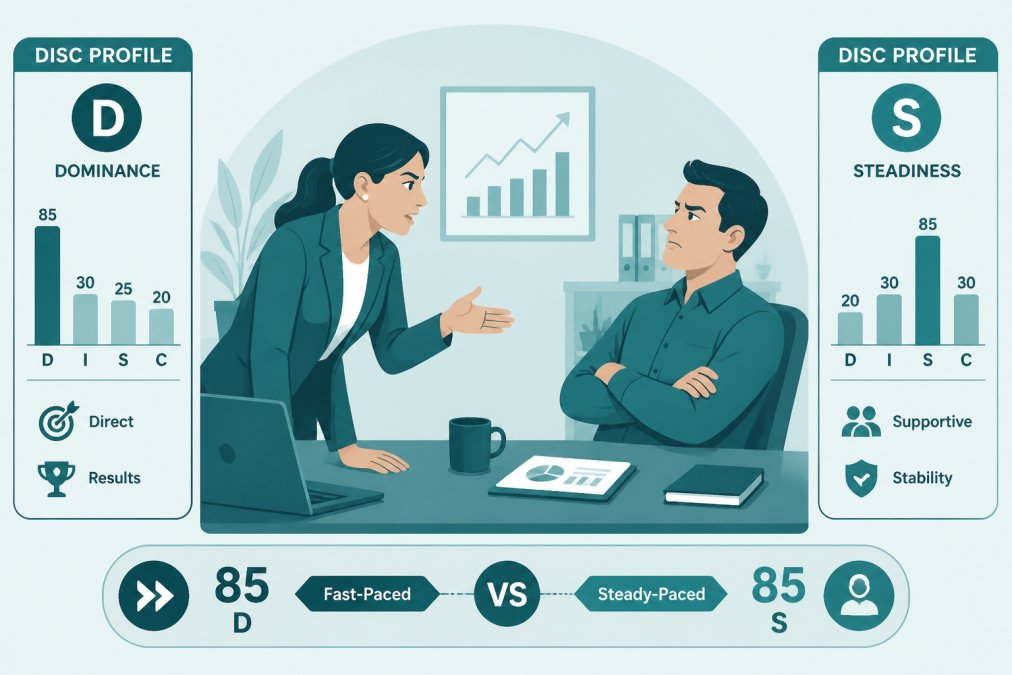
The Direct D-Style vs. Steady S-Style Clash
Dominance-style professionals move fast and cut through complexity. They want results, direct feedback, and minimal process. Steadiness-style colleagues prefer stability, relationship-building, and gradual change. When a D-style manager implements a new system without consulting the S-style team member who maintains it, conflict erupts, not because either person is wrong, but because their operating speeds are completely misaligned.
The D-style perceives the S-style resistance as obstruction. The S-style experiences the D-style approach as dismissive of their expertise and relationships. Both are operating from their strengths. The D-style’s decisiveness is valuable; the S-style’s thoughtfulness about impact is equally valuable. Without DISC awareness, these two styles often end up at odds instead of complementing each other.
This clash typically surfaces in implementation timelines, change management, and decision-making speed. A D-style leader wants to move forward; an S-style team member wants to ensure the transition won’t disrupt existing relationships or workflows. The solution isn’t to change either style, it’s to acknowledge both perspectives and build a process that honors both speed and stability.
The Influential I-Style vs. Conscientious C-Style Tension
Influence-style professionals thrive on enthusiasm, collaboration, and big-picture vision. They energize rooms and inspire action. Conscientious-style colleagues focus on accuracy, process, and data. They want to understand the details before committing to anything.
When an I-style salesperson pitches an exciting new approach without documentation, the C-style analyst sees recklessness. When a C-style manager insists on three rounds of testing before launching, the I-style colleague experiences unnecessary delay. The I-style feels constrained by process; the C-style feels pressured to move forward without sufficient information.
This tension appears in project planning, quality assurance, and strategic decisions. The I-style’s optimism and relationship focus drive business growth. The C-style’s rigor and attention to detail prevent costly mistakes. Teams need both. Without recognizing this as a style difference, the two groups often become adversarial, with I-styles dismissing C-styles as pessimistic and C-styles viewing I-styles as reckless.
Personality clashes at work aren’t character flaws. They’re the result of different behavioral styles operating without mutual understanding. DISC awareness transforms “that person is difficult” into “that person has a different style that I can learn to work with.”
Understanding DISC Personality Assessment for Teams
The DISC model categorizes behavior into four primary styles based on how people approach tasks and relationships. Understanding this framework helps teams recognize why personality differences workplace conflict happens and how to prevent it.
Dominance (D): Results-focused, direct, competitive, decisive. D-styles want control over outcomes and move quickly toward goals. They value efficiency and straight talk.
Influence (I): People-focused, enthusiastic, expressive, optimistic. I-styles energize others, build relationships, and inspire action. They value recognition and collaborative energy.
Steadiness (S): Relationship-focused, patient, supportive, consistent. S-styles create stability, listen deeply, and maintain loyalty. They value harmony and gradual progress.
Conscientiousness (C): Task-focused, analytical, precise, cautious. C-styles ensure quality, follow process, and verify accuracy. They value correctness and thorough planning.
Most people aren’t purely one style, they have a primary style and secondary tendencies. But everyone has a natural preference, and that preference shapes how they approach conflict, communication, and decision-making.
When a team lacks DISC literacy, members interpret style differences as personal preferences or character issues. A D-style’s directness feels rude to an S-style. An I-style’s enthusiasm feels scattered to a C-style. A C-style’s caution feels obstructive to a D-style. None of these perceptions are accurate, they’re style mismatches interpreted as personality flaws.
Your Lifes Path offers official Everything DiSC® assessments that help teams move beyond these misinterpretations. When people understand their own style and recognize others’ styles, they can adapt their approach instead of taking differences personally. This single shift reduces conflict significantly.
How to Adapt Communication Styles at Work
Adapting your communication style doesn’t mean changing who you are. It means adjusting how you express your natural style to be more effective with people who operate differently. This flexibility is called "flex capacity," and it’s one of the most valuable skills for managing personality differences workplace conflict.

(/blog/why-team-members-different-communication-styles-disc/) at Work]
Recognizing Your Own Style and Flex Capacity
Before you can adapt to others, you need clarity on your own style. Most people have a fairly accurate sense of their primary style once they understand the model. You probably recognize yourself in one of the four descriptions above.
Flex capacity is your ability to adjust your natural style when the situation demands it. A D-style can slow down and listen more deeply when working with an S-style. An I-style can focus on details when collaborating with a C-style. An S-style can move faster when urgency is genuine. A C-style can embrace creative exploration when innovation is the goal.
Everyone has flex capacity, but it requires conscious effort. You’re working against your natural preference, so it feels less comfortable. The key is recognizing when flex is necessary and doing it intentionally rather than resenting the other person’s style.
Taking a formal DISC assessment provides objective insight into your style and your flex patterns. You learn not just what your style is, but how others perceive you and where you naturally flex or resist. This self-awareness is the foundation for adapting to others.
Adjusting Your Approach for Different DISC Styles
Once you understand the four styles, you can adjust your communication for each one.
Take The Official DiSC® Assessment Online Now! →
When working with D-styles: Be direct and results-focused. Skip the relationship-building small talk and get to the point. Give them autonomy and clear metrics for success. Avoid lengthy explanations, they want the bottom line. Show respect for their time and decisiveness.
When working with I-styles: Be enthusiastic and collaborative. Include them in discussions and value their ideas. Recognize their contributions publicly. Build in time for relationship-building and group interaction. Focus on the exciting possibilities, not just the tasks.
When working with S-styles: Be patient and supportive. Explain how changes will affect existing relationships and workflows. Give them time to adjust to new approaches. Show genuine appreciation for their loyalty and consistency. Avoid sudden shifts or pressure.
When working with C-styles: Be accurate and thorough. Provide data and documentation. Explain the reasoning behind decisions. Allow time for analysis and verification. Respect their need for quality and correctness, don’t rush them.
These aren’t manipulative tactics. They’re respectful adjustments that honor how different people process information and make decisions. When you communicate in someone else’s style, they feel heard and understood. When you ignore their style, they feel dismissed.
The most common mistake is assuming that if someone doesn’t respond to your natural style, they’re being difficult. In reality, they simply process information differently. Adapting your approach isn’t about changing yourself, it’s about being effective with diverse team members.
Best Practices for Managing Diverse Behavioral Styles
Teams with multiple DISC styles have more creative potential and better problem-solving ability than homogeneous teams. But they also need intentional practices to prevent personality differences workplace conflict from derailing progress.
Create a shared language: When everyone on a team understands DISC, you can reference styles without judgment. Instead of "you’re being too aggressive," a D-style colleague might say, "I’m pushing hard on this because results matter to me." Instead of "you’re overthinking this," a C-style might explain, "I need more data before I’m confident." The language shifts from criticism to clarity.
Assign roles that match styles: D-styles excel at driving toward outcomes and making tough calls. I-styles energize teams and build external relationships. S-styles maintain team cohesion and support struggling members. C-styles ensure quality and catch errors. Rather than forcing everyone into the same role, use natural strengths.
Build diverse decision-making teams: When D-styles, I-styles, S-styles, and C-styles all have input on major decisions, the outcome is typically stronger. The D-style pushes for action, the I-style brings stakeholder perspective, the S-style considers team impact, and the C-style ensures accuracy. These different viewpoints create more strong decisions than any single style could produce alone.
Establish clear communication norms: Some teams default to D-style directness; others to S-style consensus. Effective teams establish norms that work for everyone. Maybe meetings have a brief relationship moment for I-styles and S-styles, then move to focused discussion for D-styles, with documented decisions for C-styles.
Address conflict quickly and style-aware: When personality differences workplace conflict emerges, address it immediately but with style awareness. Don’t expect a C-style to be comfortable with a spontaneous discussion, give them time to prepare. Don’t expect an S-style to jump into confrontation, build in relationship repair. Don’t expect a D-style to want extensive dialogue, get to resolution. Don’t expect an I-style to want a private conversation, they may prefer group processing.
Building a Conflict-Resilient Team Culture
Teams that understand DISC aren’t conflict-free. They’re conflict-resilient. They experience disagreements but resolve them more quickly because they don’t interpret style differences as personal attacks.
Building this culture starts with leadership modeling. When a manager demonstrates flex capacity, adjusting their communication based on team members’ styles, it gives permission for others to do the same. When a leader acknowledges their own style limitations and asks for feedback, it normalizes the idea that every style has strengths and growth areas.
Formal DISC training, particularly through Your Lifes Path’s offerings like the DiSC Workplace Profile or specialized management profiles, accelerates this cultural shift. When teams go through assessment and training together, they develop shared understanding that would take months to build informally. They learn not just the model but how to apply it to their specific team dynamics.
Ongoing reinforcement matters. Teams that take an assessment and never revisit it see the benefits fade. Teams that reference DISC regularly, in hiring, onboarding, project planning, and conflict resolution, maintain the cultural shift. The language stays active, and new members quickly learn that style diversity is valued.
Your Lifes Path’s Catalyst platform supports this ongoing reinforcement by making it easy for teams to return to their assessments, share insights, and apply DISC principles to real work situations. It transforms a one-time training event into a sustained cultural practice.
Personality differences cause workplace conflict when teams lack a framework for understanding how different people think and work. That framework exists in DISC. By helping your team understand the four behavioral styles, you transform potential friction into collaboration. Your team members stop taking differences personally and start using them strategically.
The shift from "that person is difficult" to "that person has a different style" changes everything about team dynamics. It’s not about changing who people are, it’s about helping them understand each other and adapt their communication intentionally. Teams that master this become more resilient, more creative, and more effective at managing the personality differences workplace conflict that emerges naturally in any diverse group.
Take The Official DiSC® Assessment Online Now! with Your Lifes Path and equip your team with the self-awareness and mutual understanding that transforms personality differences from a source of conflict into a competitive advantage.
Frequently Asked Questions
How can personality differences cause conflicts in the workplace?
Personality differences create conflict when team members have opposing communication preferences, work speeds, and decision-making approaches. For example, a Direct D-style person who values quick decisions may clash with a Conscientious C-style colleague who needs time to analyze details. Without understanding these differences through a DISC personality assessment, misunderstandings escalate into frustration and reduced collaboration.
What are the benefits of understanding behavioral styles in a team?
Understanding DISC behavioral styles helps teams recognize that different isn't wrong, it's different. When team members know their own style and others' styles, they can adjust their communication, reduce misinterpretations, and leverage complementary strengths. Teams using DISC insights report improved trust, faster problem-solving, and stronger working relationships across departments.
How can managers use personality insights to improve team communication?
Managers can use DISC profiles to tailor how they communicate with each team member. A Steady S-style employee needs reassurance and relationship-building; an Influential I-style prefers enthusiasm and big-picture thinking; a Conscientious C-style values accuracy and data. By flexing your communication style to match their preference, you strengthen engagement and reduce unnecessary conflict before it starts.
What is the role of self-awareness in reducing workplace conflict?
Self-awareness through DISC assessment helps you recognize your natural style, your triggers, and how others perceive you. When you understand your own strengths and blind spots, you can take responsibility for adapting your behavior in tense situations rather than blaming others. This accountability foundation allows teams to move from conflict toward collaboration faster.
This article was written using GrandRanker