

Table of Contents
- Why Leadership Skills Matter for New Managers
- 1. Master Assertive Communication Across DISC Styles
- 2. Build Delegation Skills That Empower Your Team
- 3. Develop Emotional Intelligence to Lead with Empathy
- Using DISC Assessment for Managers to Understand Your Team
- 4. Strengthen Decision-Making and Critical Thinking
- 5. Master Time Management and Prioritization
- 6. Build Conflict Resolution Skills for Team Leads
Last Updated: August 14, 2026
Why Leadership Skills Matter for New Managers
The transition from individual contributor to manager requires a fundamentally different skill set. Your success now depends on what your team achieves, not just your personal accomplishments. Most organizations promote based on technical performance, not managerial readiness, leaving new managers unprepared for coaching, delegation, and difficult conversations.
Understanding your team’s behavioral styles through DISC assessment bridges this gap. DISC categorizes people into four primary styles: Dominance (D), Influence (I), Steadiness (S), and Conscientiousness (C). A direct communication style that motivates a D-style employee might alienate an S-style team member who values harmony. Your Lifes Path provides official Everything DiSC® assessments specifically designed for managers, giving you the behavioral insights you need to lead more effectively.
Below are seven essential leadership skills new managers must master, with practical strategies for developing each one and applying DISC insights to amplify your impact.
1. Master Assertive Communication Across DISC Styles
Assertive communication means expressing your thoughts, expectations, and feedback clearly while respecting others’ perspectives. The challenge is adapting your message to different behavioral styles. A D-style employee appreciates directness and wants the bottom line first. An I-style team member responds better to enthusiasm and relationship-building. An S-style person needs reassurance and time to process changes. A C-style employee wants data and logical reasoning.

How to develop assertive communication:
- State your message clearly. Avoid vague language. Instead of "I think maybe we should try this approach," say "I want us to implement this approach because it aligns with our Q3 goals."
- Adjust for DISC styles. With D-style employees, be direct and results-focused. With I-style people, build rapport first. With S-style team members, explain how changes affect them personally. With C-style employees, provide data and logical justification.
- Listen actively. Ask questions, pause for responses, and genuinely consider what your team members say before responding.
- Provide specific feedback. Vague praise or criticism doesn’t help anyone grow. Be specific about what was done well or what needs to change.
True assertive communication respects the other person while honoring your own needs and responsibilities as a leader.
2. Build Delegation Skills That Help Your Team
Delegation isn’t about dumping work on others. It’s about strategically assigning tasks to develop your team while freeing yourself to focus on higher-level responsibilities. Many new managers either micromanage or avoid delegating altogether, both of which damage team development.
The DISC framework helps here. D-style employees want autonomy and clear ownership. I-style team members want recognition and collaborative energy. S-style people need detailed instructions and reassurance. C-style employees want to understand the "why" and have clear standards.
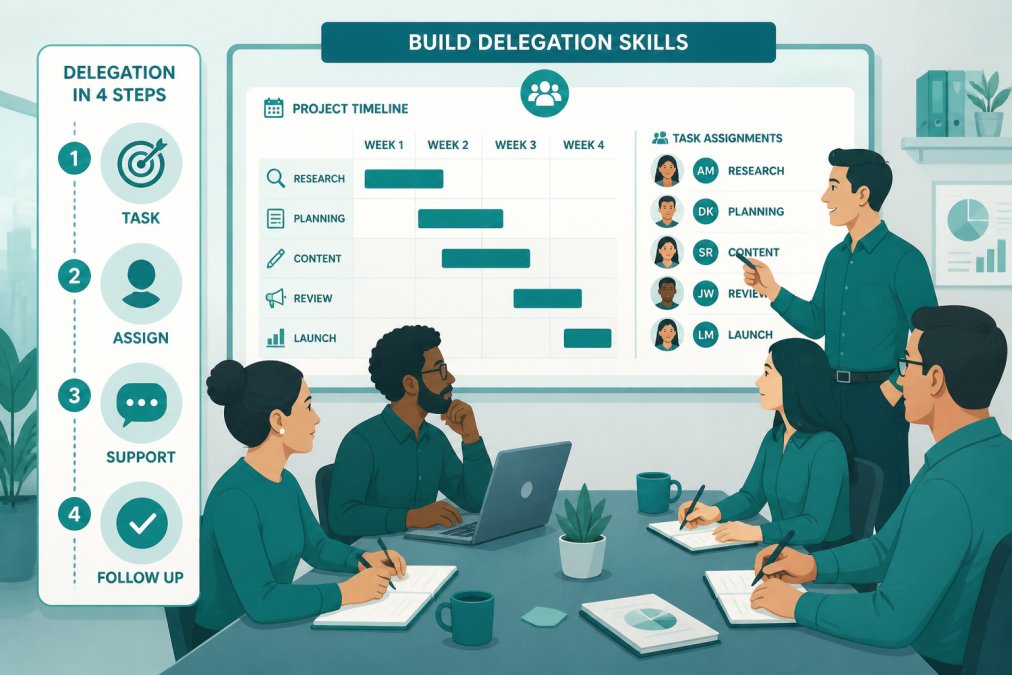
Steps to delegate effectively:
- Assess skill and motivation. Match the task to the right person based on capability and development needs.
- Explain the task and the "why." Help your team member understand how it connects to larger goals.
- Be clear about expectations. Define what success looks like, deadlines, and available resources.
- Provide support without hovering. Check in at logical milestones, but trust your team to do the work.
- Give feedback on the result. Discuss what went well and what could improve.
Delegate a mix of challenging projects that stretch your team and routine work that keeps operations running. This builds skills and maintains engagement.
3. Develop Emotional Intelligence to Lead with Empathy
Emotional intelligence is your ability to recognize emotions in yourself and others and use that awareness to manage your behavior and relationships. For managers, EQ is arguably more important than IQ. Your emotional state directly affects your team, when you’re stressed, they pick up on it immediately.
Understanding your own DISC style helps you recognize your natural strengths and blind spots. A D-style manager might be decisive but struggle to show appreciation. An I-style manager might excel at relationships but avoid difficult conversations. An S-style manager might support individuals but hesitate to make tough calls. A C-style manager might focus so much on accuracy that they paralyze the team.
How to build emotional intelligence:
- Know yourself first. Take a DISC assessment designed for managers. Understand your default style, what triggers stress, and how you show up under pressure.
- Practice self-regulation. When you feel frustrated, pause before responding. This gap between stimulus and response is where your power lies.
- Develop empathy. Regularly ask: What might this person be feeling? What matters to them? How does this decision affect them?
- Seek feedback. Ask your team, peers, and manager how you come across. Are you approachable? Do people feel heard?
- Manage your stress. Sleep, exercise, and time to decompress aren’t luxuries, they’re prerequisites for good leadership.
Emotional intelligence is the glue that holds a team together and allows you to have difficult conversations without damaging relationships.
Using DISC Assessment for Managers to Understand Your Team
A DISC assessment for managers goes deeper than a standard personality test. It shows you not just your natural style, but also how you adapt under pressure, how you make decisions, and what management situations bring out your best and worst.
When your entire team takes a DISC assessment, you get a complete picture of your team dynamics. You can see where you have natural alignment and where you might have friction. You can anticipate how different team members will respond to change, conflict, or ambiguity.
Your Lifes Path offers the DiSC Management Profile, specifically built for leaders. It helps you understand your management style, your strengths as a leader, and how to adapt your approach to different team members. With certified partner support, you can facilitate team assessments and create action plans that stick.
The real power comes when you use these insights intentionally. Instead of assuming everyone thinks and works the way you do, you recognize that your D-style employee needs decisiveness, your I-style person needs enthusiasm and recognition, your S-style team member needs stability and support, and your C-style employee needs quality and accuracy.
4. Strengthen Decision-Making and Critical Thinking
New managers often make decisions too quickly or too slowly. Quick decisions without sufficient analysis lead to mistakes. Slow decisions create frustration and missed opportunities. The skill is knowing when you have enough information to decide.
Take The Official DiSC® Assessment Online Now! →
Your DISC style influences how you naturally approach decisions. D-style managers tend to decide fast and move forward. I-style managers often seek input and build consensus. S-style managers want to make sure everyone is comfortable. C-style managers want perfect information.
How to improve decision-making:
- Define the decision clearly. What exactly are you deciding? What’s the deadline? Who needs to be involved?
- Gather relevant information. Don’t gather everything possible. Gather what’s relevant to this specific decision.
- Consider multiple perspectives. Get input from people with different DISC styles. They’ll spot risks and opportunities you might miss.
- Decide and commit. Once you’ve gathered sufficient information, make a decision and commit to it.
- Review the outcome. After the decision plays out, reflect on whether it was the right call and what you’d do differently next time.
The best managers make good decisions in reasonable timeframes and learn from the outcomes.
5. Master Time Management and Prioritization
New managers often feel overwhelmed. You still have your own work, plus team meetings, one-on-ones, emails, and unexpected issues. Without strong time management, you’ll work longer hours and accomplish less.
Your highest-value activities as a manager are usually developing your people, removing obstacles, and making strategic decisions. These get squeezed out by urgent-but-not-important interruptions.
Different DISC styles approach time management differently. D-style managers want to maximize productivity. I-style managers get pulled into conversations. S-style managers struggle to say no. C-style managers get lost in details.
How to master time management:
- Identify your highest-value activities. Protect time for one-on-ones, strategic planning, and developing people.
- Use time blocking. Block out specific times for specific types of work. Protect your calendar like you would a client meeting.
- Batch similar tasks. Handle email during designated times. Schedule one-on-ones in clusters rather than scattered throughout the week.
- Learn to say no. Not every meeting, project, or request deserves your time. Saying no to good opportunities creates space for great ones.
- Delegate ruthlessly. If someone else can do it 80% as well as you, let them do it.
Taking control of your time is one of the most powerful ways to increase your impact.
6. Build Conflict Resolution Skills for Team Leads
Conflict is inevitable when you manage people. New managers often avoid conflict, hoping it will resolve itself. It rarely does. Conflict resolution isn’t about making everyone happy, it’s about addressing the issue directly and finding a path forward.
DISC styles approach conflict differently. D-style people tend to be direct and want to win. I-style people often avoid conflict to preserve relationships. S-style people feel uncomfortable with tension. C-style people focus on being right.
How to resolve conflict effectively:
- Address it early. When you notice tension, bring it up in a neutral, private setting.
- Listen to understand, not to win. Ask each person to explain their perspective without interruption.
- Identify the real issue. Surface disagreements are often symptoms of deeper issues.
- Focus on interests, not positions. Understand why people want what they want, not just what they say they want.
- Make a clear decision. After understanding all perspectives, decide how you want to move forward.
- Follow up. Check in a week later to make sure the resolution is holding.
Managers who handle conflict well build trust with their teams. People know that if there’s a problem, their manager will address it fairly and directly.
Summary: Your Leadership Skills Checklist for New Managers
| Leadership Skill | Key Focus | DISC Adaptation | Impact |
|---|---|---|---|
| Assertive Communication | Clarity + respect across conversations | Adjust delivery to each style | Team understands expectations |
| Delegation | Strategic task assignment with support | Match tasks to strengths and styles | Team grows; you focus on leadership |
| Emotional Intelligence | Self-awareness + empathy | Understand your triggers and blind spots | Trust and psychological safety |
| Decision-Making | Gather info + consider perspectives | Balance speed with thoroughness | Team confidence in direction |
| Time Management | Protect high-value activities | Focus on leadership, not just execution | Higher impact with fewer hours |
| Conflict Resolution | Address issues early and fairly | Understand different conflict styles | Team cohesion and respect |
Stepping into a management role is one of the most rewarding and challenging transitions in your career. The leadership skills that matter most are the ones you develop intentionally. Understanding your team’s behavioral styles through DISC assessment transforms how you communicate, delegate, and lead. Take the Official DiSC® Assessment Online Now through Your Lifes Path and get the behavioral insights you need to become the manager your team deserves.
Frequently Asked Questions
What are the 7 essential leadership skills for new managers?
The seven core skills are assertive communication, delegation, emotional intelligence, decision-making, time management, conflict resolution, and talent development. Each skill builds on understanding your team's DISC behavioral styles. When you recognize whether your team members are D (direct), I (influential), S (steady), or C (conscientious), you can adapt your approach and strengthen your effectiveness as a leader.
How can a DISC assessment for managers help me lead better?
A DISC assessment reveals your natural behavioral style and helps you understand how your team members prefer to work. For example, D-style team members value efficiency and results, while S-style employees prioritize stability and relationships. By understanding these differences, you can tailor your communication, delegation approach, and conflict resolution style to each person, building stronger accountability and engagement across your team.
What should be included in a new manager leadership development plan?
Your plan should address all seven leadership skills with specific, measurable goals for each. Include time for coaching and mentorship, regular feedback loops with your team, and monthly check-ins on your progress. Use tools like Your Lifes Path's DiSC Management Profile to baseline your current strengths, then set quarterly milestones for skill improvement. Track your growth through performance reviews and team engagement metrics.
How do I handle conflict resolution when my team has different DISC styles?
Conflict resolution for team leads requires adapting to each person's style. D-style employees respond to direct, solution-focused conversations; I-style team members need enthusiasm and collaborative problem-solving; S-style employees value patience and reassurance; C-style members want data and logical reasoning. Start by understanding the root cause, acknowledge each person's perspective, and propose solutions that respect their behavioral preferences. This approach builds psychological safety and trust.
How long does it take to develop strong leadership skills as a new manager?
Most new managers see meaningful improvement in their core skills within 3-6 months of focused practice. However, leadership development is ongoing. The first 90 days are critical for establishing communication patterns and building team relationships. After six months, you'll likely feel confident in delegation and basic decision-making. Advanced skills like strategic alignment and change management typically develop over 12-18 months of consistent application and feedback.
This article was written using GrandRanker