

Table of Contents
- Why Leadership Training Programs Matter for Manager Development
- Understanding DISC Leadership Training and Behavioral Styles
- Designing Your Leadership Training Duration and Structure
- Coaching Managers Using DISC Assessments
- How to Improve Management Communication Skills Across DISC Styles
- Measuring Success and Long-Term Behavioral Change
- Building a Sustainable Leadership Development Culture
- Conclusion
Last Updated: August 8, 2026
Why Leadership Training Programs Matter for Manager Development
Managers shape organizational culture through their decisions, communication, and emotional intelligence. Yet many organizations invest heavily in individual contributor training while leaving managers to develop leadership on their own. A leadership training program built on behavioral science transforms how teams communicate and perform.
The challenge is that managers don’t all lead the same way. Some are driven by results and speed. Others prioritize relationships and team harmony. Still others focus on accuracy and process. These behavioral patterns determine how effectively a manager motivates, delegates, and handles conflict. A one-size-fits-all approach misses this reality entirely.
This is where behavioral assessments enter the picture. Tools like the Everything DiSC® framework help managers understand their own behavioral style while building empathy for how others think and work. At Your Lifes Path, we’ve seen organizations use DISC-based leadership training to dramatically improve team dynamics, reduce turnover, and accelerate decision-making.
Effective leadership training recognizes that different behavioral styles require different development approaches. A manager with a D (Dominance) style needs different coaching than one with an S (Steadiness) style.
Understanding DISC Leadership Training and Behavioral Styles
A leadership training program built on DISC starts with a simple premise: understand your behavioral style, then learn how to adapt it to your environment and the people around you.
DISC divides human behavior into four primary styles. The D style (Dominance) is results-focused, direct, and comfortable with risk. These managers move fast, make quick decisions, and challenge the status quo. Without self-awareness, they can come across as blunt or impatient.
The I style (Influence) is people-focused, energetic, and collaborative. These managers build relationships and inspire enthusiasm. Without awareness, they can prioritize popularity over accountability or get distracted by too many initiatives.
The S style (Steadiness) values stability, loyalty, and team harmony. These managers are patient listeners who create psychologically safe environments. They may struggle with rapid change or avoid necessary difficult conversations.
The C style (Conscientiousness) prioritizes accuracy, process, and quality. These managers think systematically and anticipate problems. They can get bogged down in details or appear overly critical without balance.
Most managers blend styles, but everyone has a primary style that emerges under pressure. Training that teaches these distinctions helps participants recognize their default patterns and intentionally choose different approaches when situations demand it.
A D-style manager learns that directness can shut down creative input from S and I-style team members. An S-style manager recognizes that conflict avoidance sometimes delays necessary changes. A C-style manager sees how perfectionism can paralyze a team that needs to move faster. An I-style manager understands that enthusiasm sometimes masks unclear expectations.
Research on behavioral assessment effectiveness in [leadership development(/blog/leadership-development-program-tools-disc-guide/) | ccl.org] shows that leaders who understand their behavioral patterns and actively adapt them see measurable improvements in team engagement and retention.
When introducing DISC concepts in leadership training, start with managers’ own profiles before asking them to assess their teams. Self-awareness is the foundation for everything else.
Designing Your Leadership Training Duration and Structure
How long should a leadership training program run? Research suggests that behavior change requires more than a one-day workshop.
A foundational program typically spans 8-12 weeks, giving managers time to take their DISC assessment, understand their profile deeply, practice new communication patterns, receive feedback, and integrate learning into daily work. Shorter programs create awareness but rarely drive lasting behavior change. Longer programs work best when paired with ongoing coaching and peer accountability.
Effective programs typically include:
Phase 1: Foundation (Weeks 1-2)
Managers complete their DISC assessment and receive a personalized profile report. They learn the four styles and identify their own behavioral tendencies under different conditions.
Phase 2: Application (Weeks 3-6)
Training shifts to practical scenarios. Managers practice adapting their communication style to different team members. A D-style manager learns to explain the "why" behind decisions. An S-style manager practices delivering feedback more directly. A C-style manager experiments with setting boundaries around perfectionism. An I-style manager works on follow-through and accountability.
Phase 3: Integration (Weeks 7-12)
Managers apply learning to real team situations. They receive coaching on specific challenges: managing conflict between team members with opposing styles, delegating to people who work differently, or building psychological safety across a diverse team.
Your Lifes Path offers the Everything DiSC® Management Profile, specifically designed for managers and leaders. It includes detailed guidance on adapting your style, managing across differences, and coaching others based on their behavioral preferences. Paired with facilitation through the Catalyst platform, organizations can deliver training flexibly through in-person workshops, virtual sessions, or blended formats.
Harvard Business Review research on leadership development ROI indicates that programs combining self-assessment with peer feedback and coaching show 60% higher retention of learning compared to traditional classroom training alone.
Organizations with 40-500 managers who want to improve communication and team dynamics. The structured approach works well for mid-sized companies scaling their leadership bench.
Coaching Managers Using DISC Assessments
One-on-one coaching amplifies the impact of leadership training. After a manager completes their DISC assessment, coaching sessions help them translate insights into behavior change.
Effective coaching conversations follow a pattern. First, the coach helps the manager understand their profile deeply, not just "I’m a D style" but "I’m a D style who makes decisions quickly without checking for input, which alienates my I and S team members." This specificity identifies the actual gap between current behavior and desired outcomes.

Second, coaching addresses specific challenges. A manager struggling with delegation might learn that their high C style drives them to maintain tight control. Rather than "delegate more," coaching helps them channel conscientiousness toward enabling others through clear process documentation and quality checkpoints.
Third, coaching creates accountability through feedback loops. A manager commits to a specific behavioral change, perhaps "I will ask for input before deciding on team projects." In follow-up sessions, the coach asks what happened and how they’ll adjust. This cycle of commitment, practice, and reflection drives real change.
The best coaching integrates 360-degree feedback with DISC insights. When a manager’s team feedback aligns with DISC self-awareness, it becomes powerful. A D-style manager sees that their team finds them commanding but not collaborative. An S-style manager learns that people appreciate their steadiness but wish they’d take more decisive action. This combination creates urgency for change.
Coaching sessions typically run monthly during the first 6 months, then quarterly as behavior stabilizes. Organizations use certified DISC facilitators as coaches or train internal HR and L&D leaders to facilitate these conversations. Our DiSC Certification program equips internal facilitators with the expertise to deliver coaching and training at scale.
How to Improve Management Communication Skills Across DISC Styles
Communication is where behavioral differences create the most friction. A D-style manager’s directness feels harsh to an S-style employee. An I-style manager’s enthusiasm feels scattered to a C-style peer. Leadership training must teach managers to recognize these gaps and bridge them intentionally.
Start by teaching managers to identify their team members’ styles through behavioral observation. Does someone jump into decisions quickly or ask clarifying questions first? Do they prioritize speed or accuracy? Relationships or results? This observation becomes the foundation for adapted communication.
Take The Official DiSC® Assessment Online Now! →
For D-style managers:
Slow down and provide context. With S-style team members, explain how decisions affect team stability. With C-style team members, provide data and acknowledge process needs. With I-style team members, connect decisions to team morale.
For I-style managers:
Create clarity and follow-through. S-style team members need reassurance that changes won’t destabilize their work. C-style team members need detailed expectations and quality standards. D-style team members need bottom-line clarity.
For S-style managers:
Practice directness and decisive action. D-style team members need faster decisions and clear priorities. C-style team members need acknowledgment that process matters but shouldn’t slow necessary progress. I-style team members need enthusiastic buy-in.
For C-style managers:
Balance accuracy with agility. D-style team members need efficiency and autonomy within clear boundaries. I-style team members need flexibility and recognition of effort. S-style team members need reassurance that quality standards protect stability.
When managers communicate in ways that resonate with their team members’ styles, engagement and follow-through improve significantly.
Teach managers: “Your natural style is your default, but your effectiveness depends on your flexibility.” A manager who shifts communication style to match their audience is significantly more influential.
Measuring Success and Long-Term Behavioral Change
A leadership training program only matters if it drives measurable change. Short-term metrics like assessment completion and training attendance matter for logistics but reveal nothing about actual behavior change.
Long-term metrics tracked at 3, 6, and 12 months reveal true impact:
Team engagement and retention. Do teams with trained managers report higher engagement? Are they staying longer? Behavioral change in managers directly affects psychological safety, which drives retention.
Promotion velocity. Are managers who completed training advancing faster into senior roles? DISC-based development accelerates readiness for promotion by building self-awareness and adaptability.
Peer feedback. Conduct 360-degree feedback surveys before and after training. Ask whether the manager has improved in listening, decisiveness, clarity, or conflict resolution.
Decision quality and speed. Track how quickly teams make decisions and whether those decisions stick. Managers who understand behavioral styles make better decisions because they seek diverse input and build buy-in.
Cross-functional collaboration. Do departments work together more smoothly? Managers who understand DISC build better bridges across teams with different priorities.
Behavior change is nonlinear. A manager might show strong improvement, then regress under stress. This is normal. Strong programs include reinforcement mechanisms: monthly peer learning groups, quarterly coaching check-ins, or annual refresher workshops. These touchpoints prevent regression and deepen learning.
Center for Creative Leadership research on leadership development sustainability shows that programs with ongoing reinforcement maintain behavior change at twice the rate of one-time interventions.
Building a Sustainable Leadership Development Culture
The most effective leadership training programs don’t exist in isolation. They’re embedded in a broader culture of development where learning is ongoing, feedback is expected, and behavioral growth is valued.
This starts with leadership commitment. If the CEO and executive team complete DISC assessments and openly discuss their styles and development areas, managers see that this work is serious. If leaders ask for feedback and visibly work on their own growth, development becomes a career expectation.
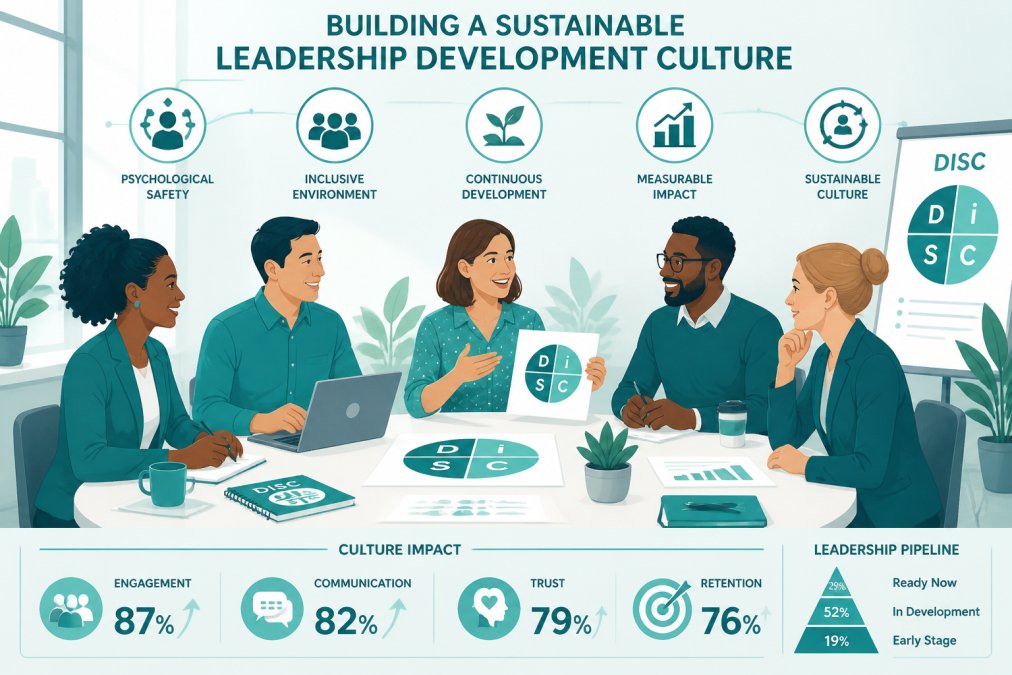
Second, build peer learning into the culture. After managers complete training, create monthly forums where they discuss real challenges through a DISC lens. A manager struggling with conflict brings it to the group. Others offer perspective based on behavioral styles involved. This peer coaching deepens learning and builds community. Organizations can also facilitate Virtual Teambuilding Workshops to strengthen these connections across distributed teams.
Third, integrate DISC language into everyday conversations. When a team makes a decision slowly, someone might say, "I think we need more input from our C-style thinkers before we move forward." When a manager is frustrated with a colleague’s approach, they might recognize, "She’s I-style and wants consensus. I’m D-style and want to decide fast. Let’s find the middle ground."
Fourth, use DISC in team formation and conflict resolution. When assembling a project team, consider the mix of styles. A team of all D-style managers will move fast but might miss details. A team with all C-style managers will be thorough but slow. Diverse teams with awareness of their style mix perform better.
Finally, measure and celebrate progress. Recognize managers who show significant growth in self-awareness and behavioral flexibility. Share stories of teams that improved collaboration after their manager completed training. This reinforces that development is valued.
A sustainable culture of leadership development around DISC doesn’t require expensive external consultants or complex systems. It requires commitment to ongoing learning, psychological safety to be vulnerable about growth areas, and practical tools like the Everything DiSC® Management Profile and Catalyst platform. Your Lifes Path provides the foundational assessments and digital infrastructure; your organization provides the commitment to embed these tools into how you develop leaders.
Leadership training programs are investments in organizational capability. When built on behavioral science and reinforced through coaching, peer learning, and culture change, they transform how teams communicate, decide, and perform. The most successful organizations recognize that their managers are their most important asset and develop them accordingly. Start with clarity on your managers’ behavioral styles, provide them tools to adapt and grow, and create a culture where development is continuous. That’s when training becomes transformation.
Frequently Asked Questions
What makes a leadership training program for managers actually stick with teams?
The most effective programs combine behavioral assessment insights with ongoing coaching and reinforcement. When managers understand their own DISC style and how to adapt to their team members' styles, they make better decisions and communicate more effectively. Programs that include follow-up accountability, peer learning, and integration with daily workflows show the strongest retention of behavioral change. Your Lifes Path's Catalyst platform supports this by making facilitation flexible and keeping insights accessible long after initial training.
How does DISC leadership training help different management styles succeed?
DISC assessments reveal four core behavioral styles: Dominance (D), Influence (I), Steadiness (S), and Conscientiousness (C). Each style brings different strengths to leadership. D-style managers drive results quickly; I-style managers energize teams; S-style managers build loyalty; C-style managers ensure quality. A strong leadership training program teaches managers to recognize their natural style, understand their blind spots, and flex their approach based on team member styles. This self-awareness and adaptability directly improve team performance and psychological safety.
How long does it take to see results from a leadership training program?
Initial behavioral shifts often appear within 2-4 weeks of training, especially in communication and decision-making. Meaningful cultural change typically emerges over 3-6 months as managers consistently apply DISC insights in daily interactions. Long-term leadership effectiveness, including improved retention, engagement, and team productivity, builds over 6-12 months. Programs structured with clear duration and reinforcement phases (assessment, workshop, coaching, review cycles) show stronger sustained results than one-time training events.
Can a small organization benefit from a formal leadership training program?
Absolutely. Organizations of 40 people or fewer often see the fastest return on leadership training because changes in manager behavior ripple immediately through the entire team. Smaller teams benefit from the personalized coaching and direct application of DISC insights. Digital platforms like Your Lifes Path's Catalyst make it cost-effective to deliver training without requiring large-scale logistics. In fact, smaller organizations often report stronger cultural alignment because leadership style shifts are visible and felt across the whole organization quickly.
This article was written using GrandRanker