
Table of Contents
- Why Behavioral Assessment Tools Matter for Small Business Growth
- What Behavioral Assessment Tools Do
- Integrating Behavioral Assessments Into Your Hiring Process
- How to Use DiSC Profiles for Team Building and Development
- DiSC Profile Interpretation for Leaders and Managers
- Key Features That Drive Real Results
- Choosing the Right Assessment Tool for Your Team
- Implementation and ROI for Small Teams
- Building a Stronger Workplace Culture
- Frequently Asked Questions
Last Updated: September 20, 2026
Why Behavioral Assessment Tools Matter for Small Business Growth
Small business leaders face a constant challenge: building high-performing teams with limited resources. The right behavioral assessment tools can transform how you hire, develop, and retain talent. Rather than relying on gut instinct during recruitment, you gain objective data about how candidates and employees actually work, communicate, and handle pressure.
According to TeamTrait and SalesFuel’s 2026 analysis, over 40 distinct behavioral assessment tools now exist specifically designed to help small businesses reduce mis-hires and improve team fit. This proliferation reflects a real shift in how organizations approach talent decisions. When you understand behavioral profiles, the DISC dimensions of Dominance, Influence, Steadiness, and Conscientiousness, you make smarter choices about who joins your team and how to develop them once they’re on board.
Smaller teams benefit even more from behavioral insights because every hire carries higher impact. A single mis-hire in a 15-person company disrupts culture and productivity far more than in a 500-person organization.
What Behavioral Assessment Tools Do
Behavioral assessment tools measure how people naturally work, communicate, and respond to pressure, not IQ or skills. They reveal your preferred communication style, how you handle conflict, what motivates you, and how you approach deadlines.
The DISC model, the foundation of many assessments, breaks down behavior into four primary dimensions. A “D” style person drives results and values speed. An “I” style seeks influence and connection. An “S” style prioritizes stability and team harmony. A “C” style focuses on accuracy and process. Most people blend these styles, but typically one or two dominate.
When you administer a behavioral assessment, candidates answer questions about their preferences and natural reactions. The tool generates a report showing their DISC profile, communication strengths, blind spots, and how they’ll perform in specific roles, actionable intelligence for hiring and development.
Behavioral assessments reveal how people naturally work and communicate, not what skills they have. This distinction matters because you can train skills, but you can’t change someone’s core behavioral style.
Integrating Behavioral Assessments Into Your Hiring Process
Integrate assessments early in recruitment to filter candidates before interviews, reducing wasted effort and improving conversation quality.
Create a behavioral profile for the role. A sales role might require high “I” and “D” energy; customer service needs “S” steadiness and “I” approachability; operations prioritizes “C” conscientiousness. This target profile becomes your benchmark.
Administer assessments to qualified candidates after initial screening but before final interviews. This lets you compare candidates against your role profile and identify who matches behavioral requirements, who might struggle, and who brings unexpected strengths.
Use results to guide interviews. If a candidate’s “D” score is low but the role demands decisiveness, ask how they’ve made tough calls. If their “I” score is high but you need detail-orientation, explore how they manage focus.
Don’t treat assessment results as a pass-fail gate. A candidate who doesn’t perfectly match the target profile might still excel if they have complementary strengths or strong motivation to grow in that area.
How to Use DiSC Profiles for Team Building and Development
Once your team is in place, DISC profiles become tools for stronger collaboration. When team members understand their own style and their colleagues’, communication improves dramatically. A “D” style person learns why their direct approach might feel harsh to an “S” style colleague; an “I” style person recognizes why a “C” style member needs more data before committing.
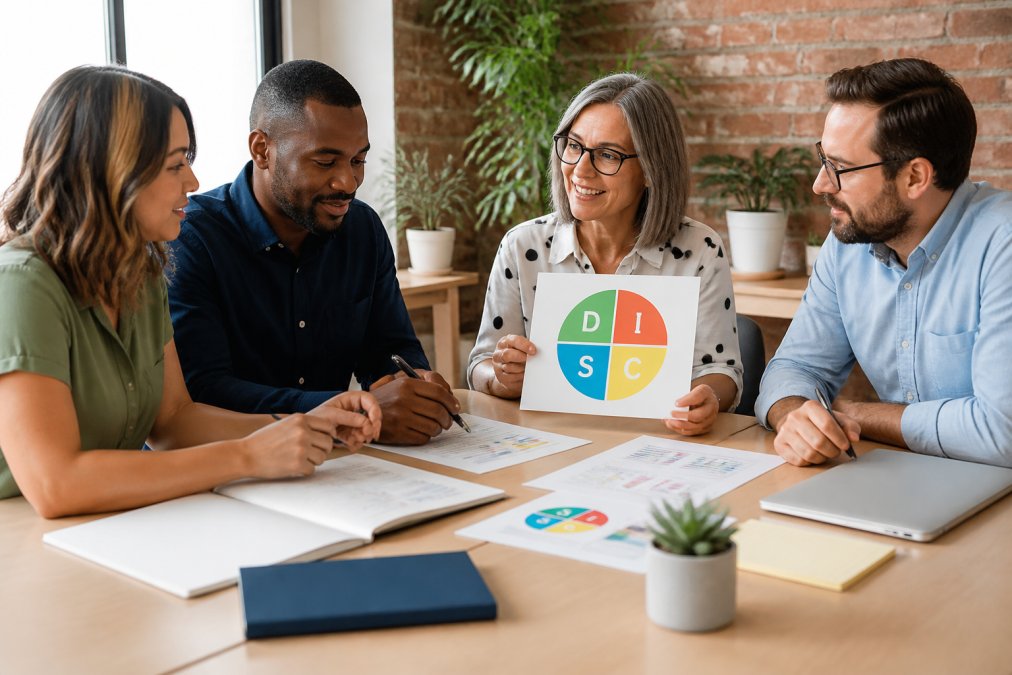
Start with a team session where everyone takes the assessment and shares their profile. This builds psychological safety and visibility. Then use profiles to assign work: pair a “C” style detail-focused person with an “I” style who loves client interaction; let your “D” style person lead strategy while your “S” style person manages implementation rhythm.
For ongoing development, refer back to DISC profiles when conflicts arise or coaching someone. A manager struggling with delegation might have a high “C” style that makes it hard to trust others’ work. Recognizing this pattern opens the door to growth. The DiSC Management Profile is specifically designed to help leaders understand their behavioral style and adapt their approach to their team’s needs.
DiSC Profile Interpretation for Leaders and Managers
Leaders who understand DISC profiles adapt their approach to different team members. A high-“D” direct report needs autonomy and clear goals. A high-“I” person thrives with recognition and social connection. A high-“S” team member values stability and predictable processes. A high-“C” person wants data and time to analyze before decisions.
Misalignment between a leader’s style and a team member’s style causes friction. A “D” style manager might push for speed, frustrating a “C” style employee who needs thoroughness. An “I” style leader might overwhelm an “S” style person with constant change. Recognizing these patterns lets you adjust.
This means flexibility, not abandoning your natural style. A “D” style leader can drive results while giving a “C” style report more time for analysis. An “I” style manager can build culture while respecting an “S” person’s need for predictability.
Avoid stereotyping based on DISC profiles. A person’s style is a preference, not a limitation. Someone with low “D” can still make tough decisions; they might just approach them differently than someone with high “D” energy.
Key Features That Drive Real Results
The best behavioral assessment tools for small businesses share features that address small-organization constraints and risks.
Clear, Role-Specific Reports
You need reports that connect DISC profiles directly to job performance. The best tools provide:
- Role-based interpretation: Reports that explain what a candidate’s DISC profile means for the specific job. A high-Dominance, high-Influence profile might be ideal for sales but problematic for operations. The report should flag this explicitly.
- Behavioral predictions: Insights about how someone with a given DISC profile will handle core role responsibilities, for example, how a high-Conscientiousness candidate approaches deadline pressure or how a high-Steadiness person responds to rapid change.
- Communication strengths and friction points: Guidance on how to communicate with this person effectively and where misunderstandings might occur.
Seamless ATS Integration
The best tools integrate directly with your ATS so assessment results flow automatically into candidate records:
- No duplicate data entry: Candidate information syncs once; hiring managers see DISC profiles alongside resumes and interview notes.
- Automated workflows: Tools can automatically flag candidates who match or don’t match your target profile, surfacing best fits first.
- Audit trails: Assessment results are timestamped and linked to candidate records for documentation.
If your ATS lacks native integration, confirm the tool offers API access or CSV import/export. Without either, the tool creates extra work and won’t be used consistently.
Compliance and Bias Mitigation
The Equal Employment Opportunity Commission (EEOC) permits behavioral assessments in hiring if they’re job-related and don’t have disparate impact on protected classes. The best tools address this directly:
- Validation documentation: Evidence that the tool predicts job performance and doesn’t systematically disadvantage candidates based on protected characteristics.
- Guidance on legal use: Clear instructions on compliant use, using assessment results as one factor among many, not as a pass-fail gate; documenting hiring reasons; ensuring job-relatedness.
- Bias-aware reporting: Tools that flag when a candidate’s profile differs significantly from your team’s current composition, prompting consideration of unconscious similarity bias.
Your Life’s Path’s Everything DiSC® assessments are backed by decades of research and validation studies. Reports include guidance on compliant use, and certified partners help you implement the tool to reduce legal risk.
Development Resources and Coaching Content
The best tools include development resources:
- Coaching frameworks: Strategies for developing people with different DISC profiles, for example, coaching a high-Conscientiousness person who struggles with delegation or a high-Influence person who needs to improve follow-through.
- Communication guides: Resources that help team members understand each other’s styles and communicate more effectively.
- Manager resources: Training materials and templates for one-on-ones, performance conversations, and team meetings.
Accessible Support and Certification
Having access to certified professionals who understand the tool makes the difference between unused tools and culture transformation. Look for:
- Certified partner network: Professionals trained in administering and interpreting the assessment who help with setup, training, and troubleshooting.
- Training resources: Online courses, webinars, or guides that help you and your managers understand DISC profiles and use them effectively.
- Responsive support: Quick answers about interpreting reports or using results in specific situations.
Your Life’s Path provides all these features through official Everything DiSC® assessments. The DiSC Catalyst For Groups platform offers flexible facilitation for group work and team development. Free EPIC Sub-Account setup means you can administer assessments without technical headaches. You get access to certified partners who help you implement the tool strategically.
Take The Official DiSC® Assessment Online Now! →
When evaluating an assessment tool, ask for a sample report and test the ATS integration with your IT team before committing. A 15-minute technical review can save you weeks of frustration after purchase.
Choosing the Right Assessment Tool for Your Team
Selecting an assessment tool depends on your specific needs: hiring, team development, or leadership coaching. Different tools excel in different contexts.
For recruitment and selection, look for tools that measure job-relevant behavioral traits and predict performance in specific roles. These tools help you identify candidates likely to succeed before you hire them. The DiSC PXT Select For Hiring is designed specifically for this purpose, combining behavioral assessment with job-fit analysis.
For team development and communication, choose assessments that reveal how people interact and what they need from colleagues. These tools reduce conflict and improve collaboration. The DiSC Workplace Profile and DiSC For Teams are built for this context.
For leadership development, select tools designed specifically for managers and leaders. They should address delegation, decision-making, and how to adapt your style to different team members. The DiSC Work of Leaders Profile focuses on these core leadership competencies.
Consider these practical factors: How easy is administration? Can you administer online or do you need facilitator training? How quickly do you get results? Can candidates complete the assessment in 15 minutes or does it require an hour? What’s the learning curve for interpreting reports?
Also evaluate support. Do you have access to certified professionals who can help you implement the tool effectively? Small businesses benefit enormously from expert guidance during rollout.
Your Life’s Path stands out because it offers official Everything DiSC® assessments backed by decades of research. The platform is straightforward to administer. Reports are clear and actionable. Most importantly, you get certified partner support to ensure you’re using the tool strategically, not just checking a box.
Implementation and ROI for Small Teams
Implementing a behavioral assessment tool requires planning, but the process is straightforward for small businesses when you follow a structured approach. Start by defining your goal. Are you improving hiring accuracy? Building stronger teams? Developing leaders? Your goal shapes how you roll out the tool and which metrics you’ll track.
Integration with Your Hiring Workflow
For hiring, the key is seamless integration with your Applicant Tracking System (ATS). Most small businesses already use an ATS, whether that’s a free tier of a major platform or a dedicated recruiting tool, and manual data entry between systems creates friction and errors. When selecting an assessment tool, confirm it integrates directly with your ATS via API or native connectors. This means assessment results automatically populate candidate records without extra steps. A candidate completes the behavioral assessment, and their DISC profile appears in your ATS dashboard alongside their resume and interview notes. This integration reduces administrative burden and ensures hiring managers see behavioral data at the moment they’re evaluating candidates.
Once integrated, your workflow becomes: (1) Initial resume screen in your ATS, (2) Qualified candidates receive assessment link via email, (3) Results flow back into candidate records automatically, (4) Hiring team reviews DISC profile alongside other candidate data during interview prep, (5) Compare final candidates’ profiles against your target role profile. This entire cycle takes 3-5 business days and requires minimal manual intervention.
Measuring ROI for Small Teams
ROI for behavioral assessments compounds over time, but you need a baseline to measure against. For a small business (15-50 employees), track these metrics over a 12-month period:
Hiring Accuracy: Document the DISC profile of every new hire and their role’s target profile. After 6 months, measure performance (manager rating, productivity metrics, or project outcomes). Compare performance of hires who matched the target profile versus those who didn’t. Most small businesses find that candidates matching the target profile on Dominance, Influence, Steadiness, and Conscientiousness dimensions often show higher performance ratings and stay in role longer.
Turnover Reduction: Calculate the cost of a single mis-hire in your organization. This includes recruiting costs (job posting, recruiter time, interview hours), onboarding time, training, lost productivity during ramp-up, and replacement recruiting. For a small business, a single mis-hire in a customer-facing or core operational role often incurs significant direct and indirect expenses. If behavioral assessments help you avoid even one mis-hire per year, the tool pays for itself.
Team Productivity and Conflict Reduction: After team members complete assessments and learn each other’s DISC profiles, track changes in collaboration metrics. This is harder to quantify but observable: fewer escalated conflicts, faster decision-making in cross-functional projects, and reduced turnover due to team friction. Managers often report that understanding why a colleague communicates a certain way reduces interpersonal friction.
Leadership Development: If you’re using assessments for manager coaching, track promotion readiness and internal advancement. Leaders who understand their own DISC style and adapt to their team’s styles typically develop high-potential employees faster and retain them longer.
Implementation Timeline
Small businesses often lack dedicated HR staff, so speed matters. A realistic implementation timeline is:
- Days 1-2: Account setup, ATS integration configuration, and user access provisioning. Your Life’s Path’s Free EPIC Sub-Account setup streamlines this, no complex IT requirements.
- Day 3: Train your hiring team and managers on how to interpret DISC reports and use them in hiring and development conversations. This typically requires 1-2 hours of group training plus access to written guides.
- Days 4-7: Pilot the tool with your next 2-3 open positions. Administer assessments to qualified candidates, review results with your hiring team, and use profiles to guide interviews. Document what you learn.
- Week 2 onward: Full rollout. All new candidates receive assessments. Existing team members take assessments for development purposes (optional but recommended).
Full deployment, from decision to active use in hiring and team development, typically takes 2-4 weeks. The investment is modest: a few hours of setup and training, plus the cost of the tool itself. The payoff begins immediately in hiring decisions and compounds as your team learns to work more effectively together.
Justifying the Investment
For a small business, the business case is straightforward: One avoided mis-hire covers the annual cost of the tool. Better team communication and reduced conflict improve retention and productivity. Managers who understand DISC profiles make faster, more confident decisions about hiring, development, and role fit. These gains are especially pronounced in small organizations where each person’s impact is significant and a single bad hire or preventable conflict has outsized consequences.
The ROI of behavioral assessments for small teams isn’t just financial, it’s cultural. Better hiring decisions and stronger team understanding create a workplace where people feel valued for their natural strengths, which drives engagement and retention.
Building a Stronger Workplace Culture
Behavioral assessment tools ultimately serve one purpose: building a culture where people understand each other and work effectively together. When your team knows their own DISC style and their colleagues’ styles, friction decreases. People stop taking things personally. A direct “D” style person isn’t being rude; they’re just wired for speed. An “I” style colleague isn’t being scattered; they’re generating ideas and connection.
This shift in perspective transforms culture. Team members become more patient with differences. Managers become more intentional about how they communicate. Hiring becomes more strategic. Over time, you build an organization where people feel understood and valued for their natural strengths.
The best cultures aren’t built on forcing everyone into the same mold. They’re built on understanding and using diversity. Behavioral assessment tools, grounded in DISC research, give you the framework to do exactly that.
Small business success depends on the people you hire and how well they work together. Behavioral assessment tools give you objective data to make smarter hiring decisions and build stronger teams. Your Life’s Path provides the official Everything DiSC® assessments and certified partner support to make this transformation real. Rather than guessing about cultural fit or leadership potential, you gain clear insights that drive better decisions and stronger results. Take The Official DiSC® Assessment Online Now!
Frequently Asked Questions
What are the main benefits of using behavioral assessment tools for small business hiring?
Behavioral assessment tools reduce hiring bias by providing objective, data-driven insights into candidate fit. They help identify candidates whose behavioral traits align with job requirements and team dynamics, leading to better retention and faster productivity. For small businesses especially, these tools accelerate the recruitment workflow by filtering candidates based on predictive performance indicators rather than subjective impressions alone.
How do DiSC assessments help with team communication and conflict resolution?
DiSC profiles reveal each team member’s natural behavioral style, Dominance, Influence, Steadiness, or Conscientiousness. Understanding these styles helps teams recognize why colleagues communicate differently and respond to pressure in different ways. When managers interpret DiSC results, they can adapt their approach to each style, reduce misunderstandings, and build stronger working relationships. This is especially valuable in small teams where interpersonal dynamics directly impact daily operations.
What should small businesses look for in a behavioral assessment provider?
Look for providers offering validated, scientifically-backed assessments with clear implementation support. Your team needs easy-to-administer digital tools, certified partner guidance for interpreting results, and integration capabilities with your existing systems. Consider whether the provider specializes in your hiring context, sales roles, management development, or general team alignment. Ensure they provide actionable insights and post-assessment support so the assessment actually drives behavior change, not just data collection.
How long does it take to see results from behavioral assessments in a small business?
Initial insights appear immediately after assessment completion, helping hiring teams make faster, better-informed decisions. Team communication improvements typically emerge within 2-4 weeks as people apply their newfound understanding of behavioral styles. Leadership development and culture change take longer, usually 3-6 months, and require consistent reinforcement through workshops, coaching, or facilitated group sessions. Small businesses often see faster adoption than large enterprises because changes can be implemented quickly across the entire team.