
Table of Contents
- Understanding the Four DISC Behavioral Styles
- Reading Your DISC Assessment Graphs and Scores
- DISC Communication Styles in Action
- How to Facilitate a DISC Debrief With Your Team
- DISC Team Workshop Activities That Drive Results
- Applying DISC Insights to Improve Team Dynamics
- Common DISC Personality Patterns and What They Mean
- Moving From Assessment to Action
- Frequently Asked Questions
Last Updated: August 30, 2026
Understanding DISC assessment results transforms how teams communicate, collaborate, and resolve conflict. When you know how to interpret DISC assessment results for teams, you unlock a shared language that helps colleagues stop misinterpreting intent and start responding to actual needs. Over a million people use the DISC personal assessment tool annually for improved teamwork and communication, according to Wiley, the publisher of the Everything DiSC assessments. At Your Lifes Path, we’ve guided organizations through this exact process, helping leaders move from individual profiles to actionable team strategies.
Understanding the Four DISC Behavioral Styles
The DISC model measures four primary behavioral dimensions: Dominance (D), Influence (I), Steadiness (S), and Conscientiousness (C). Each style represents how people approach tasks, relationships, challenges, and change. Most individuals are a blend of these styles, but understanding where someone’s natural tendencies fall helps you predict how they’ll communicate, make decisions, and handle pressure.
Dominance (D): The Direct Decision-Maker
Dominant individuals are driven by results, speed, and control. They make decisions quickly and prefer direct communication without excessive detail. When facilitating team discussions, give D-style members clear objectives and decision authority, they thrive when they can move fast and see measurable outcomes.
Influence (I): The Collaborative Communicator
Influence-style personalities are energized by people, relationships, and optimism. They communicate openly, build consensus, and motivate others through enthusiasm. I-style team members excel at cross-functional collaboration. Involve them early in planning and give them opportunities to present ideas to larger groups.
Steadiness (S): The Dependable Team Player
Steadiness-style individuals value stability, loyalty, and harmony. They’re the reliable backbone of most teams, consistent, supportive, and resistant to rapid change. S-style team members are indispensable for their follow-through and ability to create psychological safety. Give them time to adjust to new ideas and provide reassurance about how changes will affect team stability.
Conscientiousness (C): The Detail-Oriented Analyst
Conscientiousness-style personalities are driven by accuracy, quality, and systematic thinking. They ask questions, verify data, and want to understand the logic behind decisions. C-style team members catch errors others miss and ensure work meets high standards. Provide data to support your recommendations and allow time for thorough review.
Reading Your DISC Assessment Graphs and Scores
DISC assessment results typically display two critical elements: a graph showing behavioral intensity and a narrative report explaining what the scores mean. The graph shows where someone falls on each of the four dimensions, while the report contextualizes those scores within workplace scenarios.
Natural Behavior vs. Adapted Behavior
One of the most important distinctions in DISC interpretation is understanding the difference between natural behavior and adapted behavior. Natural behavior reflects how someone naturally prefers to work when in their comfort zone. Adapted behavior shows how someone adjusts their style to meet environmental demands or role expectations.
When you see two graphs on a DISC report, the first typically shows natural behavior and the second shows adapted behavior. A gap between these two graphs indicates someone who’s working harder to adjust their natural style. For example, a natural I-style person in an analytical role may show adapted C-style behavior, meaning they’re forcing themselves to be detail-oriented even though their natural preference is for big-picture thinking. Over time, this adaptation creates stress.
Interpreting High and Low Trait Intensity
On a DISC graph, each trait is plotted on a scale from low to high. High Dominance means results-focused and decisive; low Dominance means collaborative and consensus-seeking. High Influence means outgoing and relationship-focused; low Influence means reserved and task-focused. High Steadiness means valuing stability and loyalty; low Steadiness means adaptable and flexible. High Conscientiousness means demanding accuracy and analyzing thoroughly; low Conscientiousness means willing to take calculated risks and focusing on the big picture.
The key insight: high and low aren’t “good” or “bad”, they’re preferences. When teams understand this distinction, they stop judging style differences and start using them.
DISC Communication Styles in Action
Seeing DISC styles in real workplace scenarios makes the model concrete. During a crisis: A D-style team member immediately takes charge. An I-style person rallies the team emotionally. An S-style colleague supports continuity. A C-style person asks clarifying questions. Each brings value, but without DISC awareness, teammates might misinterpret these responses.
During a meeting: A D-style manager wants the bottom line. An I-style colleague shares personal anecdotes to build connection. An S-style team member listens carefully. A C-style person requests written documentation. Each response serves a purpose when understood through DISC.
When facing change: A D-style person asks “What’s the competitive advantage?” An I-style person asks “Who else is doing this?” An S-style person asks “How will this affect our team?” A C-style person asks “What’s the data supporting this?” When leaders understand these natural questions, they can address each style’s primary concern, making change adoption faster.
How to Facilitate a DISC Debrief With Your Team
A DISC debrief is a structured conversation where team members share their profiles and explore how their styles interact with colleagues’ styles. The debrief transforms individual assessments into team learning. For teams seeking guided facilitation, Virtual Teambuilding Workshops provide expert-led experiences that deepen engagement and ensure consistent application across your organization.

Step 1: Set the right tone. Emphasize that DISC is about preferences, not limitations. No style is better than another. Create psychological safety by sharing that everyone has strengths and blind spots.
Step 2: Start with individual reflection. Give each person 10-15 minutes to review their own profile privately. Ask them to identify one insight that surprised them and one that felt completely accurate.
Step 3: Share profiles in small groups first. Start with small groups of 3-4 people to reduce pressure and create safer space for vulnerability. Each person shares their style, one strength, and one challenge.
Step 4: Facilitate style-pair conversations. Pair people with different styles and have them discuss how they naturally approach decisions and what they appreciate about each other’s style.
Step 5: Create team style map. Map where each team member falls on the DISC dimensions. This visual representation shows the team’s overall composition and highlights which styles are represented.
Step 6: Identify team communication agreements. Create simple agreements based on what the team learned: “When D-style team members make quick decisions, we trust they’ve thought it through. When C-style team members ask for more data, we provide it without defensiveness.”
DISC Team Workshop Activities That Drive Results
Structured workshop activities create deeper engagement and lasting behavior change, moving teams from understanding DISC theory to actually changing how they work together.
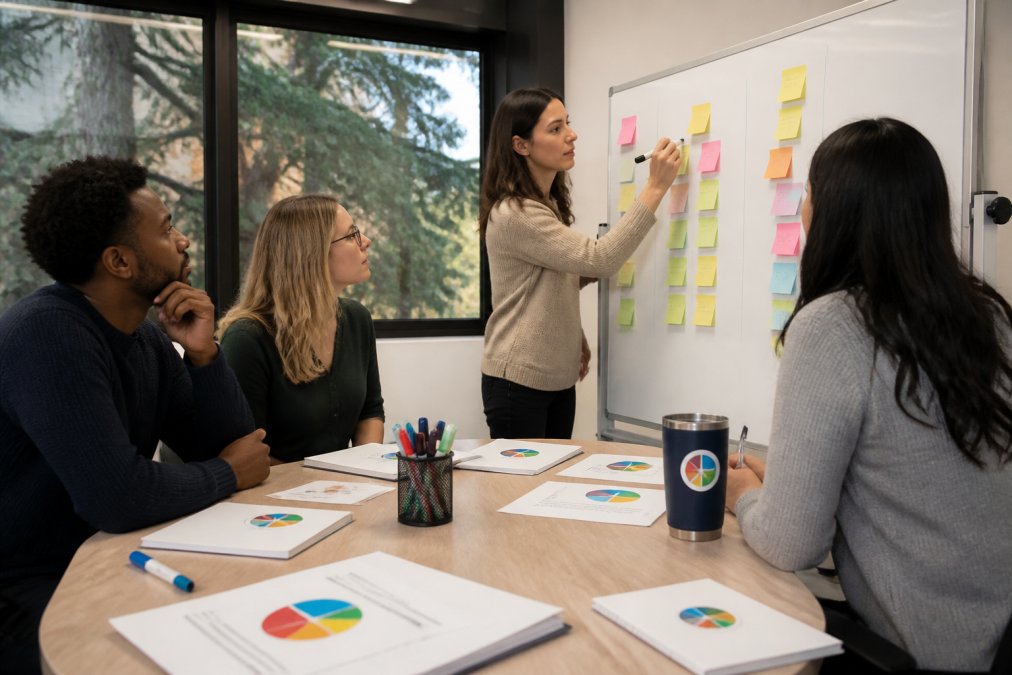
Activity 1: Style-based problem-solving. Present the team with a real workplace challenge. Divide the team by DISC style and have each group solve the problem from their style’s perspective. D-style groups focus on speed and competitive advantage. I-style groups focus on stakeholder buy-in. S-style groups focus on team morale. C-style groups focus on accuracy and process improvement.
Activity 2: Conflict resolution simulations. Create realistic scenarios where two DISC styles clash. Have pairs act out the conflict first without DISC awareness, then replay it using DISC insights. The difference demonstrates genuine understanding and respect.
Activity 3: Communication preference mapping. Have each DISC style group create a “how to work with me” guide. Post these guides visibly and reference them in daily work.
Activity 4: Cross-style mentoring pairs. Pair people with opposite DISC styles and have them meet monthly to mentor each other. These relationships build empathy and create informal advocates for style diversity.
Activity 5: Team project retrospectives using DISC. After completing a project, conduct a retrospective asking how different DISC styles contributed to success and where style differences created friction.
|
Workshop Activity |
Best For |
Time Required |
Expected Outcome |
|---|---|---|---|
|
Style-based problem-solving |
Showing multiple valid approaches |
60-90 minutes |
Team appreciates diverse perspectives |
|
Conflict resolution simulations |
Building empathy across styles |
45-60 minutes |
Reduced defensive reactions |
|
Communication preference mapping |
Creating shared working agreements |
30-45 minutes |
Clear expectations for interaction |
|
Cross-style mentoring pairs |
Long-term relationship building |
Ongoing monthly |
Sustained style appreciation |
|
Project retrospectives |
Connecting DISC to real outcomes |
45 minutes |
Continuous improvement mindset |
Applying DISC Insights to Improve Team Dynamics
Understanding DISC is only valuable if it changes how teams actually work together. The real power emerges when leaders apply these insights to specific team challenges.
Take The Official DiSC® Assessment Online Now! →
Strengthening Communication Across Personality Types
Different DISC styles have fundamentally different communication preferences. A D-style person wants facts, speed, and bottom-line impact. An I-style person wants enthusiasm, inclusion, and recognition. An S-style person wants reassurance, relationship, and time to process. A C-style person wants accuracy, logic, and thorough explanation.
When you know these preferences, you can adjust your communication to meet people where they are. For D-style team members, lead with the competitive advantage and decision authority. For I-style team members, emphasize collaboration and public recognition. For S-style team members, highlight stability and team impact. For C-style team members, provide supporting data and time for questions.
This isn’t manipulation, it’s respect. You’re not changing your message; you’re packaging it in a way each style can receive it.
Using DISC for Conflict Resolution
Conflict in teams often stems not from actual disagreement but from style clash. When you introduce DISC into conflict resolution, you reframe the issue. Instead of “You’re being difficult,” the conversation becomes “Your natural style prioritizes X, and mine prioritizes Y. How do we respect both?”
For example, a D-style project manager and an S-style team member clash over implementation pace. Without DISC, the manager thinks the team member is resistant. With DISC, the manager understands the team member needs stability. The resolution might be: “Here’s the overall timeline (giving the D-style person speed), and here are the checkpoints where we’ll pause and ensure team stability (giving the S-style person reassurance).”
Building Team Cohesion With Behavioral Awareness
Team cohesion doesn’t mean everyone has the same style, it means everyone understands and respects the styles present. The strongest teams have intentional diversity: D-style people to drive results, I-style people to build relationships, S-style people to ensure stability, and C-style people to maintain quality.
When each style understands how the others contribute, they stop seeing differences as problems. Create opportunities for styles to work together intentionally. Cross-functional projects with mixed styles can outperform homogeneous teams. Using DiSC For Teams helps you structure these interactions for maximum impact and sustained behavior change.
Common DISC Personality Patterns and What They Mean
While every person is unique, certain DISC combinations appear frequently and create predictable team dynamics.
High D / Low S: These are your decisive, fast-moving leaders. They drive results but may overlook team morale. They need an S-style person to remind them that people matter as much as outcomes.
High I / Low C: These are your charismatic communicators and networkers. They build enthusiasm but may miss important details. They benefit from working with C-style colleagues who catch what they overlook.
High S / Low D: These are your loyal, supportive team members. They create stability but may resist necessary change. They need D-style colleagues to push them toward growth.
High C / Low I: These are your quality-focused analysts. They ensure accuracy but may struggle with interpersonal dynamics. They benefit from I-style colleagues who help them connect and communicate more openly.
Balanced styles: These people are adaptable and can shift their approach based on context. They’re often effective in roles requiring flexibility.
Understanding these patterns doesn’t limit people, it helps you set them up for success.
Moving From Assessment to Action
The most common mistake organizations make with DISC is treating it as a one-time event. Sustained change requires integration into ongoing practice.
Week 1-2: Individual reflection and team debrief. Employees complete assessments and participate in group debriefs focused on understanding and acceptance.
Week 3-4: Skill practice. Teams practice applying DISC insights through workshops and simulations to build new communication habits.
Month 2-3: Integration into workflow. Reference DISC insights in regular team meetings. When conflict emerges, use DISC language to understand it. Intentionally compose teams with style diversity.
Month 4-6: Measurement and adjustment. Assess whether team communication has improved. Are conflicts being resolved faster? Use data to refine your approach.
Ongoing: Reinforcement and new hire integration. When new people join, include DISC in onboarding. Approximately 41% of HR professionals use DISC for onboarding because it is straightforward, rapid to complete, and highly actionable, according to DISC Assessment vs Other Communication Style Tools Comparison 2026 Guide.
Your Lifes Path makes this integration seamless through our DiSC Catalyst For Groups platform for flexible facilitation and specialized profiles for management, sales, and leadership development. Our certified partner support ensures your team gets proper guidance at every stage.
The transformation happens when people apply what they learned in real work situations, day after day. That’s when DISC shifts from an interesting workshop to a fundamental part of how your team operates.
Interpreting DISC assessment results for teams is one of the fastest ways to reduce miscommunication, accelerate conflict resolution, and build a workplace where people genuinely understand each other. When your team speaks the language of DISC, when they recognize that a colleague’s directness isn’t rudeness but a D-style preference, or that someone’s caution isn’t resistance but an S-style need for stability, everything changes. Get started with Your Lifes Path’s official Everything DiSC® assessments and certified partner support to transform how your team communicates, collaborates, and performs.
Frequently Asked Questions
Q: How do you read and interpret DiSC assessment results for a group?
A: Start by identifying each team member’s primary and secondary styles from their individual profiles. Look for the dominant styles present in your group—for example, if 40% of your team shows high Influence traits while 15% shows Dominance, you have a collaborative culture that values relationships. Examine patterns: teams heavy in Steadiness tend toward stability and loyalty, while teams with more Conscientiousness focus on accuracy and process. Use team reports to spot potential communication gaps. A manager with high Dominance leading a team of high Steadiness members may inadvertently move too fast for their comfort. Understanding these aggregate patterns helps you adapt your leadership approach and facilitate better cross-style collaboration.
Q: What are the practical applications of DiSC for remote teams?
A: Remote work removes many non-verbal cues that DISC styles rely on to communicate naturally. Use DISC profiles to establish shared communication norms: high Influence styles may prefer video calls and frequent check-ins, while high Conscientiousness team members might prefer detailed email documentation. Create a team DISC guide that outlines each style’s preferred response time, meeting format, and feedback approach. For conflict resolution in remote settings, DISC becomes even more valuable—misinterpreted messages in chat or email are less likely when everyone understands behavioral tendencies. Consider scheduling virtual team workshops to reinforce these insights and build the interpersonal connections that remote environments can lack.
Q: What is the rarest DISC personality type?
A: The D-Personality type (Dominance) is the rarest DISC style, representing only 2% of all assessment respondents. This means high-D leaders and team members are uncommon, which can actually be an asset in organizations that need decisive, results-driven direction. The IS Style is the most common, identified 18% of the time, reflecting how many people naturally blend Influence and Steadiness traits. Understanding rarity helps managers recognize that their D-style team member brings a unique perspective and shouldn’t be expected to adopt the communication preferences of the majority.
Q: How can managers use DiSC results to improve team conflict resolution?
A: DISC reveals how different styles approach conflict: D-styles want to resolve it quickly and win the argument, I-styles seek harmony and relationship preservation, S-styles prefer avoiding confrontation altogether, and C-styles focus on facts and finding the correct solution. When conflict arises, help each person understand the other’s behavioral tendencies. A D-style manager perceived as aggressive by an S-style employee isn’t attacking them personally—they’re just moving fast toward resolution. Conversely, an S-style’s reluctance to challenge decisions isn’t lack of engagement; they’re prioritizing team stability. When team members recognize these patterns, they stop misinterpreting intent and start responding to actual needs, turning potential friction into productive dialogue.
This article was written using GrandRanker