
Table of Contents
- Why Remote Leadership Teams Thrive With DiSC Training
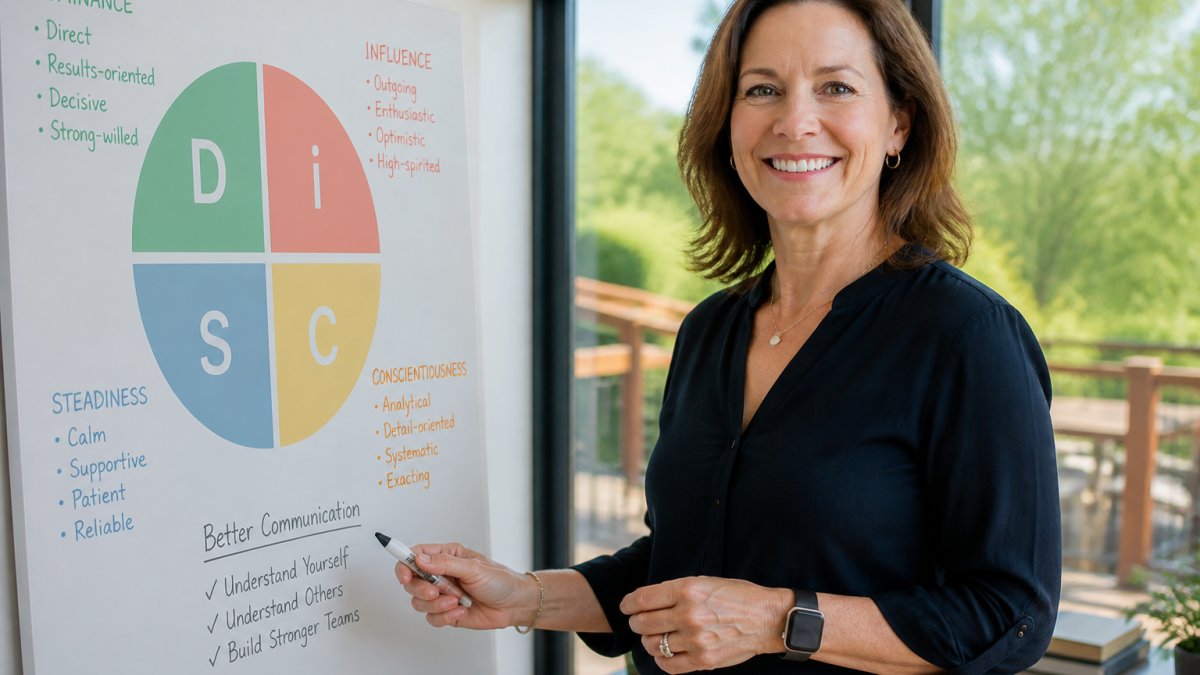
- What the DiSC Model Means: Dominance, Influence, Steadiness, Conscientiousness
- DISC Communication Styles at Work: A Shared Language for Remote Teams
- How DiSC Training Builds Trust and Collaboration Across Distributed Teams
- DISC Team Building Activities That Work in a Virtual Setting
- What to Expect in a Virtual DISC Workshop
- Matching the Right Profile to the Right Role
- How to Measure the Impact of DiSC Training on Remote Team Performance
- Frequently Asked Questions
Last Updated: October 16, 2026
Why Remote Leadership Teams Thrive With DiSC Training
Remote leadership teams face a challenge that office teams never had to solve: building trust and reading people without body language, hallway conversations, or quick desk-side check-ins. The benefits of disc training for remote leadership teams start here, because DiSC gives distributed leaders a shared, practical language for how people prefer to communicate, decide, and work.
This guide from Your Lifes Path breaks down what the DiSC model measures, how each of the four styles shows up on video calls and chat threads, and exactly how to run virtual training that sticks. We will also show you how to measure whether it worked.
The stakes are real. A case study published by the National Association of Community Health Centers in 2023 described a health center using DiSC assessment results alongside colleagues’ results to support teamwork, communication, and productivity. The results were not dramatic. They were steady and observable, which is exactly what you want from a communication initiative.
Here is the part most guides skip: DiSC does not change who people are. It changes what leaders assume about them. That single shift is why remote teams respond so well to it.
What the DiSC Model Means: Dominance, Influence, Steadiness, Conscientiousness
The DiSC model is a behavioral framework that sorts people by how they respond to problems, people, pace, and procedures. It measures observable behavior, not personality, intelligence, or mental health.
Each letter describes a behavioral preference:
- Dominance (D): Direct, decisive, results-first. D styles want the bottom line and get impatient with long explanations.
- Influence (I): Outgoing, enthusiastic, collaborative. i styles think out loud and build energy through conversation.
- Steadiness (S): Calm, patient, loyal. S styles value consistency and dislike being rushed into change.
- Conscientiousness (C): Analytical, precise, quality-focused. C styles want the details before they commit.
Most people show a primary style plus a secondary tendency. That combination explains why two managers can both be “direct” yet handle a tense meeting completely differently.
The Four Behavioral Styles at a Glance
|
Style |
Core Need |
Remote Communication Preference |
Watch For |
|---|---|---|---|
|
D |
Control and results |
Short updates, clear asks |
Impatience with group consensus |
|
i |
Recognition and connection |
Video, open discussion |
Losing track of written follow-ups |
|
S |
Stability and support |
Predictable check-ins |
Going quiet instead of pushing back |
|
C |
Accuracy and logic |
Written detail, data |
Over-analyzing before deciding |
DISC Communication Styles at Work: A Shared Language for Remote Teams
DISC communication styles at work give a distributed team something most remote groups lack: a common vocabulary for friction. Instead of “my manager is impossible to read,” a team member can say “I need shorter updates for a D style and more context for a C style.”
That reframing matters more than it sounds. A 2005 PubMed-indexed article by MK Slowikowski on using the DISC behavioral instrument to guide leadership described using behavioral evaluation to better understand and work with team members, including role-play scenarios. Role-play is the key part. Knowing your style is trivia. Practicing the adjustment is a skill.
In practice, this looks like:
- A D leader learns to pause before answering so S styles finish their thought
- An i leader writes a short recap after every call so C styles have a record
- An S leader practices stating disagreement out loud instead of absorbing it
- A C leader opens with the recommendation, then the data, for D audiences
How DiSC Training Builds Trust and Collaboration Across Distributed Teams
Trust on distributed teams is built from predictability, not from personality. DiSC training helps because it makes working norms explicit, including how decisions get made and how conflict gets handled.
That is not a soft claim. Guidance on DiSC for remote work notes that effective remote teams use DiSC data to create written team norms and document decision-making and conflict-resolution practices. Remote-management guidance adds regular check-ins, clear expectations, productive role modeling, and work-life balance to that list.
So the sequence is simple:
- Everyone learns their style and their teammates’ styles
- The team writes down how decisions get made
- The team writes down how disagreement gets raised
- Leaders model the adjustment in real meetings
Step four is where most programs stall. A leader who talks about adaptability but never adjusts their own style teaches the team that the training was theater.
DISC Team Building Activities That Work in a Virtual Setting
DISC team building activities work remotely when they are short, structured, and tied to real work. Skip the personality trivia games. Use exercises that produce something the team keeps.

Four exercises we recommend, each runnable in 30 to 45 minutes:
- Style Swap: One volunteer presents a real update in their own style, then again in the opposite style. The team notes what changed.
- Decision Mapping: The team writes how a recent decision actually got made, then compares it to how each style prefers to decide.
- Check-In Calibration: Each person states their preferred check-in rhythm. The manager builds one shared schedule from the answers.
- Conflict Rehearsal: Pairs role-play a mild disagreement using their opposite style’s approach.
The Style Swap is the one people remember. Watching a C style deliver a two-minute, headline-first update for a D audience teaches more than any slide deck.
What to Expect in a Virtual DISC Workshop
A virtual DISC workshop is a facilitated session, usually two to four hours, where a certified facilitator walks a team through their assessment results and how to apply them. It is not a webinar. Participants talk, practice in breakout rooms, and leave with a written plan they own.
The remote format changes the facilitation, not the content. On a video call, a facilitator has to design for attention, silence, and time zones in ways an in-person session never requires. Here is how a well-run virtual workshop handles each.
Before the session (one to two weeks out)
- Send assessments at least seven days ahead. People who read their report cold walk in defensive; people who have sat with it walk in curious.
- Ask each participant to bring one real, low-stakes work friction to the session, a thread that went sideways, a decision that stalled. Real material beats hypotheticals every time.
- Share a short pre-read on the four styles so the live time is spent on application, not definitions.
- Confirm camera expectations and captioning or transcription settings up front, so accessibility needs are met without anyone having to ask in the moment.
A typical two-hour agenda
- Welcome, ground rules, and a one-word check-in (five minutes)
- Individual results walkthrough in the full group (twenty minutes)
- Breakout rooms: pairs compare their top two styles and name one adjustment they will try (twenty minutes)
- Group map: where the team clusters and where it is thin (fifteen minutes)
- Style Swap practice in new pairs (twenty minutes)
- Team norms drafting in small groups, then merged live (twenty-five minutes)
- Commitments, a 30-day follow-up date, and a written recap (fifteen minutes)
Remote-specific facilitation moves that matter
- Rotate breakout pairs. Never let the same two people pair twice. The point is cross-style exposure, and random assignment beats self-selection.
- Use a shared digital board. A simple grid of D, i, S, and C columns where people drop sticky notes keeps quiet participants in the conversation and gives the facilitator a live read on the room.
- Build in silence. A C style needs thirty seconds to think before speaking. A D style fills that silence with a new idea. A facilitator who names the pause out loud, “take thirty seconds, then we will hear from three people”, gets input from both.
- Handle time zones honestly. For teams spanning more than a few hours, run two shorter sessions rather than one long one, and record the walkthrough portion so anyone who had to leave early can catch up. Do not record the breakout rooms.
- Assign a co-facilitator for chat. One person watches the chat, flags questions, and pulls quiet participants in. The lead facilitator cannot do both well.
We suggest running yours with a certified DiSC expert and facilitator from Your Lifes Path. Our virtual teambuilding workshops are built for exactly this format, and certified partner support means the facilitator can handle the hard moments, like a team that disagrees about a colleague’s results or a manager who hears their own style described and gets defensive.
What good looks like afterward
Participants should leave with three things: a one-page team norms document, a personal commitment written in their own words, and a scheduled follow-up. If any of the three is missing, the session was a good conversation rather than a training.
Take The Official DiSC® Assessment Online Now! →
Matching the Right Profile to the Right Role
The right DiSC profile depends on the seat, not the seniority. Every employee benefits from DiSC Workplace, because it builds the shared language the whole team uses. Beyond that, the profile should match the daily demands of the role.
Here is how we map it:
|
Role |
Recommended Profile |
Why It Fits |
|---|---|---|
|
Any employee, any level |
DiSC Workplace Profile |
Builds shared communication language |
|
Day-to-day managers |
Everything DiSC Management Profile |
Covers delegation, motivation, and development |
|
C-level executives |
DiSC Work of Leaders Profile |
Focuses on vision, alignment, and execution |
|
Sales professionals |
DiSC Sales Profile |
Adapts pitch and pace to buyer style |
The Everything DiSC Management profile is the one we see requested most, and for good reason. Day-to-day managers carry the heaviest communication load in a remote setup, and they are usually the least trained for it. Equipping these leaders with the right tech for remote professionals ensures that their improved interpersonal insights are supported by a seamless digital environment.
For organizations running this at scale, free EPIC Sub-Accounts make administration straightforward. You assign assessments, collect results, and generate reports from one place without chasing spreadsheets.
How to Measure the Impact of DiSC Training on Remote Team Performance
Measure DiSC training like any other business initiative: pick a baseline, pick two or three indicators, and check them at 30, 60, and 90 days. Skip this step and the program becomes a memory by quarter two.
Step 1: Set the baseline before the workshop
Run a short anonymous survey in the week before training. Keep it to five questions so people actually finish it. A workable set:
- On a 1-5 scale, how clear are expectations for how we communicate on this team?
- On a 1-5 scale, how comfortable are you raising a disagreement in a meeting?
- In a typical week, how many times do you have to ask a follow-up question on a thread that should have been clear?
- How often do meetings end with a named owner and a due date?
- How often do you adjust your communication style for the person you are talking to?
Those five map directly to the four styles: clarity and follow-ups speak to C and D preferences, comfort raising disagreement speaks to S, and style adjustment is the behavior the whole program is trying to build.
Step 2: Pick two or three indicators, not ten
Tracking everything means tracking nothing. Choose the two or three that matter most for your team and commit to them for a full quarter. Common choices:
- Meeting efficiency: average meeting length and the share of meetings that end with assigned action items
- Response clarity: how often people ask follow-up questions on the same thread
- Conflict handling: whether disagreements get raised in the meeting or after it
- Engagement: participation rates in check-ins and optional sessions
- Retention: voluntary turnover on the team, tracked quarterly
Step 3: Re-measure at 30, 60, and 90 days
Use the same five survey questions each time. Do not change the wording between waves, a changed question is a new baseline. Pair the survey with one behavioral indicator from your existing tools: meeting length from your calendar, thread follow-ups from your chat platform, or action-item completion from your project tracker. You are looking for direction and consistency, not a precise number.
Do not expect a clean result in month one. Communication change usually shows up first as fewer repeated questions and shorter threads, then as time saved, and only later as engagement or retention movement. A common pattern is a small dip at 30 days as people over-correct, then steady improvement by 90.
Step 4: Report it honestly
Share the baseline and the follow-up numbers with the team, including the parts that did not move. A team that sees its own data trusts the next initiative more. A team that only ever hears good news stops believing the numbers.
Responsible use: what DiSC is and is not
DiSC describes behavioral preferences. It is not a diagnostic tool, not a measure of intelligence or competence, and not a predictor of performance. Use it to improve communication and self-awareness, never to screen people out of roles, justify a promotion decision, or explain away a performance problem.
A few guardrails worth writing into your team norms:
- Consent and privacy. Share results only with the person who owns them. A team map should show clusters, not named individuals, unless each person has agreed to be named.
- No fixed labels. “I am a D” is shorthand, not identity. People shift style by context, stress, and role. Treat the profile as a discussion tool, not a box.
- Watch for stereotyping. The fastest way to kill a DiSC program is to let it become a way of predicting who someone is before they speak. The facilitator should name this risk out loud in the session.
- Account for context. Culture, language, time zones, neurodiversity, and accessibility needs all shape how someone shows up at work. A good facilitator builds the session so those differences are respected, not flattened into a style label.
A 30/60/90 reinforcement rhythm
- Day 30: Manager check-in using three prompts, “What adjustment did you try? What worked? What will you change?”
- Day 60: Team review of the norms document. Update anything that is not working.
- Day 90: Re-run the five-question survey and share the comparison with the team.
That rhythm is what turns a workshop into a habit. The assessment is the starting line, not the finish.
Frequently Asked Questions
What is the DISC model, and what do D, I, S, and C mean?
The DiSC model describes four behavioral styles: Dominance (D), Influence (i), Steadiness (S), and Conscientiousness (C). D styles focus on results and action. i styles bring enthusiasm and collaboration. S styles value patience and dependability. C styles prioritize accuracy and careful analysis. Most people show a blend, with one or two styles leading. Understanding these preferences helps remote leaders adapt how they communicate, assign work, and give feedback so each team member can contribute at their best.
How can DISC training improve communication in remote leadership teams?
Remote teams rely on written messages, video calls, and async updates, which leaves more room for misreading tone and intent. DISC training gives leaders a shared vocabulary for how each person prefers to receive information. A D style may want the headline first, while a C style wants details and context. When leaders know these preferences, they adjust emails, meeting agendas, and feedback accordingly. That reduces friction and keeps projects moving, even across time zones and hybrid schedules.
Which Everything DiSC profile is right for different employee roles?
Your Life’s Path offers profiles matched to specific responsibilities. The DiSC Workplace profile fits any employee position and builds foundational communication skills. The Everything DiSC Management profile supports those in day-to-day managerial roles. Work of Leaders serves C-level executives navigating vision and alignment. The Sales profile helps sales professionals adapt to buyer styles. Choosing the right profile means the insights land where they matter most for each person’s daily work.
How long does a virtual DISC training workshop take?
Most virtual DISC workshops run between two and four hours, depending on group size and depth. Many facilitators split sessions into two shorter blocks to reduce screen fatigue. Before the workshop, participants complete their assessment online, which takes about 15 to 20 minutes. Your Life’s Path offers virtual workshops led by a certified DiSC expert and facilitator, so teams get guided discussion, role-play, and practical application rather than just a report to read.