

Table of Contents
- Why Measuring Long-Term Behavioral Change From DiSC Workshops Matters
- The DiSC Model: A Quick Refresher for Measurement Planning
- Defining Behavioral Change in Observable Terms
- Workplace Behavior Change Examples You Can Track
- A Practical Framework for Measuring Training Effectiveness
- Employee Training Evaluation Questions to Ask at 30, 60, and 90 Days
- DiSC Workshop Follow-Up Activities That Reinforce New Habits
- Using the DiSC Workplace Profile to Track Team Communication Over Time
- Reporting Results and Building a Culture of Continuous Growth
- Frequently Asked Questions
Last Updated: October 21, 2026
Why Measuring Long-Term Behavioral Change From DiSC Workshops Matters
Most DiSC workshops end with a room full of energized people holding colorful profile reports. Then Monday arrives, and old habits quietly return. That gap between workshop energy and lasting change is exactly why measuring long term behavioral change from disc workshops matters so much. Bridging this divide requires moving beyond the initial excitement of the session toward the intentional process of building lasting habits that integrate new communication styles into daily routines.
At Your Lifes Path, we see the same pattern across teams. The learning lands in the session. The follow-through is where it fades.
Measurement changes that. When you track behavior over time, you turn a one-day event into an ongoing practice. You also give leaders real evidence that their investment in team development is working.
The good news: you don’t need a research department. You need a simple plan, a few honest questions, and a schedule you actually keep.
The DiSC Model: A Quick Refresher for Measurement Planning
The DiSC model is a behavioral assessment framework that groups people into four styles: Dominance, Influence, Steadiness, and Conscientiousness. Each style describes how a person tends to communicate, make decisions, and handle conflict.
Here’s what each style looks like in practice:
- D (Dominance): Direct, fast-paced, focused on results
- I (Influence): Expressive, collaborative, focused on relationships
- S (Steadiness): Calm, supportive, focused on stability
- C (Conscientiousness): Precise, analytical, focused on accuracy
Most people show a blend. The Everything DiSC® assessment places each person on a map, not in a rigid box.
For measurement, this matters because each style shows change differently. A D style might show growth by pausing before speaking. An S style might show growth by raising a concern sooner. Your tracking plan needs room for both.
Defining Behavioral Change in Observable Terms
Behavioral change is a shift in what someone consistently does at work, not a shift in what they know or believe. That definition is the foundation of any measurement plan.
This is where most training evaluation gets stuck. Teams ask people if they “found the workshop valuable.” Everyone says yes. Nothing changes.
Instead, define change as something a colleague could actually see. Compare these two:
|
Vague goal |
Observable version |
|---|---|
|
“Asks a clarifying question before responding in meetings” |
|
|
“More empathy” |
“Paraphrases a teammate’s point before offering a counterpoint” |
|
“Stronger collaboration” |
“Invites input from quieter team members at least once per meeting” |
|
“Less conflict” |
“Raises disagreements privately before escalating” |
Notice that each observable version names a specific action. You can count it, notice it, or ask about it.
Workplace Behavior Change Examples You Can Track
Real workplace behavior change examples make measurement concrete. Here are patterns we see teams track most often after a DiSC workshop.
In daily conversations:
- Adapting tone based on the other person’s style
- Slowing down for a C-style colleague who wants details
- Getting to the point faster with a D-style colleague
In meetings:
- Sharing the agenda in advance
- Making space for S-style teammates who process out loud
- Separating idea generation from decision-making
In conflict:
- Naming the behavioral difference instead of blaming the person
- Asking “how do you prefer to handle this?” before assuming
In follow-up:
- Checking in on commitments without being prompted
- Adjusting a plan when a teammate signals stress
These examples work because they’re visible. A manager can observe them. A peer can confirm them. And the person doing them knows exactly what to practice.
A Practical Framework for Measuring Training Effectiveness
Measuring training effectiveness means comparing what people do before a DiSC workshop with what they do weeks and months after. The framework below is built for real teams, no research department required, and it deliberately combines self-report, peer observation, and manager input so no single source carries the whole story.
Step 1: Set a behavioral baseline. Before the workshop, capture current behavior on two or three observable actions per participant. Use a short self-rating plus a peer rating on the same items. Keep the scale simple, a 1-to-5 frequency scale (1 = rarely, 5 = almost always) works well and is easy to compare over time. Record the baseline date so every later comparison is anchored to a known point.
Step 2: Define success in observable terms. Decide what meaningful progress looks like before you collect a single follow-up data point. Examples: three of five peers notice a change; a specific behavior (such as paraphrasing before countering) shows up in most meetings; a manager observation confirms the behavior in two separate one-on-ones. Write the success criteria down, this prevents moving the goalposts later.
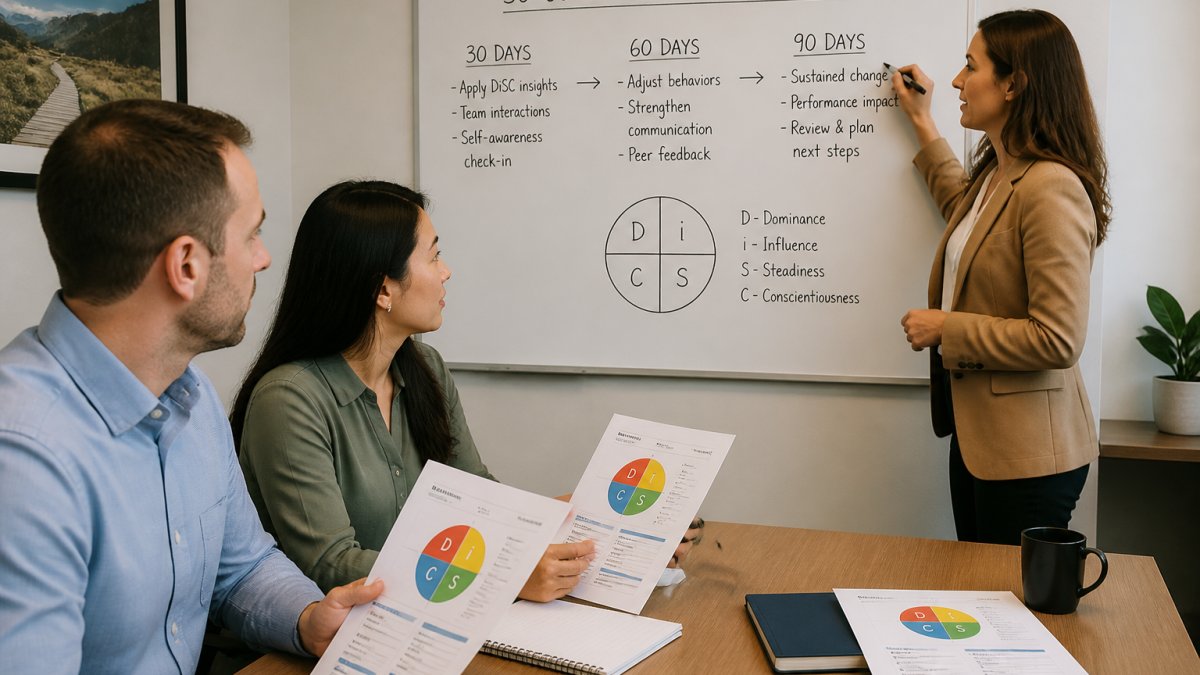
Step 3: Collect at fixed intervals using mixed methods. Gather data at 30, 60, and 90 days. Vary the method so you are not relying on any one source:
- Self-report pulse survey: Five minutes or less, same questions each time.
- Peer feedback: Two colleagues rate the same observable behaviors on the same scale as baseline.
- Manager observation: One structured observation per participant per interval, using a simple checklist.
- Work artifacts (optional): Meeting agendas, follow-up emails, or project retrospectives that show the behavior in action.
Each method has limits. Self-report is subject to social desirability bias, people want to look good. Peer feedback is subject to relationship effects, friends rate friends higher. Manager observation is subject to recency bias, managers remember the last interaction, not the pattern. Combining methods offsets these weaknesses; no single source should decide the outcome.
Step 4: Compare and attribute carefully. Look for patterns across the group, not individual outliers. Then ask the attribution question: what else changed at work during this window? A reorganization, a new manager, a busy quarter, or a policy change can all move behavior. Use one of these attribution strategies:
Take The Official DiSC® Assessment Online Now! →
- Comparison team: If you have a similar team that did not attend the workshop, track the same behaviors there. If both teams improve equally, the workshop may not be the cause.
- Staggered rollout: Run the workshop with one team first, then a second team later. Compare the first team’s 90-day results to the second team’s baseline.
- Careful interpretation: When you cannot isolate the cause, say so. “Behavior improved during the same quarter the workshop ran” is honest; “the workshop caused the improvement” may overstate what the data supports.
Step 5: Report, discuss, and adjust. Share group-level trends, not individual scores. Name the limits of the data. Then adjust the next workshop or follow-up based on what you found, for example, if D-style participants show less change on listening behaviors, add a targeted practice activity for that style in the next session.
|
Step |
Timing |
What you collect |
Method notes |
|---|---|---|---|
|
Baseline |
Before workshop |
Self-rating plus peer rating on 2-3 observable behaviors |
Same 1-5 scale used at every interval |
|
First check |
30 days |
Short pulse survey plus one peer rating |
Focus on awareness and first attempts |
|
Second check |
60 days |
Pulse survey plus one manager observation |
Focus on practice and consistency |
|
Third check |
90 days |
Full self and peer rating plus manager observation |
Focus on integration and team-level patterns |
|
Review |
90+ days |
Group trends, attribution notes, and adjustments |
Report at group level only |
Employee Training Evaluation Questions to Ask at 30, 60, and 90 Days
The right employee training evaluation questions do more work than any dashboard. They surface what people actually notice about their own behavior and their teammates’.
Keep the questions consistent across all three check-ins. That consistency is what lets you compare results over time.
At 30 days, focus on awareness:
- Which DiSC insight have you used since the workshop?
- What’s one moment where you adapted your communication style?
- Where are you still falling back into old patterns?
At 60 days, focus on practice:
- Which new behavior feels most natural now?
- What’s one situation where your style created friction?
- What support would help you keep practicing?
At 90 days, focus on integration:
- How has your approach to team communication changed?
- What do teammates seem to notice about how you work now?
- What would you want a future workshop to reinforce?
DiSC Workshop Follow-Up Activities That Reinforce New Habits
Follow-up activities turn a single workshop into a practice. Without them, learning transfer fades within weeks.
Here are follow-up activities that hold up well:
- Peer pairings: Match people with different styles for a monthly check-in
- Micro-learning nudges: Send a short prompt every two weeks about one style
- Team debriefs: Spend ten minutes in a team meeting on one real interaction
- Manager coaching: Give managers three questions to use in one-on-ones
- Refresher sessions: Run a short virtual session at the 60-day mark
We recommend pairing these with a certified DiSC trainer and facilitator. A certified facilitator knows how to keep the conversation honest and how to spot when a team is drifting back into old patterns.
Using the DiSC Workplace Profile to Track Team Communication Over Time
The DiSC Workplace Profile gives you a shared language for tracking team communication. Each participant gets a personalized report on how they work with others, plus strategies for adapting their style.
Here’s how to use it as a tracking tool, not just a one-time read:
- Run the profile before the workshop. Capture where each person sits on the map.
- Revisit it at 90 days. Ask participants to reread their report and note what’s changed.
- Compare team dynamics. Look at how the group’s style mix shapes meetings and decisions.
- Update the conversation. Use the profile to talk about what the team needs next.
We suggest the DiSC Workplace Profile for participants because it’s built for exactly this kind of ongoing reflection. It’s also easy to administer through a free EPIC sub-account, which keeps the logistics light for stretched HR teams.
The profile isn’t a scorecard. It’s a mirror. Used over time, it shows people how their default approach shifts as they practice new behaviors.
Reporting Results and Building a Culture of Continuous Growth
Reporting closes the loop. It shows leaders what changed, what didn’t, and what to do next. It also signals to employees that the organization takes team development seriously. The key is to report in a way that is useful, honest, and respectful of the people who shared data.
Choose behavioral metrics that connect to team outcomes. A metric is only useful if it points to something you can act on. Here are sample indicators you can adapt:
- Behavior frequency score: Average rating on a 1-5 scale for each observable behavior, reported as a group mean at baseline, 30, 60, and 90 days.
- Peer-notice rate: Percentage of participants whose peers report a rating increase of at least one point on the scale.
- Manager observation rate: Percentage of participants observed demonstrating the target behavior in at least two of three structured observations.
- Style-specific adoption: For each DiSC style, the average change score on the behaviors most relevant to that style (for example, pausing before responding for D styles, raising concerns sooner for S styles).
- Team outcome linkage (optional): A simple before-and-after comparison on a team-level measure such as meeting satisfaction or conflict-resolution speed, clearly labeled as correlational, not causal.
Score and report with restraint. Report group means and ranges, not individual scores. A simple dashboard with one row per behavior and one column per interval (baseline, 30, 60, 90) is enough for most teams. Add a short narrative for each behavior: what moved, what stayed flat, and what the team plans to try next. Avoid ranking individuals or teams against each other, the goal is learning, not competition.
Protect privacy and consent. Collect follow-up feedback only after telling participants what you will collect, who will see it, and how it will be reported. Keep peer and manager ratings confidential at the individual level. Report only at the group level, and suppress results when a group is too small to protect anonymity (a common threshold is fewer than five respondents). Store data securely and delete it when the measurement cycle ends unless participants agree otherwise.
Use DiSC styles responsibly. DiSC describes behavioral tendencies, not fixed labels. When you report style-specific results, frame them as patterns to explore, not verdicts. A D-style participant who shows less change on listening behaviors is not “bad at listening”, the data may simply suggest that the practice activity did not fit how that person learns. Use the results to adjust the next workshop, not to categorize people.
Build the continuous-growth rhythm. A culture of continuous growth grows from a repeatable cycle: measure, discuss, adjust, repeat. Share results in a team meeting, invite questions, and agree on one or two adjustments for the next cycle. Over time, behavioral insights become part of how the team talks about itself, and measurement becomes a habit rather than a one-time audit.
Frequently Asked Questions
How do you measure behavioral change after a DiSC workshop?
Start by defining the specific behaviors you want to see, such as speaking up in meetings or giving clearer feedback. Then collect data from three sources: self-assessments, peer feedback, and manager observations. Use the DiSC Workplace Profile as a baseline, and repeat a short pulse survey at 30, 60, and 90 days. Compare results against your operational definitions to see whether communication styles and workplace interactions have shifted. Pair that with structured employee training evaluation questions so you capture both quantitative trends and the stories behind them.
How long does it take to see behavior change after DiSC training?
Most teams show early signs within 30 days, with clearer shifts in communication preferences and meeting behavior by 60 to 90 days. Lasting change usually depends on reinforcement. Schedule follow-up activities, manager coaching, and short refresher sessions across the first six months. Track progress at each interval rather than waiting for a single end-point review. This gives you a clearer picture of measuring training effectiveness and helps you adjust support where it is needed most.
What should you measure after a DiSC workshop?
Focus on observable behaviors tied to the four behavioral styles. Examples include how often team members adapt communication, how quickly conflicts get resolved, and whether meetings include input from quieter styles. Also track self-awareness ratings, peer feedback scores, and participation in follow-up activities. Use a mix of surveys, manager observations, and team retrospectives. This combination gives you workplace behavior change examples grounded in real data rather than impressions.
How can managers reinforce DiSC learning at work?
Managers make the biggest difference by modeling the language and using it in daily conversations. Ask team members to name their style before a difficult discussion, and reference DiSC during one-on-ones. Schedule monthly DiSC workshop follow-up activities such as peer coaching pairs or short scenario practice. Recognize people when they adapt their communication style effectively. Reinforcement works best when it is consistent, visible, and tied to real work rather than treated as a one-time event.