Last Updated: October 29, 2026
Quick Summary
To use DiSC for effective disc team collaboration, build a team style map of each member’s primary style, then match the right profile to each role and run a 90- to 120-minute workshop where people practice adapting to other styles. Reinforce it with style-aware management habits, conflict fixes, and a quarterly tracking cadence.
- A team style map takes about an hour to build and gives everyone a shared picture of team dynamics.
- Everything DiSC Workplace serves employees, Management serves managers, Sales serves sales professionals, and Work of Leaders serves C-level executives.
- A strong DiSC workshop runs 90 to 120 minutes: explain the model, reveal results, then practice in pairs.
- Your Life’s Path offers free EPIC sub-account setup to assign assessments and store results in one dashboard.
- D and C clashes are the most common friction point; name the tension and agree on a checkpoint that satisfies both.
Table of Contents
- Start With a Shared Language: A Quick DiSC Overview
- Step 1: Build Your Team’s Behavioral Style Map
- Step 2: Match the Right DiSC Profile to Each Role
- Step 3: Learn How to Facilitate a DiSC Workshop
- Step 4: Set Up EPIC Sub Account Management for Your Organization
- Step 5: Apply DiSC Management Training Strategies to Daily Work
- Step 6: Use the Everything DiSC Sales Profile to Boost Revenue
- Step 7: Resolve Conflict by Addressing D and C Clashes
- Step 8: Keep Collaboration Alive for Remote and Hybrid Teams
- Step 9: Track Behavioral Change Over the Long Term
- Frequently Asked Questions
Start With a Shared Language: A Quick DiSC Overview
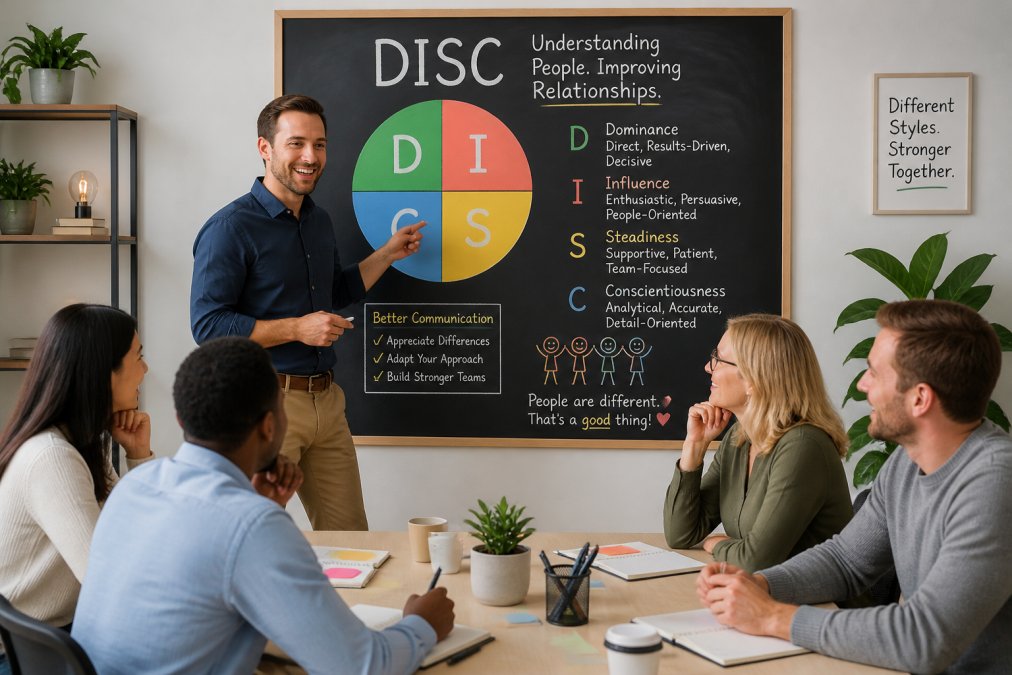
Learning how to use DiSC for effective disc team collaboration starts with one simple idea: people work differently, and that is a strength. DiSC is a behavioral assessment that sorts communication preferences into four styles: Dominance, Influence, Steadiness, and Conscientiousness. The official Everything DiSC® assessments help teams turn that insight into daily habits.
Here is what each style brings to a team:
- D (Dominance): direct, decisive, and focused on results
- I (Influence): outgoing, enthusiastic, and focused on people
- S (Steadiness): calm, supportive, and focused on stability
- C (Conscientiousness): precise, analytical, and focused on accuracy
Most people show a blend of styles, with one or two that lead. That blend shapes how someone gives feedback, handles pressure, and makes decisions.
The payoff is real. Teams with a shared behavioral language spend less time guessing and more time working. They spot interpersonal friction earlier and resolve it faster. This guide walks through nine steps, from building a style map to tracking long-term change. Applying these behavioral insights creates a foundation for lasting cohesion that thrives even under the pressure of high-stakes transactions.
Step 1: Build Your Team’s Behavioral Style Map
A team style map is a simple chart that plots each member’s primary DiSC style. It takes about an hour to build and gives everyone a shared picture of team dynamics.
Start by having each person complete a DiSC assessment. Then list every name under their primary style. Look for patterns:
- A cluster of D styles means the team moves fast but may skip details
- A heavy S and C mix means decisions take longer but land carefully
- A balanced spread means natural role alignment across tasks
Post the map where the team can see it. Review it at the start of big projects.
Reading the Four Styles in a Team Setting
Each style shows up in predictable ways during meetings. D styles push for decisions. I styles spark ideas and energy. S styles check that everyone is heard. C styles ask for the data behind a claim.
None of these is better. The goal is to read the room, not to rank people.
Step 2: Match the Right DiSC Profile to Each Role
The right profile depends on the person’s role, not their seniority. Everything DiSC® offers a family of profiles, each built for a specific job. Matching the profile to the role is where behavioral insight becomes practical.
DiSC Workplace for Employees
Everything DiSC® Workplace helps individual contributors understand their own style and adapt to coworkers. It is the foundation for everyday collaboration and communication preferences.
DiSC Management For Managers
Everything DiSC® Management gives managers tools to direct, delegate, and motivate based on each team member’s style. This is where strengths-based management starts to pay off.
DiSC Work of Leaders for C-Level Executives
Everything DiSC® Work of Leaders is built for executives who set direction and shape workplace culture. It connects leadership behavior to vision, alignment, and execution.
DiSC Sales Profile for Sales Professionals
Everything DiSC® Sales profile is recommended for sales teams to improve sales and boost revenue.
|
Profile |
Built For |
Main Focus |
|---|---|---|
|
All employees |
Day-to-day collaboration |
|
|
People managers |
Delegation and motivation |
|
|
Sales professionals |
Adaptive selling |
|
|
C-level executives |
Vision and execution |
Step 3: Learn How to Facilitate a DiSC Workshop
A strong DiSC workshop runs 90 to 120 minutes and follows a clear arc: explain the model, reveal individual results, then practice using the results in pairs. Good facilitation turns a report into a conversation, and a well-designed session gives every style a way to contribute.
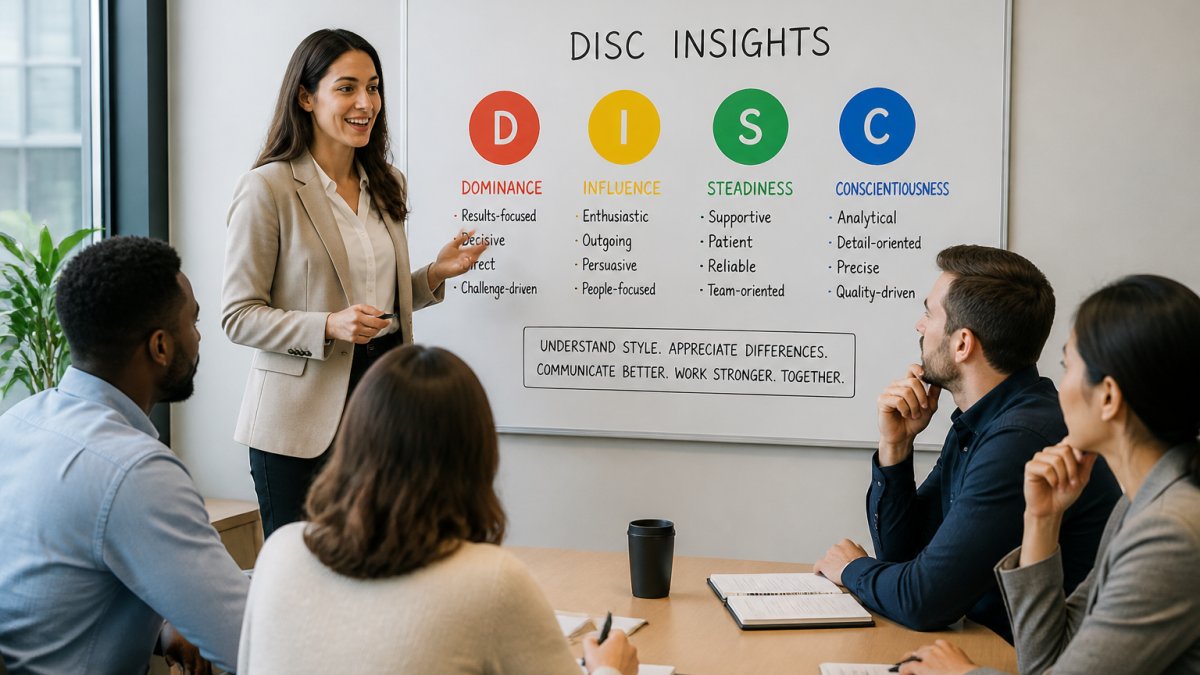
A trainer leads a workshop on disc team collaboration with a whiteboard and engaged employees.
A 120-Minute Agenda That Works In Person and Online
Plan the session in six parts, with a clear purpose for each block:
- Warm-up (10 minutes): ask each person how they like to receive feedback, and capture answers on a shared board so the room sees the range of preferences.
- Model overview (20 minutes): walk through the four styles with real examples from your own team, not textbook descriptions.
- Results review (25 minutes): let people read their profiles and mark what rings true, then share one insight with a partner.
- Style-in-action exercise (30 minutes): give mixed-style pairs a realistic scenario, such as a project handoff or a customer escalation, and ask them to plan how each style would approach it.
- Debrief (20 minutes): ask three questions, What did you notice about your own style? What did you notice about your partner’s? What will you try in the next two weeks?
- Commitment round (15 minutes): each person names one adaptation they will practice and one colleague who will check in with them.
Facilitation Techniques by Style
Facilitation is where the workshop succeeds or stalls. A few style-aware moves keep the room balanced:
- D participants want the bottom line, so give them the agenda up front and a decision to make early.
- I participants bring energy, so channel it into small-group share-outs rather than letting it dominate the room.
- S participants need time to reflect, so build in silent reading and written prompts before open discussion.
- C participants want accuracy, so be precise about what the assessment measures and what it does not.
A common pattern is that the first ten minutes set the tone. If you open with a lecture, the room stays passive. If you open with a question about how people like to be treated at work, the room leans in.
Running the Workshop for Remote and Hybrid Teams
The same agenda works online with a few adjustments. Use breakout rooms for the pair exercises, a shared digital whiteboard for the style map, and a chat prompt for the commitment round so quieter styles can contribute in writing. Keep live blocks to 60 minutes and send the profile reading as pre-work.
What to Do After the Session
A workshop is a starting point, not a finish line. Within a week, send a one-page summary of the team’s style map and the commitments people made. Within a month, run a 15-minute check-in where each person reports on the adaptation they practiced. This small follow-up is what separates a one-off event from a program.
If you want a full walkthrough, see how to conduct a DiSC workshop for employees. Managers running their own sessions can use our DISC facilitation guide for managers.
Step 4: Set Up EPIC Sub Account Management for Your Organization
EPIC sub account management is the back office that lets an organization assign assessments, store results, and pull reports from one place. It removes the manual spreadsheet work that slows HR teams down.
Your Lifes Path offers free EPIC sub-account setup, so getting started costs nothing on the admin side. From there you can:
Take The Official DiSC® Assessment Online Now! →
- Assign the right profile to each employee or manager
- Keep all results in one dashboard
- Generate comparison reports for pairs and teams
- Reuse the same account across workshops and new hires
For a stretched HR team, this is the difference between running one workshop and running a program.
Step 5: Apply DiSC Management Training Strategies to Daily Work
DiSC management training strategies only stick when managers use them in ordinary moments. That means one-on-one meetings, task handoffs, and feedback loops, not just the annual review.
Try these habits:
- Match delegation to style. Give a D a clear outcome and room to run. Give an S a steady timeline and support.
- Tune feedback. C styles want specifics. I styles want encouragement first.
- Adjust check-ins. Some people want weekly contact; others want space.
Our guide on adapting management styles for different DISC profiles breaks this down by style with example scripts. The goal is adaptability, not a script for every conversation.
Step 6: Use the Everything DiSC Sales Profile to Boost Revenue
The Everything DiSC® Sales profile helps sales professionals read a buyer’s style and adjust their pitch. It is one of the clearest ways to lift revenue, because it targets the moment that matters: the conversation with the customer.
A quick mapping helps:
- D buyers want the bottom line and a fast next step
- I buyers want energy, stories, and a sense of partnership
- S buyers want reassurance and time to think
- C buyers want proof, specs, and detail
Sales managers can build these adaptations into call reviews and coaching. Over time, the team develops a shared language for what worked and why.
Step 7: Resolve Conflict by Addressing D and C Clashes
D and C clashes are the most common friction point on mixed teams. The D wants speed and a decision. The C wants accuracy and more data. Both are right, and both can dig in.
Picture a launch meeting. The D says, “Ship it Friday.” The C says, “We have not tested the edge cases.” Neither is being difficult. They are running different decision-making processes.
A simple fix works well:
- Name the tension out loud, without blame
- Ask the D what decision they need and by when
- Ask the C what data would make them comfortable
- Agree on a checkpoint that satisfies both
For a deeper playbook, read how DiSC resolves team conflict. The point is to treat the clash as information, not a personality flaw.
Step 8: Keep Collaboration Alive for Remote and Hybrid Teams
Remote and hybrid teams lose the casual signals that keep collaboration healthy. DiSC gives distributed teams a structured way to support disc team collaboration on purpose.
A few practices work well:
- Add style notes to team profiles in your chat and project tools
- State communication preferences in meeting invites
- Rotate who runs the check-in so quieter styles get airtime
- Use async updates for C styles who think before they speak
Project management tools make this easy. A short style tag next to each name reminds people how to write, when to call, and how to give feedback. Small prompts prevent big misunderstandings.
Step 9: Track Behavioral Change Over the Long Term
Long-term change needs a light measurement habit, not a heavy audit. The goal is to see whether people are actually adapting, and to catch drift before it becomes friction. Most guides stop at the workshop; the teams that get lasting results treat DiSC as a process that runs across 6 to 12 months.
A 12-Month Tracking Cadence
A simple quarterly rhythm keeps the work visible without adding meetings:
- Month 1: baseline pulse survey and a refreshed team style map.
- Month 3: manager check-ins on handoffs and delegation, plus one team roundtable after a major project.
- Month 6: second pulse survey and a review of the style map for changes in roles or team composition.
- Month 9: peer feedback round focused on adaptation, not personality.
- Month 12: annual review of the program, with a decision on whether to refresh assessments or run a follow-up workshop.
Three Metrics Worth Tracking
Keep the measurement light and tied to DiSC behaviors:
- Self-reported adaptation: a short quarterly pulse survey asking how well people feel understood by their teammates and how often they adjust their communication style.
- Manager observations: simple notes on where handoffs went smoothly and where a style mismatch slowed things down.
- Team feedback loops: a quick roundtable after major projects, with one question per style, What did the Ds push for? What did the Is energize? What did the Ss stabilize? What did the Cs verify?
Connecting the Data Back to DiSC
Tracking only matters if it changes behavior. After each pulse, review the results by style. If the S styles report feeling rushed, the team may need longer decision windows. If the C styles report feeling unheard, the team may need to build in a data review step. If the D styles report frustration with pace, the team may need clearer decision rights.
Tooling That Makes Tracking Easy
Use the tools your team already has. A shared document holds the style map. A project management tool holds style tags next to each name. A simple form handles the quarterly pulse. The EPIC sub account keeps assessment results in one place so you can compare reports over time without rebuilding spreadsheets.
Keeping the Program Alive
Review the team style map each quarter and update it as people grow, change roles, or join the team. Celebrate adaptations publicly, a short shout-out for someone who adjusted their approach to help a colleague is more powerful than any report. Our guide on measuring long-term behavioral change from DiSC workshops gives you concrete methods to use.
Frequently Asked Questions
What are the DISC communication styles?
DiSC describes four behavioral styles: Dominance (D), Influence (i), Steadiness (S), and Conscientiousness (C). D styles focus on results and action, i styles lead with enthusiasm and relationships, S styles value patience and support, and C styles prioritize accuracy and analysis. Each person blends all four, but most people lean on one or two. Understanding these styles helps teams adapt their communication preferences and reduce interpersonal friction.
How does DiSC improve team collaboration?
DiSC gives teams a shared vocabulary for behavior. When colleagues know each other’s styles, they can adjust how they give feedback, run meetings, and assign tasks. A D style wants the bottom line first, while an S style needs context and reassurance. Using a structured assessment like DiSC Workplace turns those differences into strengths, which supports team cohesion and a more collaborative environment.
What is the difference between DiSC Workplace and Work of Leaders?
DiSC Workplace is built for employees at any level and focuses on day-to-day communication, team dynamics, and interpersonal friction. Work of Leaders is designed for C-level executives and senior leaders, examining vision, alignment, and execution through a leadership lens. Many organizations pair both profiles so managers and executives speak the same behavioral language as their teams.
How do I set up an EPIC sub account for my organization?
An EPIC sub account lets your HR or L&D team manage assessments, distribute profiles, and track completion from one dashboard. Your Lifes Path offers free EPIC sub-account setup with certified partner support, so your administrator can issue DiSC Workplace, Management, Sales, or Work of Leaders profiles without manual back-and-forth. Contact Your Lifes Path to request setup and get your team started.
