
Last Updated: October 30, 2026
Quick Summary
To run effective team meetings for diverse personalities, state the meeting’s purpose in one sentence, send an agenda 24 hours ahead, and assign facilitator, note-taker, and timekeeper roles. Facilitate by DISC style: give D styles the decision and time budget, I styles a story prompt, S styles written questions in advance, and C styles the data and risks first.
- Hold a meeting only when it is required, not as an automatic response to every question.
- Ask the team for one or two hot topics per meeting and send the agenda 24 hours ahead.
- Most working sessions fit inside 30 to 60 minutes, so cap each agenda item with a set time.
- Send discussion prompts 24 hours ahead so quiet S and C styles arrive with a formed view.
- Close by reading each action item aloud with one owner and a due date per item.
Table of Contents
- Start With Purpose: The First Step to Effective Team Meetings
- Build a Team Meeting Agenda Template That Works for Every Style
- Invite the Right Participants and Assign Clear Roles
- Meeting Facilitation Techniques That Bring Out Every DISC Style
- How to Engage Quiet Team Members in Meetings
- What Is the Right Effective Team Meeting Length?
- Make Remote and Hybrid Meetings Work for Every Personality
- Close With Clear Action Items and Follow-Up
- Bring DISC Insights to Your Next Team Meeting
- Frequently Asked Questions
Start With Purpose: The First Step to Effective Team Meetings
Effective team meetings start with a single question: why are we here? If you cannot answer that in one sentence, the meeting is not ready to happen. This guide from Your Lifes Path shows you how to conduct effective team meetings for diverse personalities, so every voice in the room has a genuine role.
That purpose-first habit matters more than any agenda tool. A meeting should never be the automatic response to every question or issue; hold one only when it is required. guidance on when a meeting is truly necessary
DISC styles approach purpose differently. D styles want the outcome stated up front. I styles want to know who they will connect with. S styles want reassurance that the session is calm and planned. C styles want the facts and the logic.
Write your purpose as one clear line:
- Decide: we leave with a choice made
- Solve: we leave with a fix for one problem
- Align: we leave with shared understanding
- Create: we leave with new ideas on the table
Share that line before anyone walks in. It gives every personality type a reason to show up ready.
Build a Team Meeting Agenda Template That Works for Every Style
A team meeting agenda template is a shared plan that lists each topic, its owner, and the time it gets, sent to the team before the meeting. The best templates leave room for different thinking styles, not just different topics. Structuring these sessions to accommodate various cognitive approaches provides a foundation for leaders to manage different styles effectively throughout the collaborative process.
Asking the team asking the team for one or two hot topics per meeting and sending the agenda 24 hours ahead. Harvard Business School Working Knowledge on mastering the team meeting
Here is a simple template we recommend:
|
Agenda Block |
Time |
DISC Style It Serves |
|---|---|---|
|
Welcome and check-in |
5 min |
I and S |
|
Hot topics from the team |
10 min |
I and D |
|
Decision items with data |
15 min |
C and D |
|
Open discussion and questions |
10 min |
S and C |
|
Action items and owners |
5 min |
D and C |
An agenda that only suits the planner’s own style can leave other styles behind. A C-style planner fills it with detail; an I-style planner leaves it loose. Neither works for everyone. Build for all four styles and the meeting runs smoother.
Invite the Right Participants and Assign Clear Roles
Invite only the people who add to the outcome or own a piece of the work. A packed room slows decisions and makes quiet voices quieter.
Every effective team meeting needs three roles filled out loud:
- Facilitator: runs the flow and watches the room
- Note-taker: captures decisions and action items
- Timekeeper: protects the clock and the agenda
Rotate these roles across meetings. It builds shared responsibility and gives quieter team members a structured way in. For S and C styles, a named role is a safe anchor. For D styles, ownership is fuel.
Then set the room up for hospitality. A welcome, a clear start, and a comfortable setting all help people relax and speak up. Small courtesies shape the meeting environment more than most leaders realize.
Meeting Facilitation Techniques That Bring Out Every DISC Style
Meeting facilitation techniques are the deliberate moves a facilitator makes to draw out each personality style and keep the discussion balanced. The right technique depends on who is in the room, and on what each style needs in order to contribute at their best.
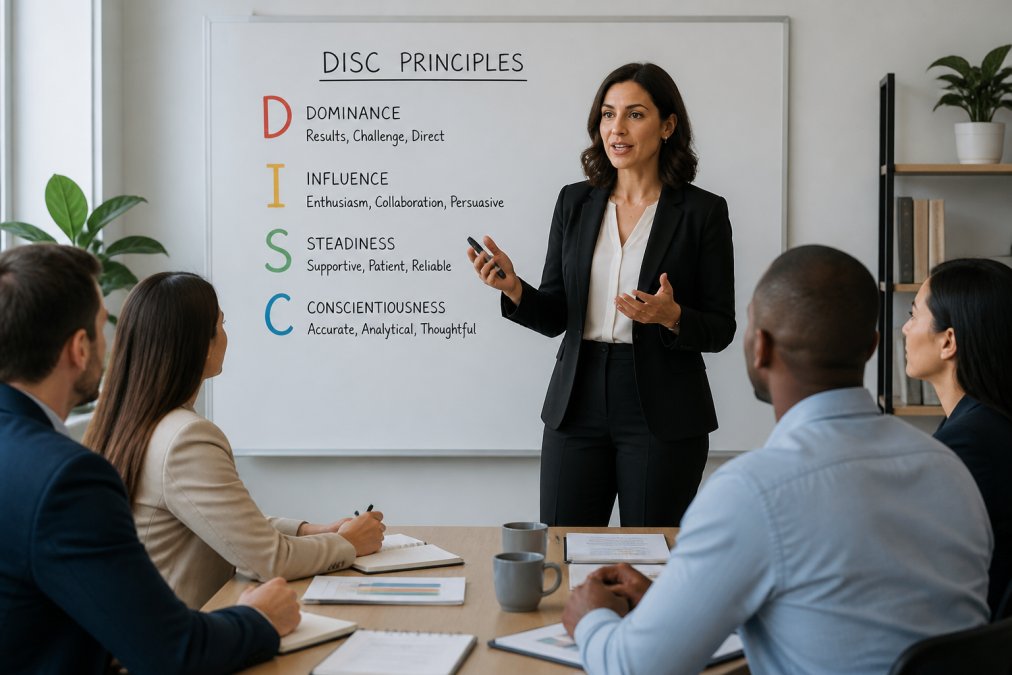
Process diagram visualizing facilitation techniques for effective team meetings across diverse DISC styles.
Start by knowing what each style is optimizing for. D styles want momentum and the bottom line. I styles want energy and connection. S styles want steadiness and a sense that the group is aligned. C styles want accuracy and enough information to trust the conclusion. When you facilitate to those needs, participation stops being a matter of who is loudest.
Style-by-style facilitation moves
- D styles: Open with the decision to be made and the time budget. Ask, “What’s your bottom line on this?” first, then invite others. D styles disengage when a meeting meanders, so give them a clear target and a defined window, and they will help drive the room toward a decision.
- I styles: Give them a story prompt, “Walk us through what you’re hearing from clients”, then redirect with “What should we do about it?” I styles generate energy and options; your job is to capture the ideas and steer toward a decision before the conversation circles.
- S styles: Send the question in writing 24 hours ahead so they arrive with a formed view. In the room, ask by name with a gentle, specific prompt: “Maria, you’ve seen this process up close, what would you want us to protect here?” S styles often hold the team’s practical wisdom; they just need a low-pressure opening.
- C styles: Ask for the data and the risks before opinions. “What does the evidence say, and what could go wrong?” C styles will surface the detail that saves the team from a hasty call, give them the floor before the group commits.
Scripts that keep the room balanced
Concrete language does more than good intentions. Keep a few phrases ready:
- To slow the fastest talker: “Let’s hold that thought for a second, I want to hear from someone who hasn’t weighed in yet.”
- To draw out a quiet voice: “I’d value your read on this. Take a moment if you need it.”
- To redirect an overlong point: “That’s helpful context, what’s the one thing you’d want us to decide?”
- To protect thinking time: “Let’s take thirty seconds of quiet to jot down reactions before we discuss.”
- To close a drifting thread: “We’ve got two minutes on this item, what’s the call?”
Balancing styles in the same conversation
The fastest talkers can set the pace, so the quieter styles benefit from deliberate structure. Counter it with structure: round-robin turns on high-stakes items, written input before open discussion, and a facilitator who tracks who has spoken. When a D and a C disagree, name the tension warmly, “It sounds like we have a speed question and a risk question”, and let each style answer the other’s concern. That single move turns style differences from friction into a fuller decision.
Active listening is the base layer under all of it. Reflect back what you hear, then invite the next voice. For a deeper set of tools, our guide on best practices for DISC workplace facilitation walks through session design step by step.
How to Engage Quiet Team Members in Meetings
To engage quiet team members in meetings, give them a low-pressure way in before the live discussion. Many quiet participants are not disengaged; they simply process before they speak.
Try these approaches:
- Share discussion prompts 24 hours ahead
- Open with a written check-in before open talk
- Use turn-taking so no one gets skipped or talked over
- Ask direct, gentle questions by name
- Protect thinking time after each question
S and C styles often need a moment to form a full answer. Giving them time helps them contribute fully.
Psychological safety is the real goal here. When quiet voices trust that their input will be heard and not judged, participation rises on its own. Our article on managing introvert employees with DiSC insights goes deeper on this.
Take The Official DiSC® Assessment Online Now! →
What Is the Right Effective Team Meeting Length?
The right length for an effective team meeting is the shortest time that gets the outcome done, and most working sessions fit inside 30 to 60 minutes. Short, focused meetings beat long ones every time.
Use these rules to protect the clock:
- Start and end on time, every time
- Cap each agenda item with a set time
- Cut any topic that has no owner or decision
- End early when the work is done
Time management is a courtesy. When you respect the clock, C styles trust the process and S styles feel secure. D styles appreciate the pace, and I styles stay engaged when the meeting keeps moving.
A quick check before you book: does this need a meeting at all? A short message often does the job. Save the room for real discussion.
Make Remote and Hybrid Meetings Work for Every Personality
Remote and hybrid meetings need extra structure because the room’s natural cues are gone. Plan for the personalities on the screen, not just the ones in the office.
What works in practice:
- Send the agenda and materials before the call
- Ask camera-shy members to contribute in chat
- Use round-robin check-ins so remote voices are not skipped
- Build in short pauses so people can unmute and think
- Assign a chat monitor to catch typed input
A common mistake is letting the in-room group dominate. Remote S and C styles fade fast when they cannot read the room. Give every participant the same footing, whether they are at the table or on the screen.
For a fuller playbook, read our guide on improving remote team communication with DiSC.
Close With Clear Action Items and Follow-Up
Every meeting should end with action items, owners, and dates written down before people leave. Follow-up turns a conversation into results, and measurement shows how each meeting can keep improving.
Close with these steps:
- Read each action item aloud
- Name one owner per item
- Set a due date for each
- Share meeting notes within a day
- Check progress at the next meeting
Assign action items in a style-aware way
Accountability is where diverse styles shine, if you match the task to the style. D styles drive items to done and thrive on ownership of outcomes. C styles track the details and produce the documentation the team relies on. S styles keep the team steady and follow through on commitments that affect people. I styles keep people connected to the why and are at their best rallying others around a shared goal.
Naming one person per item gives shared work a clear owner. Where a task plays to a style’s strength, say so, “This one needs your detail focus” lands better than a silent assignment.
A simple framework for measuring meeting outcomes
A lightweight review helps teams see whether their meetings are getting better. A lightweight review every four to six weeks changes that. Track four signals:
- Participation spread: Did every attendee contribute at least once? Note who spoke and who didn’t, without judgment, the pattern tells you where to focus your facilitation.
- Decision clarity: Could each attendee state what was decided and why? A quick one-line poll at the close reveals gaps while there is still time to fix them.
- Action-item completion: What share of items closed by their due date? This is the clearest sign that follow-up is real.
- Attendee feedback: Ask two questions, “Did this meeting help you do your work?” and “What would make the next one better?” Keep it short and anonymous so quieter styles answer honestly.
Review the results through a DISC lens. If C styles report low decision clarity, your close may be moving too fast. If S styles aren’t contributing, your openings may need more written preparation. If D styles say meetings drag, tighten the agenda and protect the clock.
For a fuller playbook on keeping diverse teams connected between sessions, read our guide on improving remote team communication with DiSC.
Bring DISC Insights to Your Next Team Meeting
The fastest way to improve how you conduct effective team meetings for diverse personalities is to know your team’s styles before the next session. DISC gives you a shared language for how each person thinks, decides, and speaks.
Start with the official Everything DiSC® assessments from Your Lifes Path. The DiSC Workplace Profile shows each team member’s style and practical tips for working with other styles, while DiSC for Teams gives you a shared framework for putting those insights to work in your meetings.
Then build the habit:
- Share each person’s style with the team
- Match agenda blocks and roles to the mix
- Review what worked after each meeting
Ready to bring DISC into your meetings? Our step-by-step guide on using DiSC for team collaboration shows you how. Managers who want to run DISC-based sessions can use our DISC facilitation guide for managers.
Frequently Asked Questions
How do you run an effective team meeting for diverse personalities?
Set a clear purpose and share the agenda 24 hours ahead, then design the discussion around how different people process information. D-style participants want the bottom line first, I-style participants thrive on open discussion, S-style participants need time to reflect, and C-style participants want the data. Build in a short written reflection before open discussion so every style has a path to contribute, and close with named action owners so the meeting produces outcomes, not just conversation.
How can DISC assessments improve team communication?
DISC assessments give team members shared language for describing how they work. When everyone knows their own style and their colleagues’ styles, meetings run smoother because people can adapt. A C-style team member learns to lead with the conclusion for a D-style colleague, and a D-style facilitator learns to pause for the S-style voices who need a moment before speaking. Your Life’s Path offers official Everything DiSC® assessments, including the DiSC Workplace Profile, that teams can use to build this shared understanding.
How can you encourage quieter team members to participate?
Try three techniques. First, send discussion prompts with the agenda so quieter members can prepare their thoughts in advance. Second, use round-robin turn-taking so everyone speaks once before open discussion begins. Third, offer a written or chat channel for input during and after the meeting. S-style and C-style participants often have valuable perspectives but need a different entry point than the I-style colleagues who speak up immediately. The goal is employee voice for everyone, not just the loudest voices in the room.
How long should an effective team meeting be?
Most working sessions land between 25 and 50 minutes, with 50 minutes as a practical ceiling for a standard team meeting. The right length depends on the agenda, not the calendar default. A decision-making meeting may need 30 focused minutes, while a planning session can justify 60. Try scheduling 25 or 50 minute blocks instead of 30 or 60, which leaves a buffer between meetings. Whatever length you choose, start and end on time and protect the time for the relevant discussion on the agenda.
The real challenge is not the agenda or the clock; it is knowing who is in the room and meeting them where they are. Your Lifes Path makes that easy with official Everything DiSC® assessments, certified partner support, and free EPIC sub-account setup for administering profiles across your team. Get started with Your Lifes Path and turn your next team meeting into one where every personality contributes.
