
Last Updated: November 3, 2026
Quick Summary
To build trust in remote work teams, match your communication to each teammate’s DISC style, set clear written expectations, and resolve conflict with style-aware empathy. Small, repeatable habits like fast acknowledgements and written trust contracts keep distributed teams reliable across time zones.
- Lead with the headline first, then add detail for C and S styles.
- Write down outcomes, not activity, so everyone knows what success looks like.
- Give every message a one-line reply within one business day.
- Move conflict off public threads into private one-to-one conversations.
- Follow up within 48 hours after a disagreement to rebuild trust.
Table of Contents
- Why Trust Is the Foundation of Every Remote Team
- Remote Team Communication Strategies That Foster Transparency
- Setting Clear Expectations and Shared Goals
- How a DiSC Assessment for Remote Managers Builds Self-Awareness
- Virtual Team Building Activities That Create Real Connection
- Building Psychological Safety in Remote Environments
- Asynchronous Trust-Building Across Time Zones
- Resolving Conflict in Virtual Settings with Empathy
- Start Building Trust with Your Remote Team Today
- Frequently Asked Questions
Why Trust Is the Foundation of Every Remote Team
Remote teams run on trust, and the numbers show how fragile it can be. According to Hubstaff’s analysis of remote team dynamics, 80% of remote team members have experienced workplace conflict, and 65% of those conflicts happen between fellow team members. When you can’t see a colleague’s effort in person, trust becomes the currency that keeps work moving, and every interaction is a chance to build trust.
At Your Lifes Path, we see trust as a behavior you can build, not a personality trait you either have or lack. That’s where DISC comes in. The four behavioral DiSC styles, Dominance, Influence, Steadiness, and Conscientiousness, explain why one teammate needs a fast answer while another needs time to think. When you understand those differences, you stop misreading them as bad intent.
Below, we’ll show you exactly how to build trust in remote work teams using DISC as your guide. Each strategy is practical, and each one works whether your team is fully remote or hybrid.
Remote Team Communication Strategies That Foster Transparency
Transparency starts with matching your message to the person receiving it. A D-style teammate wants the bottom line first. An S-style teammate wants context and reassurance. Send the same email to both and one feels rushed while the other feels overwhelmed.
Try these remote team communication strategies:
- Lead with the headline, then add detail for C and S styles
- Keep video conferencing short and purposeful
- Confirm understanding in writing after verbal decisions
- Share the “why” behind changes, not just the “what”
Setting Clear Expectations and Shared Goals
Ambiguity is the quiet trust killer in a distributed workforce. When people don’t know what success looks like, they fill the gap with worry. Clear expectations remove that worry.
Write down outcomes, not activity. “Respond to client tickets within one business day” beats “stay on top of tickets.” Then tie each goal to a person’s natural style. I-style teammates thrive on visible wins, while C-style teammates want measurable standards.
How a DiSC Assessment for Remote Managers Builds Self-Awareness
A DiSC assessment for remote managers is a behavioral tool that reveals how a leader’s natural style lands on a screen instead of in a room. That self-awareness is the starting point for every trust-building strategy.
Here’s what most guides miss: managers often assume their intent travels through a video call. It doesn’t. A blunt D-style message reads as cold in text. An I-style manager’s enthusiasm can feel scattered without structure. Seeing your own profile makes those blind spots visible.
At Your Lifes Path, our official Everything DiSC® Management profile gives managers a clear read on their style.
Virtual Team Building Activities That Create Real Connection
Connection doesn’t happen by accident on a remote team. It happens when you design it. The good news: virtual team building activities can build real cohesion when they’re built around how people actually behave.

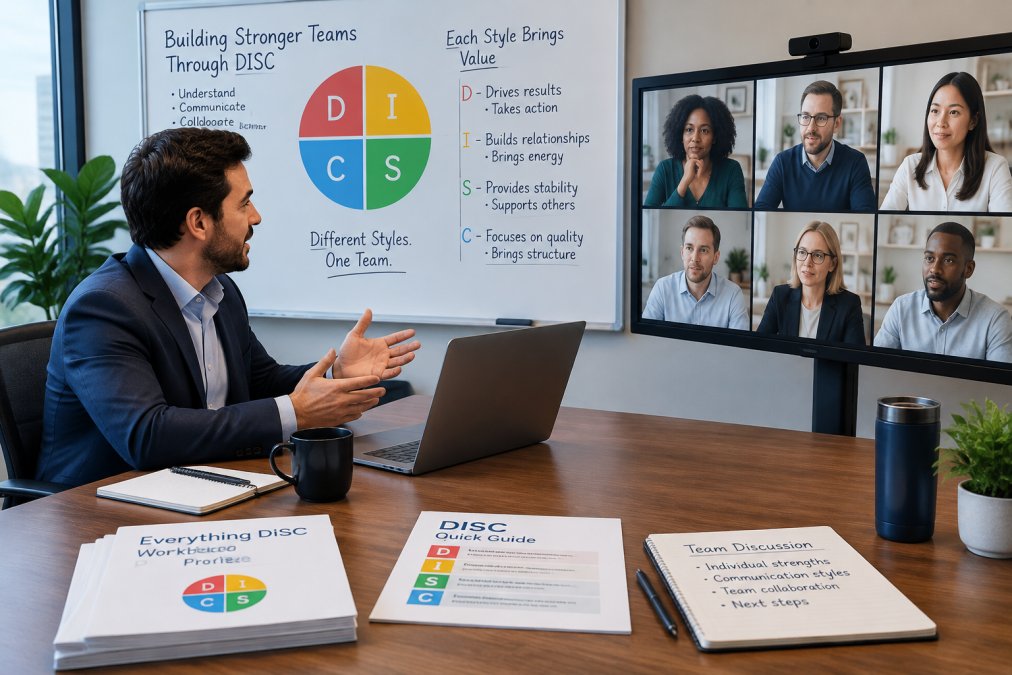
Remote team members on a video call using icebreakers to build trust
Try these DISC-based activities:
- Style swap: each person shares how they like to receive feedback
- Two truths and a preference: teammates guess each other’s DISC style
- Recognition round: praise a colleague in the way their style prefers
Regular, purposeful connection between remote colleagues helps build a sense of belonging and trust according to Gallup on How to Build Trust With Remote Employees. Our Virtual Teambuilding Workshops give distributed teams a facilitated way to put these activities into practice together.
Building Psychological Safety in Remote Environments
Psychological safety is the shared belief that you can speak up, ask questions, and admit a mistake without punishment. In remote settings, it’s harder to read, so leaders have to build it on purpose.
Start by rewarding honesty publicly. When a teammate flags a risk early, thank them in the team channel. Model fallibility yourself: “I got that wrong, here’s the fix.” Different styles show safety differently. S-style teammates need calm reassurance; D-style teammates need to know their candor is welcome, not risky.
Asynchronous Trust-Building Across Time Zones
Asynchronous work is where distributed teams either earn trust or quietly lose it. When a reply lands six hours later, silence can read as neglect, and each DISC style fills that silence differently. D-style teammates assume the worst and escalate. I-style teammates feel disconnected and disengage. S-style teammates worry they did something wrong. C-style teammates start documenting everything to protect themselves. The fix is not more meetings; it is a written rhythm that each style can trust.
Take The Official DiSC® Assessment Online Now! →
Build a written trust contract
A written trust contract is a short team document that states how work moves when no one is online at the same time. A short set of clauses can cover most async friction:
- Acknowledgement window. Every message gets a one-line reply within one business day, even if the full answer comes later. This single norm removes the “did they see it?” anxiety that hits S and C styles hardest.
- One ask per message. A message with three questions gets one answer. D and I styles especially tend to bundle asks; splitting them keeps C-style teammates from feeling ambushed.
- Decision log. Every decision gets a line in a shared doc with the date, the owner, and the reasoning. C-style teammates trust decisions they can trace; D-style teammates trust decisions that are already made.
- Escalation path. If a thread stalls past the acknowledgement window, the sender tags a named backup. This protects S-style teammates from feeling responsible for every silence.
Match the channel to the style
Async trust also depends on where the message lives. One approach is to let each teammate declare a preferred async channel in their profile, chat for quick D-style decisions, a shared doc for C-style analysis, a short recorded video for I-style context, and a threaded note for S-style reassurance. When teammates can predict where information will appear, they stop scanning every channel for fear of missing something.
Design for the handoff, not the meeting
The real test of async trust is the handoff, the moment work passes from one time zone to the next. A DISC-aware handoff note answers four questions in order: what was decided (D), who it affects (I), what still needs care (S), and what evidence supports it (C). Writing handoff notes this way lets each style see its own priority reflected first, which can reduce “I thought you were handling that” moments.
Watch out: async norms work best when leaders model them, since a single late-night “bumping this” can reset the whole team’s expectations.
Measure trust in async work
You can track async trust without surveillance. Count how often messages get an acknowledgement inside the window, how many decisions land in the log, and how often handoffs require a follow-up question. These are outcome signals, not activity monitors, and they respect the autonomy that remote professionals expect. Many organizations are shifting away from surveillance toward outcome-based management, and async trust metrics offer a practical way to make that shift real.
Resolving Conflict in Virtual Settings with Empathy
Conflict in virtual settings escalates faster because tone, timing, and body language all disappear. A terse message from a D-style teammate reads as an attack to an S-style recipient; a long analytical reply from a C-style teammate reads as stonewalling to an I-style one. Empathy is the reset button, and DISC gives you a repeatable way to press it.
A four-step DISC repair process
A structured sequence can help keep virtual conflict from spiraling. Try this order:
- Pause the channel. Move the conversation off the public thread and into a one-to-one call or a private doc. Public correction damages trust for S and C styles in particular, who feel exposed by visible conflict.
- Name the style, not the person. Open with something like, “I want to make sure I’m reading your intent right, you tend to move fast on decisions, and I tend to want the data first. Can we align on this one?” This frames the friction as a style difference rather than a character flaw.
- Reflect the need behind the message. D-style teammates need the fix and the timeline. I-style teammates need the relationship acknowledged before the problem is solved. S-style teammates need to feel heard without pressure to decide on the call. C-style teammates need the facts and a clear process for what happens next.
- Write the resolution down. End every conflict conversation with a short written summary of what was agreed, who owns what, and when it will be reviewed. C-style teammates trust written commitments; D-style teammates trust deadlines; S-style teammates trust that the issue is closed; I-style teammates trust that the relationship is intact.
Scripts that lower the temperature
A few phrases work across styles because they signal respect before they signal a position:
- “Help me understand what you were optimizing for.” (works well with D and C)
- “I hear that this landed badly, that wasn’t my intent.” (works well with I and S)
- “Here’s what I can commit to, and here’s what I need from you.” (works well with D)
- “Let’s put the facts on one page before we decide.” (works well with C)
Repair after the conflict
Trust is rebuilt in the days after a disagreement, not during it. One approach is a short follow-up message within 48 hours that references the resolution and asks a small, specific question about the work. This gives each style a low-stakes way to re-engage: D-style teammates get a decision to confirm, I-style teammates get a warm reconnection, S-style teammates get reassurance that the relationship is steady, and C-style teammates get a documented next step.
Watch out: resolving conflict only in group channels teaches the team that disagreement is a public performance, move the hard conversations private, then share the outcome with the team so trust scales.
When to bring in a manager
Escalate to a manager when the same style clash repeats three times on the same topic, when a teammate stops contributing in the shared channel, or when the disagreement has moved from the work to the person. A manager who understands DISC can mediate by translating each side’s need into the other’s language, which is faster and less costly than letting resentment compound across time zones.
Start Building Trust with Your Remote Team Today
Trust on a remote team isn’t luck. It’s a set of small, repeatable habits shaped around how each person is wired. The teams that get this right communicate with intention, set clear goals, and resolve friction with empathy. Those same habits of clear communication and shared responsibility can extend to securing remote teams, making careful digital practices part of the trust people build every day.
|
Challenge |
DISC Fix |
What Improves |
|---|---|---|
|
Mixed communication needs |
Match message to style |
Clarity and speed |
|
Vague goals |
Write outcomes, not activity |
Accountability |
|
Low psychological safety |
Reward honesty publicly |
Candor and engagement |
|
Time-zone silence |
Fast acknowledgments |
Reliability |
|
Virtual conflict |
Style-aware empathy |
Faster resolution |
Your Lifes Path gives you the tools to make this stick. Our official Everything DiSC® assessments come with certified partner support, free EPIC sub-account setup, and the Catalyst platform for flexible facilitation. You get clear profiles for management, sales, and leadership that turn insight into daily behavior.
Get started with Your Lifes Path and build a remote team that trusts, communicates, and performs.
Frequently Asked Questions
How do you build trust in a remote team without face-to-face interaction?
Building trust remotely starts with consistent, transparent communication and clear expectations. Use regular video check-ins, share updates asynchronously, and follow through on commitments. Understanding behavioral styles through a DiSC assessment helps managers tailor their approach to each team member, reducing miscommunication. Proactive trust-building strategies like these are essential for team cohesion.
What are the key components of trust in a virtual work environment?
The key components include transparency, accountability, psychological safety, and empathy. Remote team communication strategies that prioritize clarity and consistency build a foundation of trust. Shared goals and regular feedback loops also matter. A DiSC assessment for remote managers can reveal how different behavioral styles perceive trust, helping leaders adapt their style to foster stronger interpersonal relationships across the distributed workforce.
How can DiSC assessments help improve remote team communication?
DiSC assessments reveal individual behavioral styles (Dominance, Influence, Steadiness, Conscientiousness), helping remote teams understand how colleagues prefer to communicate and receive feedback. This insight reduces friction in virtual collaboration and supports psychological safety. Managers can use DiSC profiles to tailor their leadership style, set clear expectations, and design virtual team building activities that resonate with different personalities, ultimately strengthening trust and team cohesion.
What are the best practices for managers to build trust with remote employees?
Best practices include setting clear expectations, providing regular feedback, and being transparent about decisions. Focus on outcome-based performance rather than surveillance. Instead, focus on outcome-based performance metrics and intentional communication rhythms. A DiSC assessment for remote managers helps leaders understand their own style and adapt to team members’ needs, fostering authenticity and empathy in a remote work environment.
