
Table of Contents
- Understanding the Four DiSC Styles in Remote Settings
- Step 1: Assess Your Team’s DiSC Profiles
- DiSC Communication Styles for Remote Teams: Practical Approaches
- Step 2: Tailor Your Emails and Digital Messaging Using DiSC Profile Communication Examples
- Step 3: Adapt Your Feedback Approach for Each Style
- Step 4: Run DiSC Team Building Activities for Remote Workers
- Step 5: Establish Team Norms Based on Behavioral Insights
- Step 6: Improve Virtual Meeting Efficiency with DiSC Awareness
- Resolving Conflict and Building Trust Across DiSC Profiles
- Frequently Asked Questions
Last Updated: September 30, 2026
Understanding the Four DiSC Styles in Remote Settings
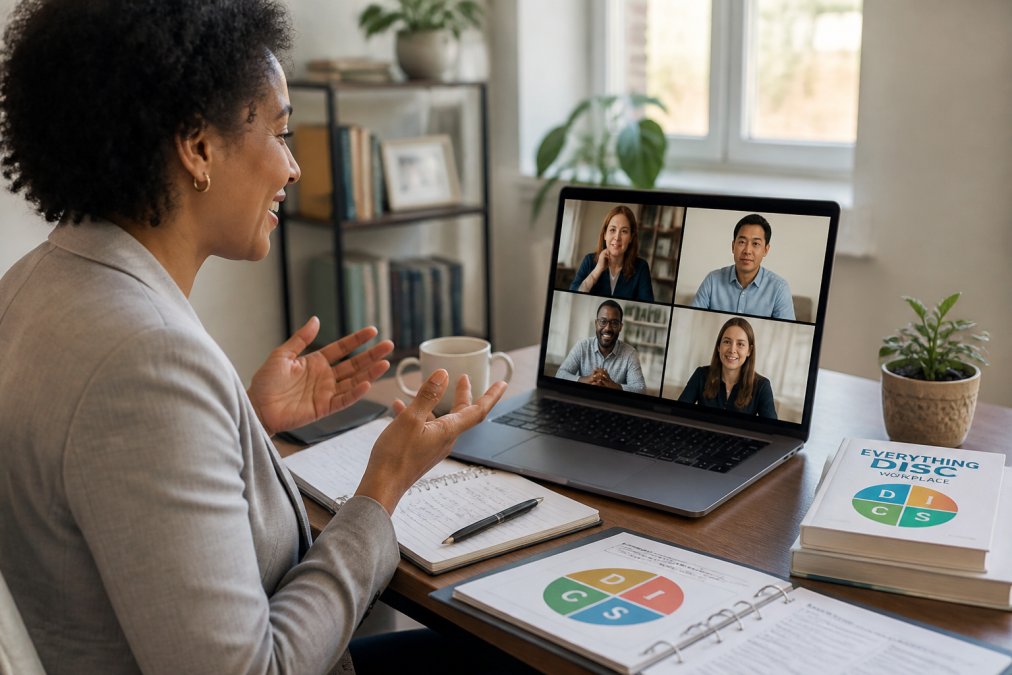
Learning how to use disc profiles for remote team communication starts with understanding how people naturally behave and interact. DiSC profiles identify four distinct behavioral styles: Dominance (D), Influence (I), Steadiness (S), and Conscientiousness (C). Each style has unique communication preferences, decision-making approaches, and work priorities. When you understand these differences, you can tailor your messages, feedback, and interactions to match how each person actually prefers to work.
Remote work amplifies the importance of this knowledge. Without in-person cues, misaligned communication becomes costly. Your Lifes Path helps teams map these differences using official Everything DiSC® assessments, giving everyone a shared language for how they work best.
Dominant personalities drive for results and efficiency. Influencers prioritize relationships and enthusiasm. Steadiness styles value stability and support. Conscientious types focus on accuracy and process. None is better than another, they’re simply different operating systems for getting work done.
Step 1: Assess Your Team’s DiSC Profiles
Start by having your team complete official DiSC assessments. You cannot tailor communication without knowing who you’re communicating with. The assessment takes 15-20 minutes per person and generates a personalized profile report.
Here’s how to execute this step:
- Select the right assessment format. Your Lifes Path offers multiple DiSC profile options designed for different contexts. The DiSC Workplace Profile works well for general team communication. If your team includes managers, the DiSC Management Profile provides leadership-specific insights. Sales teams benefit from the DiSC Sales Profile, which addresses selling styles and client interaction.
- Administer assessments to your entire team. Use Your Lifes Path’s digital administration tools to send assessments to all team members simultaneously.
- Collect and organize the results. Your Lifes Path’s EPIC (Electronic Profile Information Center) Sub Account system centralizes results, making it easy to reference profiles when planning communication strategies.
- Share profiles with the team. Create transparency by sharing results with willing participants to build understanding and reduce interpersonal friction.
DiSC Communication Styles for Remote Teams: Practical Approaches
Each behavioral style communicates differently in remote settings. Understanding these differences prevents misunderstandings and speeds up decision-making.
Communicating with Dominant (D) Styles
Dominant personalities value speed, efficiency, and results. In remote settings, they prefer direct messages, clear action items, and bottom-line answers.
When communicating with D styles:
- Lead with the bottom line. Start with the conclusion or recommendation, not the background. “We need to move the launch date up by two weeks” works better than a 10-paragraph explanation of why.
- Be concise in writing. Keep emails short. Use bullet points. Avoid rambling Slack threads. D styles scan quickly and move on.
- Provide autonomy. They want to know the goal and the deadline, then be left alone to achieve it. Micromanaging frustrates them.
- Respect their time. Schedule meetings only when necessary. Come prepared. End on time.
- Focus on outcomes. Frame discussions around results and impact, not process or feelings.
Engaging Influencing (I) Styles
Influencing personalities thrive on connection, enthusiasm, and collaboration. Remote work can isolate I styles if communication becomes purely transactional.
When communicating with I styles:
- Include relationship-building time. Start meetings with genuine conversation. Ask about their weekend or their perspective on a challenge. I styles need to feel connected to people, not just tasks.
- Use video when possible. I styles respond to visual cues and tone. A video call feels more personal than email or chat.
- Celebrate wins together. I styles are motivated by recognition and team energy. Share successes publicly and celebrate progress.
- Create opportunities for collaboration. I styles want to work with others. Pair them on projects, involve them in brainstorming, create team initiatives.
- Keep communication warm and personal. They notice tone. A friendly “Hey! How are you doing?” lands better than “Please submit your report.”
Supporting Steadiness (S) Styles
Steadiness personalities value stability, support, and predictability. Remote work can feel isolating to S styles without intentional connection.
When communicating with S styles:
- Provide advance notice of changes. S styles need time to process transitions. Don’t spring surprises. Warn them about shifts in process, schedule, or expectations.
- Show appreciation for their consistency. S styles are the reliable backbone of teams. Acknowledge their steady contributions and dependability.
- Offer support proactively. Ask how you can help. S styles don’t always speak up about struggles. Create space for them to share concerns.
- Maintain regular, predictable contact. One-on-ones work well for S styles. Regular check-ins (weekly or biweekly) help them feel supported.
- Be patient with decision-making. S styles need time to think things through. Don’t rush them. Their careful approach prevents mistakes.
Working with Conscientiousness (C) Styles
Conscientiousness personalities prioritize accuracy, quality, and process. They want to understand the “why” behind decisions and the standards they’re being held to.
When communicating with C styles:
- Provide detailed information upfront. C styles want context and specifics. Include background, data, and reasoning in your communication.
- Be accurate and precise. Avoid rough estimates or vague language. “Approximately sometime this week” frustrates C styles. “Tuesday by 3 PM” works.
- Explain the standards. C styles want to know exactly what success looks like. Provide clear criteria, guidelines, or rubrics.
- Allow time for questions. C styles ask detailed questions to ensure they understand. Don’t interpret this as pushback, it’s how they work.
- Put things in writing. C styles prefer documentation. Email summaries, written guidelines, and recorded decisions help them track what’s expected.
Step 2: Tailor Your Emails and Digital Messaging Using DiSC Profile Communication Examples
Understanding how to use disc profiles for remote team communication through email and chat, the lifeline of remote work, builds trust and speeds up outcomes. A well-crafted message aligned with the recipient’s DiSC style builds trust and speeds up outcomes.
Here’s how to adapt your digital messaging for each style:
For Dominant (D) styles:
Subject: Project deadline moved to Oct 15
Hi [Name],
New launch date: October 15. Your team owns the timeline. Let me know if you need resources.
[Your name]
This email delivers the key information immediately. No preamble. No explanation of why (unless they ask). Just the decision and what they need to do.
For Influencing (I) styles:
Subject: Let’s talk about the new project, excited to get your input!
Hi [Name],
Hope you’re having a great week! I wanted to touch base about the upcoming project. Your energy and ideas are always a game-changer for the team, and I’d love to get your thoughts on how we can make this one special.
Can we grab 15 minutes this week to brainstorm? I think this could be a really fun collaboration.
Looking forward to hearing from you!
[Your name]
This message emphasizes relationship, enthusiasm, and collaboration. It invites their input and makes them feel valued. It also suggests a real conversation rather than just email exchange.
For Steadiness (S) styles:
Subject: Update on your current project, here to support you
Hi [Name],
I wanted to check in on how the project is going. I know we made some changes last week, and I wanted to make sure you feel supported and have everything you need.
Your consistent work on this has been really valuable. If you have any concerns or need anything from me, please let me know. I’m here to help.
[Your name]
This message reassures them about stability, acknowledges their contribution, and offers support. It creates space for them to share concerns without pressure.
For Conscientiousness (C) styles:
Subject: Project specifications and timeline
Hi [Name],
Per our meeting, here are the project specifications:
- Deliverable: Final report
- Format: 12-page document with data appendix
- Deadline: October 15, 5 PM EST
- Standards: Follow the template in the shared folder (page 2 has the formatting guidelines)
- Questions: Please send any clarifications by October 8
I’ve attached the full specification document for your reference.
[Your name]
Take The Official DiSC® Assessment Online Now! →
This message provides all the details upfront. It’s specific about format, deadline, and standards. It invites questions and gives a clear process for asking them.
Step 3: Adapt Your Feedback Approach for Each Style
Feedback is where remote communication often breaks down. When you adapt your feedback style to match the recipient’s DiSC profile, feedback becomes constructive rather than defensive.
Feedback for Dominant (D) styles:
D styles want feedback fast and focused on results. They don’t need lengthy preambles or emotional softening. They want to know what didn’t work and how to fix it.
- Be direct. “This approach didn’t hit the deadline. Here’s what needs to change.”
- Focus on the outcome. “The result missed our target by 15%. Let’s adjust the strategy.”
- Offer solutions. “Here’s what I’d recommend trying instead.”
- Move forward quickly. Don’t dwell on what went wrong. Shift to what’s next.
D styles respect straightforward feedback. They see it as respect for their intelligence and time.
Feedback for Influencing (I) styles:
I styles need feedback delivered with warmth and relationship intact. They worry that critical feedback means you don’t like them. Balance the feedback with genuine appreciation.
- Start with appreciation. “I really value your energy and creativity on this project.”
- Frame feedback as partnership. “I’d love to work together on this. I noticed something we could improve.”
- Be specific but gentle. “The presentation was engaging, and I’d suggest tightening the middle section for clarity.”
- End on an encouraging note. “I know you can nail this with a small adjustment. Let’s work on it together.”
I styles respond well to feedback delivered in conversation rather than email. Schedule a brief call rather than sending a critical message in writing.
Feedback for Steadiness (S) styles:
S styles are sensitive to feedback and may worry they’ve let you down. They need reassurance that the relationship is intact and that you’re supporting them through improvement.
- Reassure first. “Your work on this project has been solid. I want to help you strengthen one area.”
- Explain the “why.” “This change will help us avoid delays and keep the team on track.”
- Offer support. “Here’s how I can help you with this. What support do you need?”
- Give them time. “Take a few days to think about this. Let’s talk again on Thursday.”
S styles appreciate one-on-one feedback rather than group settings. They also appreciate follow-up check-ins to see how they’re doing with the feedback.
Feedback for Conscientiousness (C) styles:
C styles want feedback based on data and standards. They want to understand exactly what the standard was, how they missed it, and what the correct approach looks like.
- Use specific data. “Your analysis was 87% accurate. The standard is 98%. Here’s where the gaps are.”
- Reference standards. “According to our quality guidelines, this needs three rounds of review. We did one.”
- Provide examples. “Here’s what a stronger version would look like. Notice how this section includes the supporting data.”
- Ask for their input. “What do you think happened here? How would you approach it differently?”
C styles appreciate detailed feedback in writing. They want time to review it and think through the response. Follow up with a discussion, but give them the written feedback first.
Step 4: Run DiSC Team Building Activities for Remote Workers
Team building in remote settings requires intention. Activities that work in person often fall flat on video. DiSC-based team building activities create engagement because they’re grounded in behavioral understanding.
According to research on remote team dynamics, teams that use behavioral data to practice communication and negotiation skills show measurable improvement in how they adapt to different working styles. The ‘Ace of Trades’ game, for example, has participants practice these skills based on their own and their counterparts’ DISC personality profiles.
Here are practical activities your team can run:
Activity 1: Style-Specific Breakout Rooms
Divide your team into breakout rooms by DiSC style. Each group solves a scenario, such as “How would you handle a tight deadline with limited resources?” Have each group present their approach. This shows how different styles solve the same problem and builds appreciation for different perspectives.
Activity 2: Cross-Style Pairing Challenges
Pair people with different DiSC styles (for example, a D with an S, or an I with a C). Give them a task that requires both their strengths. The pairing forces them to adapt to each other’s style and builds flexibility and mutual respect.
Activity 3: Communication Simulation
Create scenarios where team members practice adapting their communication and role-play responses. This builds real skills they can use in their actual work.
Activity 4: Profile Sharing Circle
Have team members share their profiles voluntarily, discussing their style, what they value, and what frustrates them. This humanizes the profiles, builds empathy, and creates psychological safety.
The biggest mistake teams make is treating team building as a one-time event. Run these activities quarterly or biannually. Consistency is what builds team cohesion. One activity creates awareness. Repeated activities create culture change.
Step 5: Establish Team Norms Based on Behavioral Insights
High-performing remote teams create explicit norms around how they communicate, make decisions, and handle conflict. These norms should be grounded in DiSC insights. According to research on remote team best practices, teams that document how decisions are made and how conflict is resolved based on behavioral data show stronger performance than teams without these norms.
Here’s how to establish norms:
- Identify key decision points. What decisions does your team make regularly? Hiring, project prioritization, budget allocation, timeline changes? For each decision type, identify which DiSC styles need to be heard.
- Create decision protocols. For example:
- D styles need the decision made quickly. Set a deadline.
- I styles need input opportunities. Include a brainstorm session.
- S styles need advance notice. Communicate changes early.
- C styles need data. Provide analysis and justification.
- Document conflict resolution. What happens when team members disagree? Create a process. For example:
- First, each person explains their perspective (addresses I and S needs for being heard).
- Then, review the data and standards (addresses C needs).
- Finally, make a decision focused on outcomes (addresses D needs).
- Communicate norms clearly. Write them down. Share them in your team handbook or onboarding materials. Reference them when issues come up.
- Revisit norms periodically. As your team evolves, norms may need adjustment. Revisit them annually or when new team members join.
Step 6: Improve Virtual Meeting Efficiency with DiSC Awareness
Virtual meetings are where remote teams waste the most time. DiSC awareness transforms meetings by accounting for different styles.
Here’s how to run meetings that work for all styles:
Before the meeting:
- Send an agenda in advance. This helps C styles prepare, I styles know what to expect, and S styles appreciate clarity.
- Specify the time limit. D styles respect boundaries and stay engaged.
- Clarify the decision point. If a decision will be made, say so.
During the meeting:
- Start on time. D and C styles are frustrated by delays.
- Invite input from all styles. Ask quieter people directly to ensure C and S styles contribute.
- Keep the discussion focused. Gently redirect I styles who go off-topic.
- Acknowledge different viewpoints. This validates S and I styles who worry about conflict.
- Move to a decision. Set a decision point and move forward.
After the meeting:
- Send a summary. Document decisions, action items, and deadlines for C and S styles.
- Confirm action items with owners. Be specific about who owns what and by when.
- Follow up with quieter participants. Check in with S and C styles individually.
Resolving Conflict and Building Trust Across DiSC Profiles
Remote settings can amplify conflict because communication lacks nuance.
When conflict arises:
Understand the root cause. Often, conflict stems from different work styles colliding. Recognizing this prevents defensiveness.
Learn more about DiSC team communication strategies
Frequently Asked Questions
How do DiSC profiles improve communication in virtual environments?
DiSC profiles reveal how each team member prefers to communicate, receive feedback, and make decisions in remote settings. When managers understand these behavioral preferences, they can adapt their approach to email tone, meeting style, and feedback delivery. For example, a Dominant (D) style prefers direct, results-focused communication via quick messages, while a Conscientiousness (C) style appreciates detailed documentation and data-backed explanations. This alignment reduces miscommunication and builds stronger working relationships across distributed teams.
What are the four DiSC personality styles in a remote workplace?
The four DiSC styles are Dominant (D), Influencing (I), Steadiness (S), and Conscientiousness (C). D styles are direct and results-driven. I styles are enthusiastic and relationship-focused. S styles are collaborative and supportive. C styles are detail-oriented and analytical. In remote work, each style faces unique challenges: Ds may come across as abrupt in writing, Is may struggle with asynchronous communication, Ss may hesitate to speak up in group calls, and Cs may get lost in endless email threads. Understanding these patterns helps teams adapt and thrive.
How can managers use DiSC to support remote employees effectively?
Managers can use DiSC insights to personalize their leadership approach. Schedule one-on-ones in the format each style prefers: quick calls for Ds, collaborative brainstorms for Is, consistent check-ins for Ss, and detailed written updates for Cs. Adapt delegation by matching task complexity and autonomy to each style’s strengths. Provide feedback in their preferred medium and timeframe. Track progress using methods they trust. When you align your management style to each person’s DiSC profile, remote employees feel understood and supported, which boosts engagement and performance.
Why is self-awareness important for remote team communication?
Self-awareness through DiSC assessment helps you recognize your own communication blind spots and how you might be perceived by other styles. A manager with a Dominant style may not realize their direct emails feel harsh to a Steadiness style. An Influencing style may dominate meetings without noticing quieter Conscientiousness team members. When you understand your own profile first, you can intentionally adjust your approach, listen more actively, and create psychological safety. This models adaptability and encourages your team to do the same, transforming remote communication from transactional to genuinely collaborative.