

Table of Contents
- DISC Assessment Platform Comparison for HR Directors: Feature Overview
- Top DISC Assessment Platforms: Side-by-Side Comparison
- Best DISC Assessment Tools for Business: Selection Criteria
- How to Implement DISC Training in the Workplace
- DISC Assessment Use Cases for Team Building
- DISC Assessment Pricing Comparison: Cost-Per-Assessment vs. Enterprise Models
- How to Choose the Right Platform: Decision Framework for HR Directors
- Conclusion: Selecting Your DISC Assessment Platform
Last Updated: June 25, 2026
Choosing the wrong behavioral assessment platform costs HR teams credibility, candidate trust, and months of wasted implementation effort. This DISC assessment platform comparison for HR directors evaluates the five platforms that matter for enterprise teams in 2026. The real decision comes down to three factors: psychometric validity documentation, HRIS integration depth, and total cost of ownership at volume. The platform that looks cheapest per assessment often becomes the most expensive when you factor in facilitation overhead and compliance exposure.
DISC Assessment Platform Comparison for HR Directors: Feature Overview
A DISC assessment platform administers the DISC behavioral model, generates personality profiles, and delivers development resources doe workplace application. The best platforms connect assessment data to coaching workflows, team comparison reports, and learning management systems.
The D-I-S-C model categorizes workplace behavior across four dimensions: Dominance, Influence, Steadiness, and Conscientiousness. Each dimension describes how a person responds to challenges, influences others, responds to pace, and approaches rules and procedures.
What Makes a Platform Right for Enterprise HR Teams
Enterprise HR teams require:
- Psychometric validity: Published reliability and validity studies
- HRIS/ATS integration: Native connectors or open APIs that eliminate manual data entry
- Facilitation infrastructure: Certified facilitator support and group report capabilities
- Compliance documentation: EEOC-aligned usage guidelines and bias mitigation features
- Scalable pricing: Volume licensing that doesn’t penalize growth
|
Platform |
Best For |
Pricing Model |
HRIS Integration |
White-Label |
|---|---|---|---|---|
|
Your Lifes Path |
Small Business and Enterprise L&D programs |
$90/report |
Catalyst platform |
No |
|
Everything DiSC (Wiley) |
Everything DiSC (Only sold through their Authorized Partners) |
$90/report |
Catalyst platform |
No |
|
PeopleKeys |
HR tech stack integration |
Subscription/volume |
Strong native integrations |
Limited |
|
Assessments 24×7 |
Branded HR consulting |
From $99/month |
Manual setup required |
Full |
|
Crystal |
Sales teams and recruiters |
From $49/month |
Salesforce, HubSpot, Gmail |
No |
Top DISC Assessment Platforms: Side-by-Side Comparison
Your Lifes Path: Official Everything DiSC® With Certified Support
Your Lifes Path is the top choice for HR directors needing official Everything DiSC® assessments backed by certified partner support. It provides Free EPIC Sub-Accounts, giving HR teams their own administrative environment to manage assessments, track completions, and distribute reports at scale. This eliminates onboarding friction and puts assessment management directly in your hands.
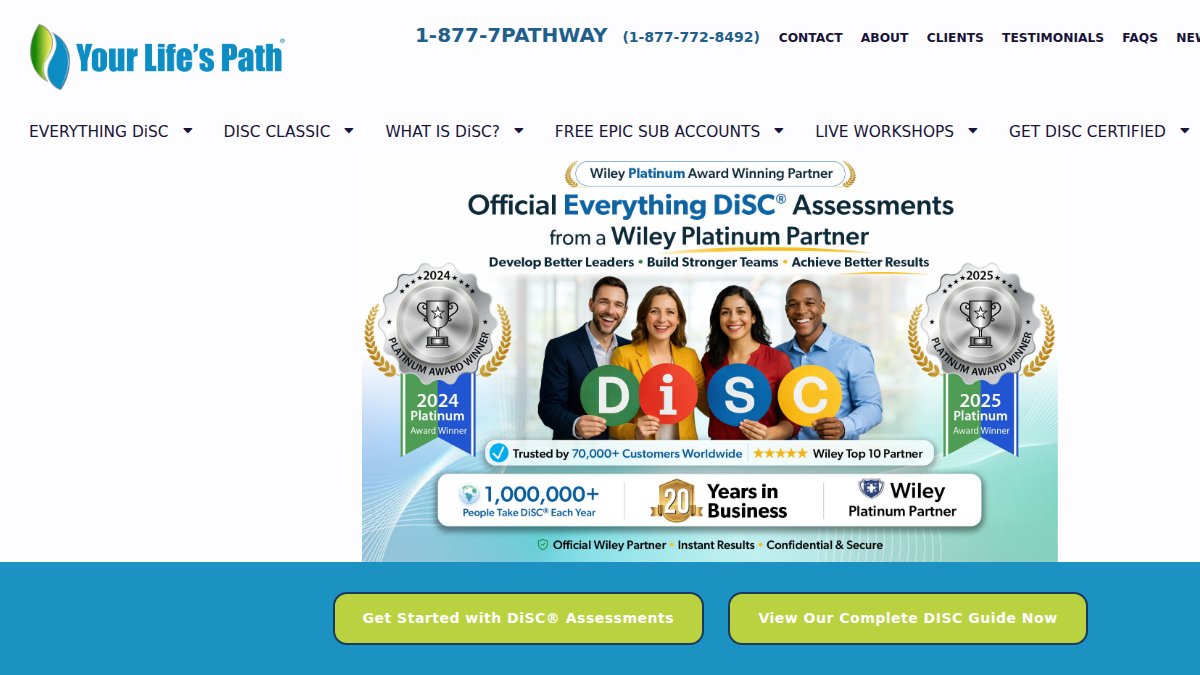
The Catalyst platform transforms static reports into ongoing development tools. Employees can compare profiles with colleagues, access personalized content, and revisit results as team dynamics evolve.
Pros:
- Official Everything DiSC® assessments with full psychometric validity documentation
- Certified partner support for facilitation guidance
- Free EPIC Sub-Account setup for enterprise account management
- Catalyst platform for ongoing team facilitation
- Specialized profiles for Management, Sales, and Leadership roles
Cons:
- No white-label option for external consultants
Everything DiSC by Wiley: Enterprise-Grade Research Validation
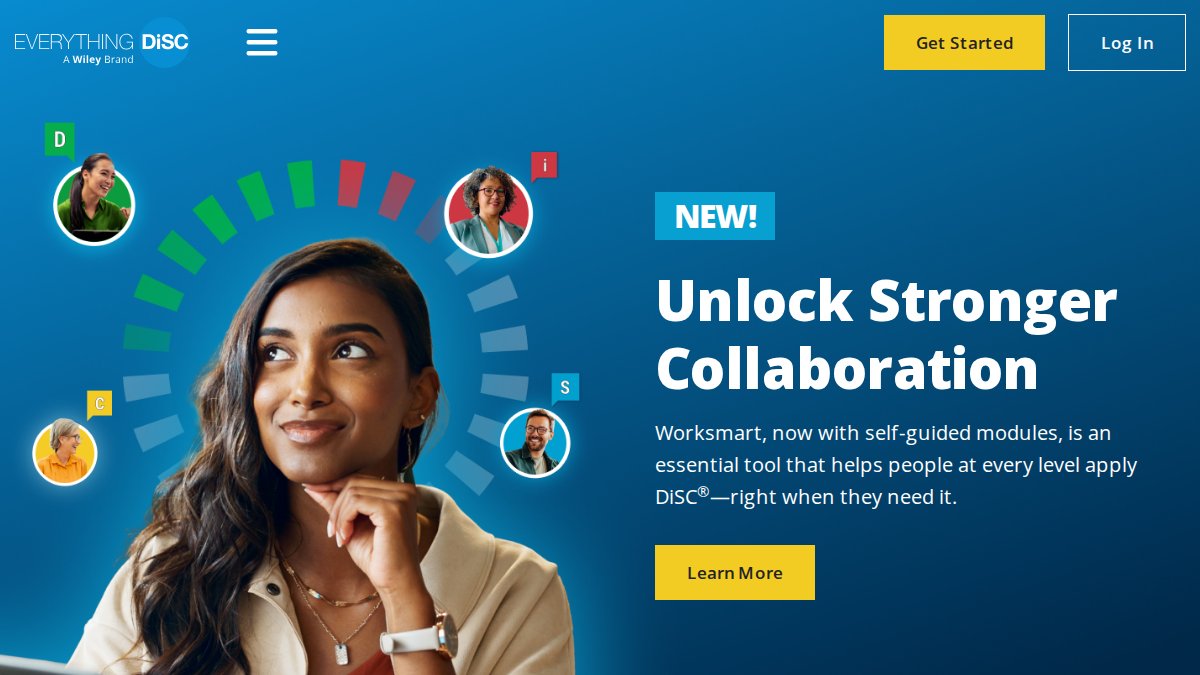
Wiley publishes full technical manuals, validity studies, and reliability coefficients, exactly what HR legal teams need when hiring decisions get challenged. Pricing runs $73.50 to $90.00 per report, positioning it at the premium end. At enterprise volume, this model becomes expensive without a negotiated licensing agreement.
Pros:
- Gold-standard psychometric validity with published technical documentation
- Extensive facilitator resource library and certification programs
- Catalyst platform for interactive team development
Cons:
- Higher per-report cost compared to volume-licensing alternatives
- Direct procurement can be slower than working through a certified partner
PeopleKeys: HRIS Integration and Workflow Automation
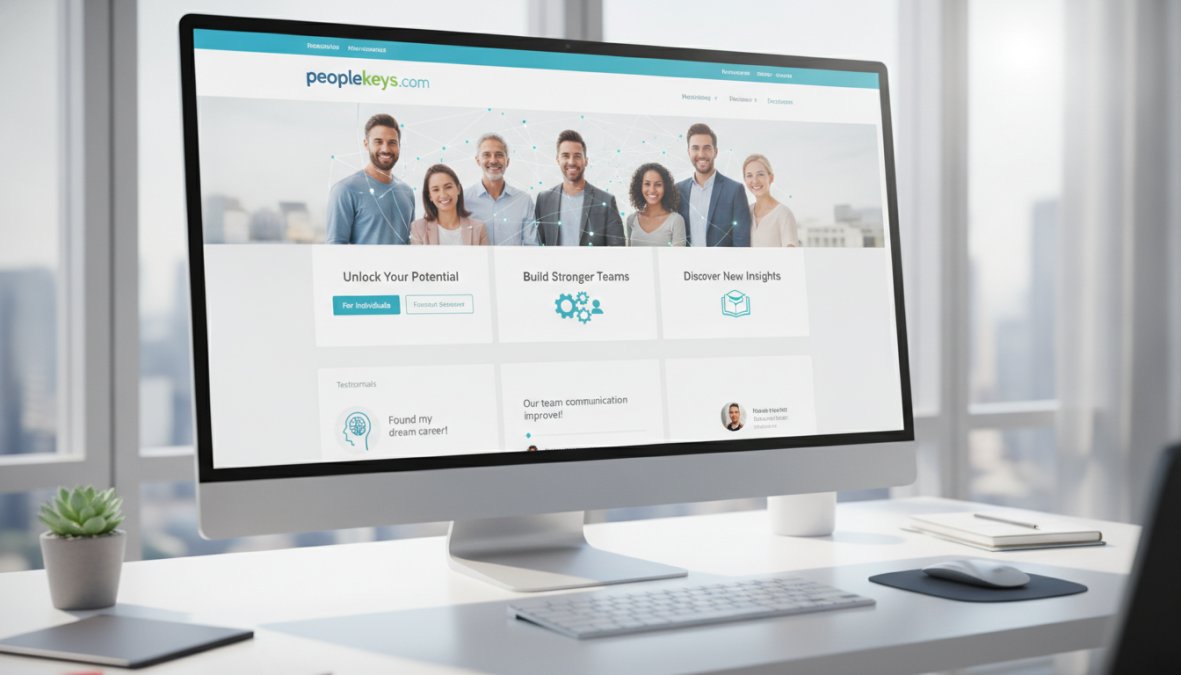
PeopleKeys solves a problem most DISC platforms ignore: connecting assessment data to existing HR software. It offers integration capabilities with HRIS and ATS platforms, multi-language support for global teams, and an industry-specific report library covering hiring, leadership, and team dynamics.
Pros:
- Strong HRIS and ATS integration capabilities
- Industry-specific report library for targeted applications
- Multi-language support for global workforce programs
Cons:
- Pricing opacity creates friction for initial budget evaluation
- Less brand recognition than Everything DiSC
Assessments 24×7: White-Label Customization at Scale
Assessments 24×7 serves HR consultants and internal teams needing fully branded assessment experiences. Starting at $99/month with volume-based discounts, the subscription model rewards high-frequency users. A team running 200+ assessments annually will find favorable unit economics compared to per-report pricing.
Pros:
- Full white-labeling for corporate branding
- Scalable subscription pricing with volume discounts
- Comprehensive reporting suite
Cons:
- Initial branding setup is more complex than plug-and-play alternatives
- Lower brand recognition may require more stakeholder education
Crystal: Real-Time Communication Coaching for Sales Teams
Crystal uses AI to provide real-time communication coaching during active workflows. The LinkedIn Chrome extension delivers personality insights while recruiters browse candidate profiles. Starting at $49/month with a free tier, it integrates with Salesforce, HubSpot, and Gmail.
Pros:
- Seamless integration into daily sales and recruiting workflows
- Immediate, actionable communication advice
- Lowest entry price point with a functional free tier
Cons:
- Prediction accuracy degrades with limited online data
- Not a substitute for validated psychometric testing in formal hiring
Best DISC Assessment Tools for Business: Selection Criteria
The best DISC assessment tools align psychometric rigor with operational requirements. A tool can be scientifically sound but operationally impractical, or highly integrated but psychometrically weak.
Psychometric Validity and Reliability Standards
Validity and reliability determine whether an assessment measures what it claims and does so consistently. According to Society for Industrial and Organizational Psychology guidelines on assessment standards, employment assessments should demonstrate construct validity, criterion-related validity, and internal consistency reliability before being used in hiring decisions.
Ask every vendor for their technical manual before purchasing. If they cannot provide one, treat that as disqualifying for any formal talent acquisition application.
EEOC Compliance and Bias Mitigation Features
The EEOC Uniform Guidelines on Employee Selection Procedures require that any assessment used in hiring demonstrate validity for the specific job and show no adverse impact on protected groups. Platforms providing adverse impact analysis, documented validity studies, and usage guidelines give legal teams necessary documentation.
HRIS and ATS Integration Capabilities
Manual data transfer between assessment platforms and HR systems creates errors, delays, and compliance gaps. The strongest integration architectures use native API connectors that push assessment completion data and profile scores directly into employee records.
PeopleKeys leads on this dimension. Crystal integrates tightly with sales-oriented CRM platforms. Everything DiSC through Your Lifes Path connects via the Catalyst platform. Map your current tech stack before evaluating platforms.
How to Implement DISC Training in the Workplace
Knowing how to implement DISC training effectively is the difference between a one-time assessment event and a sustained behavioral development program.
Phase 1: Assessment Administration and Profile Generation
Administration setup typically takes one to two weeks for 50 or fewer employees. Configure your EPIC Sub-Account or platform dashboard, import employee lists, and send assessment invitations with clear context about purpose and confidentiality. Employees complete assessments in 15 to 20 minutes. Framing matters more than the assessment itself: employees who understand DISC is a development tool, not an evaluation instrument, complete assessments with higher engagement.
Phase 2: Facilitation and Behavioral Coaching
Static reports without facilitation generate minimal behavior change. Effective DISC training requires a structured debrief session where employees explore profiles, discuss behavioral tendencies with teams, and identify specific communication adjustments. Certified facilitators guide these sessions using facilitation kits with discussion guides, activities, and team mapping exercises.
Phase 3: Ongoing Development and Team Dynamics
The Catalyst platform converts DISC assessments from point-in-time events into ongoing development resources. Employees access profiles, compare styles with colleagues, and receive personalized communication tips as team composition changes. Quarterly team reviews using group comparison reports keep DISC data relevant through organizational changes.
DISC Assessment Use Cases for Team Building
Conflict Resolution and Communication Improvement
DISC profiles give managers a neutral framework for understanding behavioral mismatches. A high-D leader and a high-S team member experience friction because one prioritizes speed and directness, the other prioritizes stability and process. Naming that difference removes personal charge from workplace conflict.
Leadership Development and Succession Planning
Leadership development programs incorporating DISC data produce more targeted coaching than generic competency frameworks. A high-C leader struggling with ambiguous decisions needs different development support than a high-I leader struggling with analytical rigor.
Hiring Accuracy and Candidate Screening
Using DISC in hiring improves accuracy by adding behavioral context to skills-based evaluation. Build job benchmarks, profiles of behavioral tendencies associated with high performance in specific roles, and compare candidates against those benchmarks rather than each other. This reduces interviewer bias and provides defensible selection rationale.
DISC Assessment Pricing Comparison: Cost-Per-Assessment vs. Enterprise Models
The total cost of ownership across administration, facilitation, and ongoing development matters more than sticker price per report.
Per-Assessment Pricing and Volume Discounts
Everything DiSC through Wiley or Your Lifes Path runs $73.50 to $90.00 per report at standard pricing. Volume discounts apply at higher quantities. For organizations running fewer than 100 assessments annually, per-assessment pricing is typically most cost-effective.
Subscription Models and Licensing Tiers
Assessments 24×7 starts at $99/month with volume-based discounts. Crystal starts at $49/month with a free tier. PeopleKeys uses subscription or volume models with pricing available on request. Subscription models favor organizations with consistent, ongoing assessment volume above roughly 10 to 15 assessments per month.
Long-Term ROI and Post-Hire Longitudinal Value
ROI extends well beyond cost per report. Organizations using DISC data across onboarding, team development, and conflict resolution reduce expensive interventions: executive coaching, HR mediation, and voluntary turnover. According to SHRM research on employee turnover costs, replacing an employee costs between one-half and two times their annual salary. A DISC program preventing even one mid-level turnover annually typically covers its full annual cost.
Platforms delivering strongest ROI have ongoing development infrastructure, specifically the Catalyst platform and facilitated team sessions, rather than those delivering a report and stopping.
How to Choose the Right Platform: Decision Framework for HR Directors
Selecting the right DISC assessment platform requires structured evaluation, not vendor demos and gut feelings.

Assessing Your Organization’s Size and Budget
Organizations under 200 employees with limited HR tech infrastructure should prioritize ease of administration and facilitation support. Your Lifes Path’s free EPIC Sub-Account setup and certified partner support make it practical for this segment.
Organizations above 500 employees with established HRIS and ATS should prioritize integration capabilities and volume pricing. PeopleKeys’ integration depth and Everything DiSC’s enterprise licensing become more relevant at this scale.
Decision checklist:
- Annual assessment volume (under 50 / 50-200 / 200+)
- Internal facilitation capacity (none / partial / full)
- HRIS/ATS integration requirements (none / preferred / required)
- Compliance documentation requirements (development only / hiring use)
- White-label or branding requirements (yes / no)
Evaluating Integration Needs and Tech Stack Fit
Document your current HRIS, ATS, and LMS platforms before requesting demos. Ask each vendor for specific integration documentation, not general API claims. Request a sandbox demonstration of data flow between the assessment platform and your HRIS. Integration promises that cannot be demonstrated in a sandbox often fail in production.
Prioritizing Support, Training, and Certification
The quality of support determines whether DISC programs sustain momentum beyond initial rollout. Platforms offering certification programs, facilitation kits, and ongoing partner support produce better long-term outcomes than self-service-only models.
For HR directors building internal DISC competency, DiSC Certification programs create in-house facilitators who can run sessions, coach managers, and maintain program quality without ongoing vendor dependency. According to Harvard Business Review analysis of leadership development program effectiveness, development programs with ongoing coaching produce significantly stronger behavior change than one-time training events.
Conclusion: Selecting Your DISC Assessment Platform
The DISC assessment platform comparison for HR directors ultimately comes down to one question: are you buying a report, or building a program? Most platforms sell reports. The ones worth investing in build programs.
For HR directors needing official assessments, certified support, and a platform designed for ongoing team development, Your Lifes Path delivers the full Everything DiSC® ecosystem, including Free EPIC Sub-Accounts for management, the Catalyst platform for continuous learning, and access to DiSC Certification for internal facilitators. The combination of psychometric credibility and operational infrastructure makes it the strongest choice for organizations serious about behavioral development as a long-term HR strategy.
Take the Official DiSC® Assessment Online Now and see how Your Lifes Path supports your team from first assessment through sustained culture change.
Frequently Asked Questions
What should HR directors look for in a DISC assessment platform?
HR directors should prioritize platforms offering psychometric validity, EEOC compliance, HRIS/ATS integration, and certified partner support. Consider whether the platform provides specialized profiles for your use cases—management, sales, or leadership development. Evaluate ongoing facilitation support, training resources, and the ability to generate group comparison reports for team dynamics analysis. Cost-per-assessment versus enterprise licensing models should align with your organization's scale and frequency of use.
How do DISC assessment pricing models differ between platforms?
DISC assessment pricing comparison reveals two main models: per-assessment pricing (typically $73–$90 per report) and subscription-based plans ($99–$500+ monthly). Per-assessment works well for occasional hiring or small teams, while subscriptions suit organizations conducting frequent assessments. Volume discounts and white-label customization may apply. Enterprise licensing often includes HRIS integration, certified partner support, and advanced reporting—factors that influence long-term ROI and post-hire employee development value.
Can DISC assessment platforms integrate with my existing HRIS or ATS?
Many platforms support HRIS and ATS integration, though depth varies. PeopleKeys specializes in HR software integration and workflow automation. Your Lifes Path offers EPIC Sub-Account access for flexible data management. Before selecting a platform, confirm it supports your specific HRIS or ATS system—Salesforce, HubSpot, and similar tools are commonly integrated. Integration capability directly impacts hiring accuracy, onboarding efficiency, and the ability to track behavioral data longitudinally for employee development.
How can DISC assessments reduce employee turnover and improve team dynamics?
DISC assessment use cases for team building include conflict resolution by clarifying communication styles, improving interpersonal skills, and identifying work style friction points. When teams understand the D-I-S-C model—dominance, influence, steadiness, and conscientiousness—they adapt their communication approach. Group comparison reports visualize team dynamics and reveal where coaching is needed. Organizations using DISC for onboarding and ongoing employee development report stronger retention, better collaboration, and reduced turnover by aligning roles with behavioral strengths.
This article was written using GrandRanker