Table of Contents
- Why Team Building Workshops Fail: The Root Causes
- Understanding DISC Behavioral Styles in Workshop Design
- Designing a Team Building Workshop Agenda Template That Works
- Selecting Team Building Activities for Work That Resonate
- Measuring Team Building ROI and Long-Term Impact
- How Why Team Building Workshops Fail Can Be Reversed
- Integrating DISC Assessments for Sustainable Success
- Conclusion
How to Run Team Building Workshops That Actually Succeed
Last Updated: July 6, 2026
Team building workshops often fail because they ignore behavioral differences and lack follow-through. At Your Lifes Path, we’ve identified what separates transformative workshops from forgotten events: intentional design rooted in how people actually behave. The difference isn’t bigger budgets or flashier activities, it’s understanding behavioral styles and building accountability systems that extend beyond the event itself.
Why Team Building Workshops Fail: The Root Causes
The most common reason workshops underperform is they ignore fundamental behavioral differences in the room. Without understanding how Dominance, Influence, Steadiness, and Conscientiousness styles respond differently to group settings, facilitators default to one-size-fits-all exercises that energize some participants while alienating others.
Lack of Clear Behavioral Alignment
When workshop designers skip behavioral assessment, they’re guessing at what will resonate. A high-D personality craves competition and clear outcomes. An I style thrives on social connection and spontaneity. An S style values stability and collaborative harmony. A C style wants structure, accuracy, and meaningful data. One icebreaker cannot serve all four effectively.
Conduct a brief DISC assessment of your team before the workshop, or gather behavioral insights through a simple survey about working preferences. This data becomes your design blueprint. When you know your team composition, you can structure activities that create genuine connection rather than forced participation.
Missing Follow-Through and Accountability
The second major failure point happens after the workshop ends. Teams return to their desks, momentum dissipates, and old patterns resume within days because workshops rarely include structured post-event action plans with clear accountability.
Effective workshops embed accountability into their design. Before participants leave, they commit to specific behavioral changes tied to real work scenarios. A D-style leader might commit to asking for input before deciding. An I-style team member might commit to documenting decisions in writing. These commitments become part of team rituals, reviewed in weekly standups or monthly one-on-ones.
Understanding DISC Behavioral Styles in Workshop Design

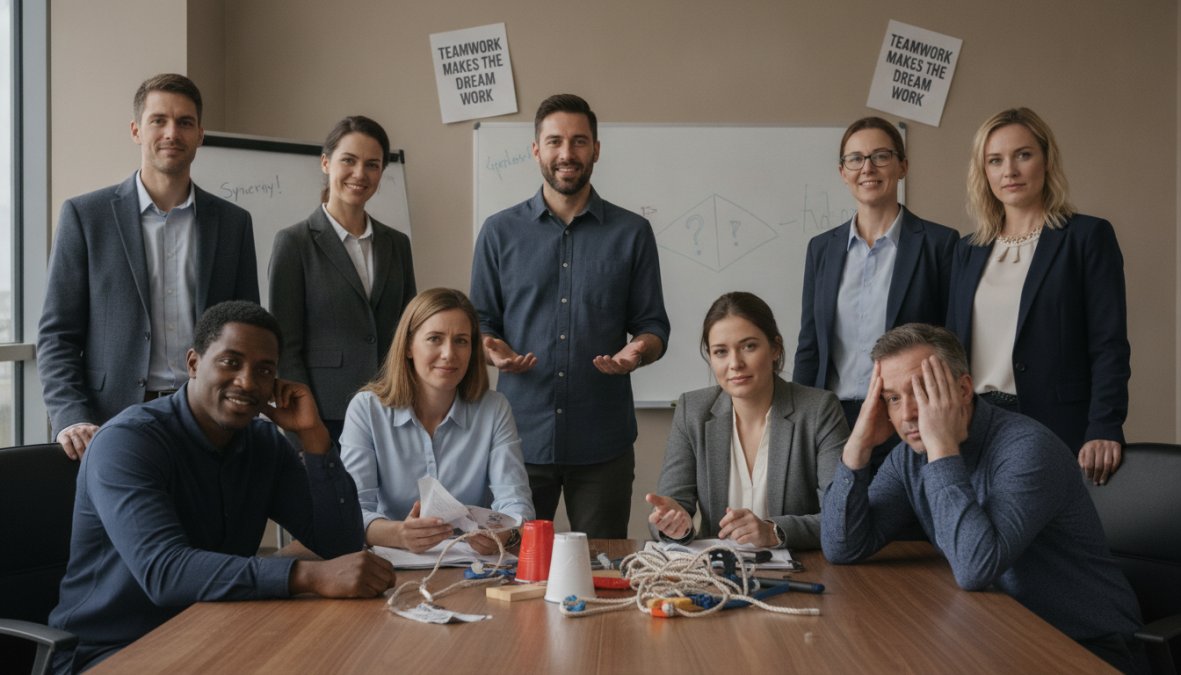
Diverse team of professionals collaborating and discussing around a table in a modern office setting with natural lighting and engaged body language
The DISC model provides practical language for understanding how different behavioral styles show up in group settings. Rather than labeling people as “good” or “bad” team members, DISC explains the why behind their preferences and reactions.
How D, I, S, and C Styles Respond to Different Activities
Dominance styles thrive in activities with clear winners, measurable outcomes, and leadership opportunities. They disengage quickly from activities that feel pointless or overly touchy-feely.
Influence styles are energized by social interaction and variety. They excel in storytelling, group discussion, and role-plays. They need permission to have fun and move around, but can lose focus during long, detailed planning sessions.
Steadiness styles prefer activities where everyone participates equally, without spotlight pressure. They excel in small-group discussions and one-on-one conversations. High-stakes competitive games or large-audience presentations create anxiety rather than engagement.
Conscientiousness styles want accuracy, structure, and a clear agenda. They appreciate workshops that start on time, follow a published schedule, and include reflection time. They need data and logic, not just enthusiasm.
Creating Inclusive Activities for All Personality Types
The strongest workshop agendas include activities designed for different behavioral styles, not activities expecting everyone to participate identically. A team problem-solving exercise might include a competitive element for D styles, collaborative brainstorming for I styles, small breakout groups for S styles, and detailed documentation for C styles. When all four elements exist in one activity, each style finds their moment to contribute meaningfully.
Designing a Team Building Workshop Agenda Template That Works
A well-structured agenda is your insurance policy against wasted time and missed opportunities.
Pre-Workshop Assessment and Communication
Start three weeks before your workshop. Send participants a brief DISC assessment or behavioral questionnaire. This gives you design data and primes participants to think about their working style.
One week before, send a detailed agenda with clear learning objectives. Explain why each activity matters and how it connects to real team challenges. Include a pre-workshop survey asking: “What’s one communication challenge your team faces?” This generates real scenarios you can weave into activities.
Structuring Your Agenda for Maximum Engagement
Total Duration: 4-6 hours
|
Time Block |
Activity Type |
Duration |
Purpose |
|---|---|---|---|
|
0:00-0:15 |
Welcome & Context |
15 min |
Frame objectives |
|
0:15-0:45 |
Behavioral Assessment Debrief |
30 min |
Discuss DISC styles, team composition |
|
0:45-1:45 |
Activity 1: Strengths Mapping |
60 min |
Identify how each style contributes |
|
1:45-2:00 |
Break |
15 min |
Movement, informal conversation |
|
2:00-3:00 |
Activity 2: Communication Scenarios |
60 min |
Role-play real conflicts, practice new approaches |
|
3:00-3:15 |
Break |
15 min |
Reset and reflection |
|
3:15-4:15 |
Activity 3: Action Planning |
60 min |
Individual commitments, accountability pairs |
|
4:15-4:30 |
Closing & Celebration |
15 min |
Celebrate progress, preview next steps |
Alternate between high-energy activities and reflective time. Include at least two breaks, non-negotiable.
Selecting Team Building Activities for Work That Resonate
Not all team building activities are created equal. The difference between an activity that transforms understanding and one that feels wasted often comes down to relevance and behavioral fit.
Behavioral-Focused Activities Over Generic Icebreakers
Skip generic icebreakers. Instead, choose activities directly connected to how your team communicates and solves problems.
Example: Communication Styles Under Pressure Divide the team into mixed behavioral groups. Present a realistic work scenario with tight deadlines and competing priorities. Ask each group to solve the problem using only one communication style per round. D-style directness moves fast but misses nuance. I-style collaboration builds buy-in but takes longer. S-style consensus feels safe but delays decisions. C-style analysis ensures accuracy but can paralyze action. Debrief by asking which style worked best and what was missed when using only one approach. This creates the insight that behavioral diversity is a competitive advantage when managed intentionally.
Matching Activities to Your Team’s Needs
New teams (0-6 months): Focus on building psychological safety and clarifying communication norms. DISC debrief and strengths-mapping activities work well.
Established teams with good dynamics (1-3 years): These teams benefit from problem-solving challenges and cross-functional scenario work.
Teams with communication friction: These teams need explicit conflict resolution practice through role-play activities where they practice new approaches to real disagreements.
Measuring Team Building ROI and Long-Term Impact
Without measurement, you can’t prove the workshop mattered or adjust your approach for future workshops.
Defining Success Metrics Before the Workshop
Decide what success looks like before the workshop. Specific metrics work; vague goals don’t.
Examples of measurable outcomes:
- Meeting engagement: percentage of team members who contribute substantively in meetings (track before and 30 days after)
- Decision velocity: average days to resolve team decisions
- Conflict resolution time: days from disagreement to resolution
- Retention: turnover rate in the 12 months following the workshop
- Psychological safety: anonymous survey scores on questions like “I can voice disagreement without fear”
Post-Workshop Action Plans and Accountability
The workshop itself is just the catalyst. Structure the follow-up explicitly.
Post-Workshop Action Plan:
- Individual Commitments (due day 1): Each person identifies one behavioral change they’ll make.
- Accountability Pairs (assigned during workshop): Partner each person with someone of a different behavioral style. They check in weekly for the first month, then bi-weekly for two months.
- Team Rituals: Spend 5 minutes in each weekly team meeting reviewing how the team is living the workshop insights.
- 30-Day Pulse Check: Send an anonymous survey asking what’s changed and what’s still hard.
- 90-Day Review: Measure your pre-defined success metrics. Share findings with the team. Celebrate progress.
How Why Team Building Workshops Fail Can Be Reversed
The path from failed workshops to successful ones requires leadership alignment and psychological safety.
Leadership Alignment and Behavioral Modeling
If the leadership team doesn’t model the behaviors taught in the workshop, the entire effort collapses. Before the workshop, align with your leadership team on what behavioral change looks like. When a leader says, “I’m going to take the D approach here and make a quick decision, but I want to hear the C-style caution before I finalize,” the team sees behavioral awareness in real time.
Building a Culture of Psychological Safety
The strongest teams have psychological safety. People feel safe being themselves, admitting mistakes, and disagreeing with authority. Workshops built on behavioral assessment naturally create this because they normalize difference. When a team understands that D-style directness isn’t rudeness and S-style caution isn’t weakness, they stop judging each other. Reinforce this in your post-workshop culture by celebrating moments when different styles solved a problem together and framing conflict through the lens of behavioral difference.
Integrating DISC Assessments for Sustainable Success
The most sustainable team building approach weaves DISC assessment into ongoing team practices, not just into a one-time workshop.
Your Lifes Path offers official Everything DiSC® assessments specifically designed for workplace teams. These profiles focus on workplace behavior, how people communicate under pressure, what they need to feel valued, and how they approach problems. When you administer these assessments as part of your workshop design, you get data that directly informs activity selection and team dynamics.
The DISC Workplace Profile provides a shared language your team can use long after the workshop. When someone says, “I’m in D mode right now, I need a quick decision,” the team understands what that means. Beyond the initial assessment, use DISC insights for ongoing team development. When you hire new team members, their DISC profile helps existing team members understand their working style. When you form project teams, intentionally balance behavioral styles. When conflict arises, you have a framework for understanding why it’s happening and how to resolve it.
Conclusion
Team building workshops fail when they ignore behavioral diversity, skip assessment, and assume one activity will resonate with everyone. They succeed when rooted in understanding how D, I, S, and C styles work, when they include explicit accountability mechanisms, and when reinforced through ongoing team practices.
Start with a clear assessment of your team’s behavioral composition and communication challenges. Your Lifes Path’s official Everything DiSC® assessments provide the foundation, detailed behavioral insights, a shared language, and the data you need to design workshops that stick. With structured follow-up and leadership modeling, you can turn a one-day event into a catalyst for lasting cultural change.
Take The Official DiSC® Assessment Online Now and start building workshops that transform how your team communicates and collaborates.
Frequently Asked Questions
What makes a team building workshop fail?
Team building workshops often fail when they lack clear behavioral alignment, skip post-workshop follow-up, or ignore individual personality differences. Without understanding how different DISC styles (Dominant, Influencer, Steady, Conscientious) respond to activities, facilitators may create one-size-fits-all sessions that alienate participants. Additionally, workshops without measurable goals, leadership accountability, or concrete action plans rarely translate into lasting culture change or improved employee engagement.
How can I design an effective team building workshop agenda template?
A strong team building workshop agenda template should include pre-workshop DISC assessments to understand team composition, clear learning objectives tied to business goals, a mix of activities suited to different behavioral styles, built-in reflection time, and defined next steps. Structure your agenda with opening alignment, interactive activities (30-40 minutes), group discussion (20 minutes), and a closing action-planning session. Always allocate time for psychological safety conversations and ensure your facilitator is trained in behavioral dynamics.
What team building activities for work actually improve performance?
Team building activities for work that succeed are those tied to real workplace challenges—like communication gaps or cross-functional silos. Rather than generic icebreakers, choose activities that help teams discover their DISC profiles, practice conflict resolution using behavioral language, or solve business problems together. Activities should feel relevant to daily work, allow all personality types to contribute, and conclude with specific commitments the team will implement back at work. Follow-up accountability is essential.
How do you measure team building ROI and know if your workshop worked?
Measuring team building ROI requires defining success metrics before the workshop—such as improved employee engagement scores, reduced turnover, better cross-team collaboration, or faster project delivery. Use pulse surveys 30, 60, and 90 days post-workshop to track behavioral changes. Monitor team performance indicators like meeting effectiveness, conflict resolution speed, and project outcomes. Include qualitative feedback on psychological safety and trust. Without baseline metrics and post-workshop tracking, it's impossible to prove impact or justify future investment.
This article was written using GrandRanker