

Table of Contents
- Defining a Leadership Pipeline Strategy
- Why Succession Planning and Leadership Pipelines Matter
- Identifying High-Potential Employees for Leadership Roles
- DiSC Assessment for Leadership Development and Readiness
- Building Your Leadership Pipeline: Key Steps and Transitions
- Leadership Development Best Practices That Stick
- Aligning Your Pipeline Strategy With Organizational Goals
- Conclusion
Last Updated: August 17, 2026
Defining a Leadership Pipeline Strategy
A leadership pipeline strategy is a structured, long-term approach to identifying, developing, and advancing high-potential employees into leadership roles. Rather than waiting for vacancies to occur, organizations build a continuous flow of talent ready to step into positions at every leadership level, from frontline supervisors to the C-suite.
The core idea is simple: treat leadership development as an ongoing system, not a reactive hiring process. According to iMocha’s 2026 succession planning research, only 11% of HR executives report having a strong bench to fill leadership roles, underscoring why intentional pipeline strategies matter. Without one, organizations scramble to fill critical positions, often promoting people who aren’t ready or hiring expensive external talent when internal talent could have been developed.
Your Lifes Path works with organizations to align their leadership development efforts with behavioral insights from DISC assessments. This ensures that as you build your pipeline, you’re matching the right people to the right roles based on their behavioral strengths and developmental needs.
A strong leadership pipeline strategy includes identifying which employees have the potential to lead, understanding what competencies they need to develop, creating structured development experiences, and tracking progress against clear milestones.
Why Succession Planning and Leadership Pipelines Matter
Succession planning and leadership pipelines are fundamentally linked. Succession planning answers “What happens when someone leaves?” A leadership pipeline answers “Who’s ready to step in, and how do we keep that bench full?”
Research from iMocha’s 2026 leadership transition data reveals that 37% of directors have delayed CEO transitions due to a lack of internal candidates ready to assume the role. This directly impacts business continuity, investor confidence, and organizational stability. When boards can’t confidently promote from within, they turn to external searches, which take months and cost significantly more than developing internal talent.
Organizations with intentional talent management systems experience faster decision-making, lower leadership turnover, and stronger cultural alignment. When people know there’s a clear path to advancement, engagement increases. When leaders are developed internally, they already understand the organization’s values and strategic direction.
Identifying High-Potential Employees for Leadership Roles
Identifying who has the potential to lead is the foundation of any pipeline strategy. According to iMocha’s 2026 research on succession planning, 45% of companies lack a formal process for identifying high-potential employees. Those that do define high-potential criteria are 7 times more effective at succession planning overall.
The challenge is that potential isn’t always obvious. High performers aren’t always high-potential leaders. Someone excels at their individual role but may lack the interpersonal skills, strategic thinking, or resilience required to lead others.
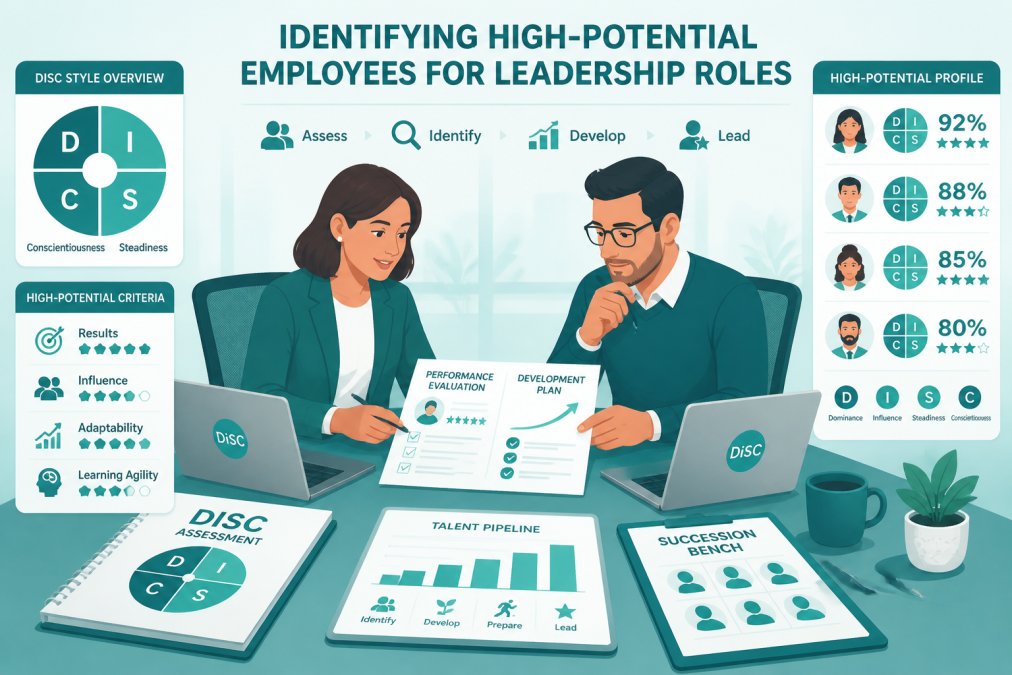
A structured approach to identification typically includes:
- Current performance: Does the person consistently deliver results in their current role?
- Learning agility: Can they adapt, learn new skills, and apply lessons across different contexts?
- Behavioral fit: Do their natural behavioral strengths align with leadership demands?
- Ambition and intent: Do they actually want to lead?
- Relationship skills: Can they influence, collaborate, and build trust across the organization?
This is where DISC assessments become invaluable. The DiSC model identifies four behavioral styles, Dominance, Influence, Steadiness, and Conscientiousness, and helps you understand how people naturally approach challenges, relate to others, and respond to change. A high-potential D-style individual may be decisive and driven but need coaching on listening and empathy. An I-style person may excel at relationship building but need support with follow-through and detail orientation.
When you combine performance data with behavioral insights, you get a clearer picture of who’s ready to develop and what kind of development they need. This prevents the common mistake of promoting the best individual contributor into a role where their behavioral style doesn’t match the requirements.
DiSC Assessment for Leadership Development and Readiness
Understanding behavioral styles through DISC assessment is a game-changer for leadership pipelines. It shifts the conversation from “Is this person smart enough?” to “Does this person’s natural style support the kind of leadership this role requires, and where do they need to grow?”
Each DISC style brings different strengths to leadership. A dominant D-style leader is often decisive and results-focused. An influencing I-style leader excels at building relationships and inspiring teams. A steady S-style leader brings stability and focus on team harmony. A conscientious C-style leader brings precision and process discipline.
The most effective leaders develop flexibility across styles. They learn to adapt their approach based on the situation and the people they’re leading. A D-style leader who learns to listen and collaborate becomes more effective. An I-style leader who develops stronger follow-through and accountability becomes more credible.
Your Lifes Path’s DiSC assessments, including the DiSC Management Profile and DiSC Work of Leaders Profile, help emerging leaders understand their natural style and identify where they need to stretch. These aren’t pass-fail tests; they’re developmental tools that create honest conversations about strengths and growth areas.
When you use DISC insights in your leadership pipeline, you can:
- Match high-potential employees to development experiences that address their specific gaps
- Create peer coaching relationships where different styles complement each other
- Help leaders understand how their behavior impacts their team
- Prepare people for the specific demands of the role they’re being groomed for
Building Your Leadership Pipeline: Key Steps and Transitions
A functioning leadership pipeline operates through clear transitions. Think of it as a series of gates, each with criteria for readiness and development activities required to move forward.
Step 1: Define Leadership Levels and Competencies
Map your organization’s leadership structure: individual contributor leaders, team leaders, managers, directors, and executives. Each level requires different competencies. Define what success looks like at each level to prevent promotion surprises and help candidates understand what they’re working toward.
Step 2: Identify and Assess High-Potential Talent
Use a formal process to identify people with the potential to move up. Include performance reviews, manager input, and behavioral assessments. Use DISC profiles to understand how candidates’ natural styles align with leadership demands at the next level.
Step 3: Create Targeted Development Plans
High-potential employees need individualized development plans that address their specific gaps. If someone is strong on execution but weak on strategic thinking, design experiences that build that capability. If they’re visionary but struggle with detail, pair them with mentors who can coach them on follow-through.

Step 4: Provide Stretch Assignments and Rotations
Take The Official DiSC® Assessment Online Now! →
Development happens through experience. Research shows that 32% of boards use targeted internal rotations to build successor capabilities. Rotations expose high-potential employees to different functions, geographies, and business challenges, building resilience and expanding perspective.
Step 5: Implement Mentoring and Coaching
Executive coaching accelerates learning and provides safe space for feedback. Pairing high-potential employees with experienced mentors, especially those with different behavioral styles, creates opportunities to learn flexibility and adaptability.
Step 6: Track Progress and Adjust
Review progress quarterly. Are people hitting development milestones? Are they ready to move to the next level, or do they need more time? Adjust plans based on what you learn about each person’s progress and readiness.
|
Transition Point |
Key Criteria |
Development Focus |
Timeline |
|---|---|---|---|
|
IC to Team Lead |
Execution + relationship skills |
Delegation, team dynamics |
6-12 months |
|
Team Lead to Manager |
Team results + strategic thinking |
Managing managers, complexity |
12-18 months |
|
Manager to Director |
Multi-team leadership + strategy |
Enterprise perspective, influence |
18-24 months |
|
Director to Executive |
Enterprise leadership + vision |
Board-level thinking, vision setting |
24-36 months |
Leadership Development Best Practices That Stick
The difference between leadership development that transforms behavior and development that fades after a workshop comes down to how you design the experience.
Make It Behavioral, Not Just Conceptual
People don’t change because they attended a seminar. They change when they practice new behaviors, get feedback, and repeat. DISC-based development works because it gives leaders concrete language for understanding themselves and others, then provides opportunities to apply that understanding in real situations.
Create Accountability Structures
Development plans need accountability. When a high-potential employee commits to a specific behavior change and knows their progress will be reviewed, follow-through improves dramatically. This might mean monthly check-ins with a mentor or quarterly reviews against development milestones.
Use Peer Learning
Creating cohorts of high-potential employees at similar career stages builds peer relationships, allows them to learn from each other’s challenges, and creates a sense of shared journey.
Connect Development to Business Strategy
Leadership development that’s disconnected from organizational priorities feels like busywork. When high-potential employees understand how their development supports the company’s strategic direction, engagement increases.
Measure and Iterate
Track what works. Are people who complete your pipeline program successful in their new roles? Do they stay longer? Use this data to refine your approach.
Aligning Your Pipeline Strategy With Organizational Goals
A leadership pipeline exists to serve the organization’s strategy. If your strategy is to expand into new markets, you need leaders with international experience and adaptability. If your strategy is operational excellence, you need leaders with process discipline. If your strategy is innovation, you need leaders who can tolerate ambiguity and encourage experimentation.
Start by asking: What does our strategy require from our leaders over the next three to five years? What capabilities are critical? What behavioral styles will we need more of? Then work backward to your pipeline: Are we developing the right people with the right capabilities?
Many organizations also use DISC insights to build diverse leadership teams. If your current leadership skews heavily toward one or two DISC styles, you may be missing perspectives. A team with D, I, S, and C representation tends to make more balanced decisions and adapt better to changing circumstances.
A leadership pipeline strategy is how organizations ensure they’re never caught without ready talent. It’s the difference between promoting someone and hoping they work out versus developing someone with intention and confidence. By identifying high-potential employees early, understanding their behavioral strengths and gaps through DISC assessment, creating targeted development experiences, and aligning everything to your business strategy, you build organizational resilience and reduce the anxiety around leadership transitions.
Your Lifes Path helps organizations implement this through official Everything DiSC® assessments that give leaders concrete behavioral insights. Whether you’re using the DiSC Management Profile to develop frontline leaders or the DiSC Work of Leaders Profile to prepare directors and executives, behavioral clarity accelerates readiness and improves the quality of promotions. Start with a clear-eyed assessment of your current bench, define what readiness looks like at each level, and build a system that continuously develops the next generation of leaders. Take The Official DiSC® Assessment Online Now and begin building the pipeline your organization needs.
Frequently Asked Questions
What are the key components of a leadership pipeline strategy?
A leadership pipeline strategy includes talent identification, skill assessment, targeted development, mentorship, and succession planning. Organizations use behavioral assessments like DiSC to understand leadership styles and readiness. The strategy also involves internal rotations, executive coaching, and clear career pathing. Strong pipelines align individual development with organizational capability and future business needs, ensuring leaders are ready before transitions occur.
How does identifying high-potential employees improve succession planning?
Organizations that define high-potential employees formally are 7 times more effective at succession planning. Identifying high-potential employees early allows you to invest in their development, assign stretch roles, and prepare them for leadership transitions. This proactive approach reduces the risk of CEO transition delays—37% of directors have delayed transitions due to lack of internal candidates. Clear identification criteria and ongoing assessment ensure your bench is strong when you need it.
Why should we use DiSC assessment for leadership development?
DiSC assessment for leadership reveals behavioral styles, communication preferences, and work values that shape how leaders motivate teams and make decisions. Understanding DISC profiles helps high-potential employees adapt their style to different situations and team needs. This behavioral insight accelerates leadership readiness and improves team communication. Combined with targeted coaching and internal rotations, DiSC assessments create a foundation for developing leaders who understand themselves and their impact on others.
What's the difference between a leadership pipeline and succession planning?
Succession planning focuses on preparing for specific leadership transitions, while a leadership pipeline strategy is a continuous system for developing talent at all levels. A pipeline builds organizational capability over time, identifying and developing multiple candidates for future roles. Succession planning uses the pipeline to fill critical positions when they open. Think of the pipeline as the system and succession planning as the application—you need both. Only 11% of HR executives report having a strong bench, showing how rare effective pipelines are.
This article was written using GrandRanker