
Table of Contents
- Understanding DiSC Behavioral Styles for Remote Work
- How to Implement DiSC Assessments for Remote Teams: A Step-by-Step Approach
- How to Facilitate a Virtual DiSC Workshop for Your Team
- DiSC Assessment Tools for Remote Work Environments
- DiSC Profile Examples for Remote Teams in Action
- DiSC Assessment Best Practices for Managers Leading Distributed Teams
- Building High-Performing Remote Teams Through DISC-Based Role Assignment
- Leveraging DISC Insights to Strengthen Trust and Collaboration Across Distance
How to Implement DiSC Assessments for Remote Teams
Last Updated: July 1, 2026
Understanding DiSC Behavioral Styles for Remote Work
Remote work fundamentally changes how behavioral styles interact. DiSC identifies four core patterns: Dominance (D), Influence (I), Steadiness (S), and Conscientiousness (C). Each has distinct communication preferences, decision-making approaches, and stress responses that become either friction points or competitive advantages depending on whether you understand them.
The challenge with remote teams is invisibility. You can’t read body language through a screen or overhear hallway conversations that clarify misunderstandings. A high-D team member might interpret a cautious S-style colleague’s questions as resistance. An I-style person thrives on spontaneous brainstorming, while C-style teammates need time to process before speaking. These natural differences aren’t problems, they’re signals you need better alignment structures.
Research on remote team communication challenges shows that distributed teams struggle most with trust and clarity. DiSC assessments address both by making invisible preferences visible. Once your team understands their own styles and each other’s, you can design workflows, communication cadences, and feedback mechanisms that work with behavioral differences instead of against them.
How to Implement DiSC Assessments for Remote Teams: A Step-by-Step Approach
Step 1: Define Your Team Goals and Readiness
Before administering any assessment, clarify why you’re doing this. Common goals include improving communication, reducing conflict, strengthening trust across distributed locations, or preparing for major transitions. Each goal requires slightly different follow-up work.
Your team needs psychological safety, they should feel that understanding behavioral differences is about better collaboration, not evaluation. If your team is mid-conflict or experiencing trust issues, address that context first. Ask yourself: Are team members likely to be open to this? Do I have leadership buy-in to follow through with insights? A single assessment without follow-up action creates skepticism.
For remote teams, consider timing. Don’t roll this out during crisis periods or heavy workload seasons. You want people’s attention available for the workshop and reflection that follows.
Step 2: Select and Administer Your Assessment
Your Lifes Path offers official Everything DiSC® assessments purpose-built for workplace teams. The platform provides specialized profiles for management, sales, and leadership contexts. Assessments are administered digitally, which works seamlessly for remote environments.
The assessment takes 10-15 minutes per person. Participants answer questions about their natural preferences, work style, and how they respond under pressure. There’s no way to “fail” a DiSC assessment, it measures patterns, not right or wrong answers.
For remote administration, send the assessment link with clear instructions: completion deadline, expected time commitment, and what happens next. Emphasize that people should answer based on their natural preference, not how they think they should be. After completion, team reports populate in the EPIC (Electronic Profile Information Center) Sub Account, Your Lifes Path’s platform for managing team data and accessing individual profiles, team dynamics reports, and comparison views. With Free EPIC Sub-Accounts, you can get started without upfront infrastructure costs.
Step 3: Interpret Results and Create Team Reports
Raw assessment data means nothing without interpretation. Start with individual profiles. Each person gets a detailed report showing their primary style, secondary influences, and how they likely show up in different contexts. Read your own profile first, understanding your own style gives you credibility when discussing others’ results.
Then move to team-level reports. Your Lifes Path’s platform generates reports showing the distribution of styles across your team, potential communication gaps, and natural strengths and challenges. A team heavy in D and I styles might excel at quick decisions and innovation but struggle with follow-through. A team with strong S representation brings stability and loyalty but might move slowly on change.
Create a simple one-page team summary showing: the style distribution, your team’s top 2-3 strengths, and 1-2 potential blind spots to watch for. This becomes the foundation for your facilitated workshop.
How to Facilitate a Virtual DiSC Workshop for Your Team
The assessment is data collection. The workshop is where the data becomes actionable. A virtual DiSC workshop typically runs 60-90 minutes and includes individual profile review, team dynamics discussion, communication strategy development, and action planning. Many teams benefit from working with a facilitator experienced in DiSC delivery, consider exploring Virtual Teambuilding Workshops to guide your team through this process.
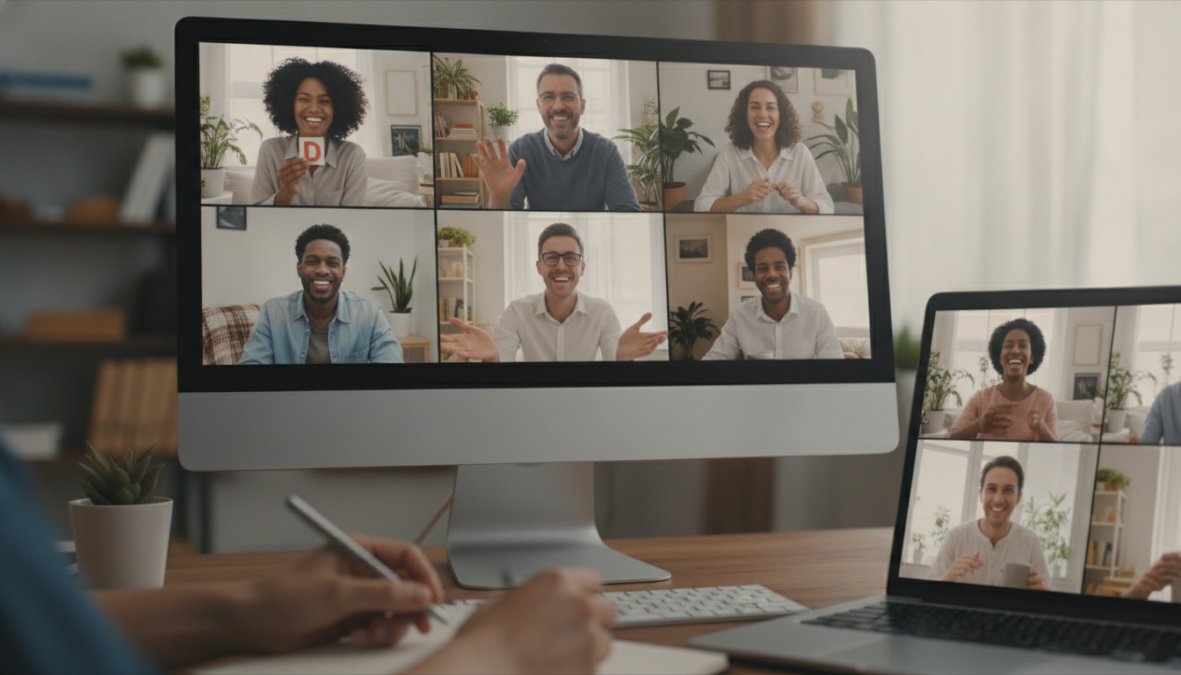
Start with individual reflection: “What surprised you about your profile? What felt accurate?” Then move to style-specific breakout discussions. Group people by their primary style and have them discuss: “What do people with your style need from teammates? What frustrates you in virtual collaboration?” This gives each style a voice and prevents the conversation from being dominated by high-I or high-D personalities.
Bring the full group back together and have each style group share their key insights. A D-style person hears directly from S-style colleagues: “We need more time to process before decisions. When you move fast without checking in, we feel left behind.” That’s useful information. Similarly, S-style people learn that D-style directness isn’t rudeness; it’s efficiency.
For remote facilitation, use breakout rooms for small-group discussions, not chat. Voice conversations feel safer and allow for more nuanced discussion. If your team spans multiple time zones, run two workshops with the same agenda rather than trying to record and asynchronously process.
Close the workshop with concrete commitments. What will this team do differently? Examples: “We’ll send agendas 24 hours before meetings so C-style members can prepare.” / “We’ll make space in meetings for I-style people to think out loud without judgment.” Document these commitments and revisit them in team meetings over the next month.
DiSC Assessment Tools for Remote Work Environments
Your Lifes Path’s platform is built specifically for this work. The EPIC Sub Account system lets you manage multiple team assessments, track results over time, and access team dynamics reports without per-person fees. The digital delivery works seamlessly for remote teams. People complete assessments on their own schedule, reports generate automatically, and you can access everything from any device. For managers leading distributed teams across time zones, this asynchronous capability is essential.
The platform also supports facilitation through Catalyst, a flexible tool that lets you run virtual workshops, share profiles with team members, and create discussion guides. For teams considering deeper expertise, DiSC Certification programs teach you to administer assessments, interpret results, and facilitate workshops with confidence.
DiSC Profile Examples for Remote Teams in Action
Consider a product team with four core members:
- Marcus (D-style): Product manager, direct communicator, moves fast, wants outcomes
- Priya (I-style): Designer, energetic, generates ideas, thrives on collaboration
- Sam (S-style): Developer, steady contributor, prefers predictability
- Casey (C-style): QA lead, detail-oriented, wants processes and clear standards
Before DiSC, this team had friction. Marcus pushed for quick decisions. Priya wanted to brainstorm alternatives. Sam felt rushed and made mistakes. Casey wanted documented standards that nobody maintained.
After the assessment and workshop, they redesigned their process: weekly brainstorm calls (Priya-led) on Tuesdays give Marcus and Priya dedicated space for idea generation. Decision meetings (Marcus-led) on Thursdays give Sam and Casey time to process. Async written standups in Slack work for Sam’s preference for predictability and Casey’s need for documentation.
The team’s output didn’t change. Their process did. Because the process now accommodates different styles, the quality of work improved, with fewer mistakes and faster decisions.
DiSC Assessment Best Practices for Managers Leading Distributed Teams
Reference behavioral styles in regular conversations. When a team member proposes something, acknowledge their style: “That’s a great high-I energy idea, and I want to make sure we also check in with Casey to see if there are any process gaps.” This normalizes the language and shows that understanding styles is part of how you operate.
Use styles as a diagnostic tool when conflict arises. Often it’s not personal, it’s style mismatch. A D-style person’s directness can feel harsh to an S-style person. When you recognize the pattern, you can intervene with style-specific language: “I see what’s happening. You’re approaching this differently because of how you’re wired. Let’s talk about what each of you needs.”
Design feedback conversations around styles. High-D people want direct, bottom-line feedback. High-I people want to know how their work affects the team. High-S people want to know how changes affect stability. High-C people want specific examples and data. Same feedback, different delivery.
Use styles to assign roles and projects. Match people’s natural strengths to work that needs doing. A high-D person excels at driving decisions. A high-I person excels at building excitement. An S-style person excels at maintaining consistency. A C-style person excels at quality control.
Revisit assessments annually. People’s styles don’t change fundamentally, but their secondary influences can shift based on role, stress, and experience.
Harvard Business Review research on remote team management shows that managers of distributed teams who understand and actively manage communication preferences see 30% higher engagement.
Building High-Performing Remote Teams Through DISC-Based Role Assignment
Remote teams often default to assigning roles based on job title or seniority. A better approach incorporates behavioral style. This doesn’t mean changing someone’s job, it means clarifying which aspects of their role play to their strengths.
A project with multiple phases offers a clear example. The kickoff phase requires energy and vision (high-I work). The planning phase requires detail and risk mitigation (high-C work). The execution phase requires consistency and support (high-S work). The closure phase requires decisiveness (high-D work).
If you assign the entire project to one person, you’re asking them to do work that doesn’t match their natural style. If you distribute the phases based on style strengths, each person does what they do best.
For ongoing roles, a high-D person should own decisions and drive outcomes. A high-I person should own communication and team energy. A high-S person should own consistency and follow-through. A high-C person should own quality and process.
This also affects how you structure accountability. High-D people respond to clear outcomes and autonomy. High-I people respond to recognition and team impact. High-S people respond to stability and appreciation. High-C people respond to clear standards and competence.
Using DISC Insights to Strengthen Trust and Collaboration Across Distance
Trust in remote teams is fragile. You can’t build it through proximity. You build it through clarity and consistency.
DiSC creates clarity. When team members understand why someone communicates the way they do, they’re less likely to misinterpret behavior. A D-style person’s quick decision isn’t dismissiveness, it’s efficiency. An S-style person’s careful listening isn’t slowness, it’s thoroughness. An I-style person’s enthusiasm isn’t superficiality, it’s genuine optimism. A C-style person’s questions aren’t doubt, it’s diligence.
Collaboration improves when you design processes that honor different styles. If your team includes high-C people, they need time and documentation before decisions. If your team includes high-I people, they need space to think out loud. If your team includes high-S people, they need predictability. If your team includes high-D people, they need clear outcomes and autonomy.
A practical example: structure a weekly standup with 5 minutes each for high-D updates (outcomes achieved), high-I updates (excitement and collaboration), high-S updates (consistency and support), and high-C updates (quality and process). Everyone gets heard. Everyone contributes.
MIT research on remote team trust and communication shows that teams with explicit communication norms and style awareness build trust 40% faster than teams that assume everyone communicates the same way. For remote teams, this is essential. You don’t have the luxury of informal relationship-building that happens in offices. You have to be intentional.
Implementing DiSC assessments for remote teams requires clarity, follow-through, and ongoing attention. The assessment itself is straightforward, 10-15 minutes per person with automated reporting. The real work is interpretation and application. Your Lifes Path provides the official Everything DiSC® assessments, team dynamics reports, and facilitation tools that make this manageable. By understanding your team’s behavioral styles and designing workflows that honor those differences, you create conditions where remote collaboration actually works better than in-person work. Start with a clear goal, administer the assessment, facilitate a workshop, and anchor the insights into how your team operates every day.
Frequently Asked Questions
Are DiSC assessments effective for remote teams?
Yes. DiSC assessments are highly effective for remote teams because they provide behavioral insights that bridge communication gaps created by distance. By understanding each team member's work style—whether they're driven, influential, steady, or conscientious—remote managers can tailor communication approaches, reduce misunderstandings, and build stronger interpersonal connections. This leads to improved accountability, trust, and team cohesion even when working asynchronously.
How do you facilitate a DiSC workshop virtually?
To facilitate a virtual DiSC workshop, start by administering assessments through a digital platform, then schedule synchronous sessions where team members discuss their profiles in breakout rooms. Use visual aids and real-world remote work scenarios to illustrate how different behavioral styles collaborate. Follow up with asynchronous resources—recorded modules and reference guides—so team members can review content on their schedule. This hybrid approach respects distributed time zones while maintaining engagement.
What are the key benefits of using DiSC for remote employees?
DiSC assessments for remote employees deliver several key benefits: improved self-awareness of communication needs, stronger conflict resolution skills, clearer role assignment based on behavioral strengths, and enhanced feedback loops. Remote workers gain confidence in their interactions with colleagues across different time zones. Managers gain clarity on how to motivate each team member, reducing isolation and boosting professional development. The result is a more cohesive remote culture and higher retention.
How do you explain DiSC results to remote team members?
Explain DiSC results by focusing on strengths and work style preferences, not labels. Use your team's digital collaboration platform to share individual profiles and team reports. Conduct one-on-one or small group video calls to discuss how each style contributes to team dynamics and how behavioral insights apply to real remote work scenarios—like asynchronous communication, meeting participation, and project collaboration. Emphasize that all styles are valuable and complementary.
This article was written using GrandRanker