Table of Contents
- Understanding DISC Personality Styles in Remote Work
- Best Strategies for Managing Remote Teams with DISC Awareness
- Remote Team Communication Tools and Best Practices
- Remote Team Management Best Practices for Engagement
- Addressing Challenges of Managing Remote Teams
- Remote Team Meeting Agenda Templates for Productivity
- Implementing DISC Assessments for Remote Team Success
- Conclusion
Best Strategies for Managing Remote Teams
Last Updated: July 4, 2026
The shift to remote work has fundamentally changed how managers lead their teams. Organizations that implement the best strategies for managing remote teams report significantly higher employee engagement and retention rates. Applying DISC behavioral insights to remote environments creates measurable differences in team performance. Below, we’ll show you how to adapt your leadership approach, communicate effectively across distance, and build a cohesive culture while respecting the personality styles that make your team tick.
Understanding DISC Personality Styles in Remote Work
Every team member has a distinct behavioral style that shapes how they prefer to work, communicate, and solve problems. DISC divides these styles into four categories: Dominance (D), Influence (I), Steadiness (S), and Conscientiousness (C). In remote settings, understanding these styles is critical because you lose casual hallway interactions and in-person cues that naturally bridge communication gaps.
D-style personalities are task-focused and direct. They want autonomy, clear objectives, and quick decision-making. I-style personalities are people-focused and enthusiastic but can feel isolated without intentional team interaction. S-style personalities value stability and harmony, preferring consistent processes and strong relationships. C-style personalities are detail-oriented and analytical, needing comprehensive information and documented processes.
Remote management requires recognizing these styles and adapting your communication in real time. A D-style employee frustrated by unclear goals will disengage faster than one receiving crystal-clear direction. An I-style team member struggling without social connection may produce lower-quality work despite having the skills.
How Each DISC Style Communicates Remotely
D-style communicators are efficient and results-oriented. They prefer brief, direct messages and quick video calls rather than lengthy email chains. When managing D-style remote employees, send concise updates, respect their time by getting to the point immediately, and give them decision-making authority.
I-style communicators thrive on enthusiasm and personal connection. They prefer frequent video calls over email and enjoy informal check-ins blending work with personal updates. Remote management requires regular face-to-face video interaction and channels for casual team connection.
S-style communicators value consistency and harmony. They prefer detailed, thoughtful communication explaining the reasoning behind decisions and appreciate warnings about changes. Managing S-style remote employees means providing advance notice of shifts and maintaining stable routines.
C-style communicators want accuracy and completeness. They prefer written documentation, detailed explanations, and time to review information before responding. Remote management requires comprehensive documentation and respect for their need to thoroughly understand expectations.
Remote Work Preferences by Behavioral Style
D-style personalities often excel in remote environments because they value independence and outcome-based accountability. However, they can become disconnected from team dynamics without intentional strategic touchpoints.
I-style personalities struggle most with traditional remote work because they need interpersonal connection. They perform best with scheduled video meetings, collaborative tools that foster interaction, and explicit permission to engage in non-work conversation.
S-style personalities appreciate the predictability of remote work but need strong relationship continuity. They benefit from consistent one-on-one check-ins, stable team routines, and clear role definitions.
C-style personalities often thrive remotely because they can control their environment and work at their own pace. They need comprehensive documentation, clear processes, and written communication trails.
Best Strategies for Managing Remote Teams with DISC Awareness
Effective remote team management recognizes that one-size-fits-all approaches fail. Your strategies must account for personality diversity by adjusting communication style, meeting cadence, feedback approach, and recognition methods based on individual DISC profiles.
Start by having each team member complete an official DISC assessment. This creates a shared language for how your team works best. When everyone understands their own style and their teammates’ styles, friction decreases dramatically. Many organizations find that Virtual Teambuilding Workshops provide an excellent way to introduce DISC concepts and build team cohesion around personality insights in a remote setting.
Adapting Your Leadership Style to Remote Environments
Your leadership approach must flex based on DISC profile while remaining consistent in values. For D-style team members, lead with autonomy and clear metrics. Set outcome-based goals, provide resources, then get out of their way. For I-style team members, lead with connection and enthusiasm through regular video calls and visible celebration. For S-style team members, lead with consistency and support through predictable routines and regular check-ins. For C-style team members, lead with clarity and data through comprehensive documentation and logical reasoning.
Building Psychological Safety Across Distance
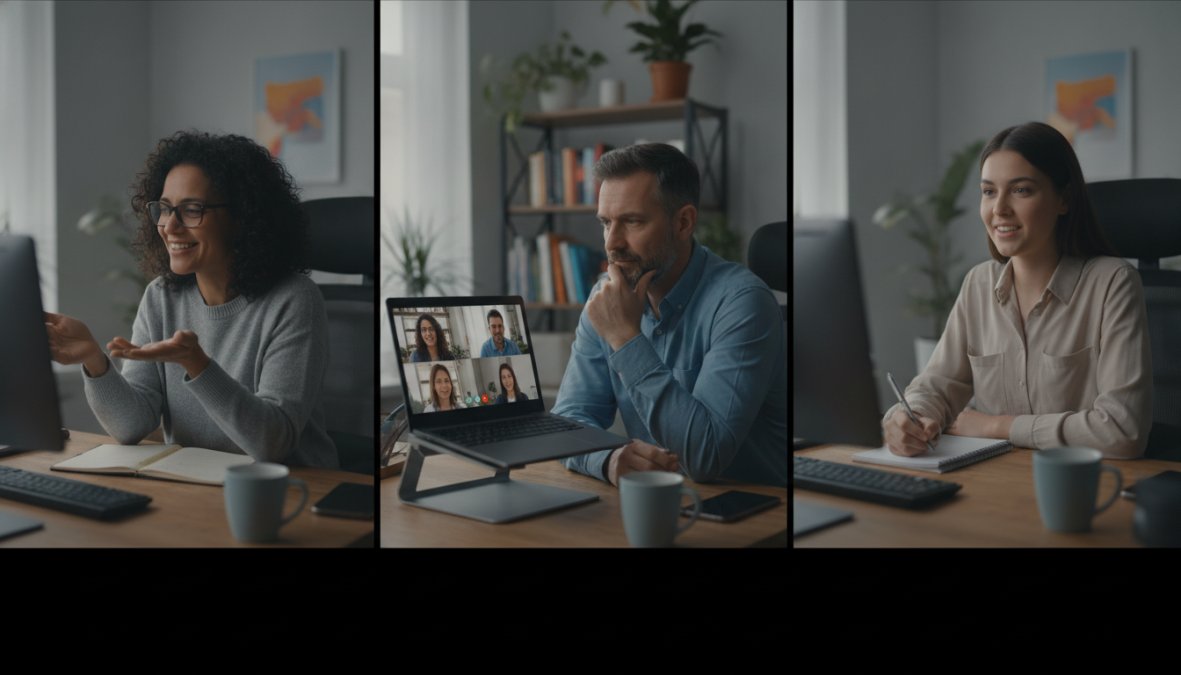
Psychological safety, the belief that you can take interpersonal risks without fear of negative consequences, becomes harder to establish remotely yet is essential for high-performing teams. Different DISC styles need different approaches to feel safe.
D-style employees feel safe when they have clear authority and aren’t micromanaged. S-style employees feel safe when relationships are stable and expectations are consistent. I-style employees feel safe when they feel valued and included. C-style employees feel safe when standards are clear and information is accurate.
Create channels for honest feedback without fear of retaliation. Schedule regular one-on-ones where people know they can voice concerns. Use anonymous surveys to gather feedback on team dynamics. Model vulnerability by acknowledging your own mistakes.
Remote Team Communication Tools and Best Practices
The right communication tools matter, but they’re not a substitute for thoughtful communication practices. Different DISC styles gravitate toward different tools, so use multiple channels intentionally.
Choosing Tools Based on DISC Communication Preferences
Slack works well for D-style quick decisions and I-style social connection. Asana and Monday.com provide structure and documentation that S-style and C-style employees need. Zoom excels at synchronous communication that I-style and S-style employees prefer. Loom enables asynchronous video that respects C-style processing time while providing personal touch.
Use Slack for quick decisions and informal connection. Use Asana or Monday.com for project tracking and process documentation. Use Zoom for strategic meetings and relationship building. Use Loom for detailed explanations that don’t require real-time interaction.
Asynchronous vs. Synchronous Communication for Different Styles
Asynchronous communication respects D-style employees’ need for focus and C-style employees’ need for processing time. It allows people across time zones to participate meaningfully. Synchronous communication builds the connection that I-style and S-style employees need and enables quick decision-making.
The solution is intentional mixing. Schedule recurring synchronous touchpoints for relationship building and strategic alignment. Use asynchronous channels for routine updates and detailed explanations. For important decisions, provide both synchronous discussion and asynchronous written documentation.
| Communication Method | Best For | Frequency | DISC Preference |
|---|---|---|---|
| One-on-one video calls | Relationship building, feedback | Weekly or bi-weekly | I, S |
| Team video meetings | Strategic alignment, celebration | Weekly | I, S |
| Recorded video updates | Detailed explanations, announcements | As needed | C, D |
| Written documentation | Process clarity, reference | Ongoing | C, S |
| Quick chat messages | Rapid decisions, informal connection | Daily | D, I |
Remote Team Management Best Practices for Engagement
Engagement in remote settings requires active management. People disengage when they feel invisible, when they don’t understand how their work matters, or when they don’t feel connected to their team.
Motivating Each DISC Profile in a Distributed Setting
D-style employees are motivated by autonomy, challenge, and visible impact. Give them stretch goals, decision-making authority, and clear metrics. In remote settings, make their impact visible by celebrating wins and giving them ownership of important projects.
I-style employees are motivated by connection, recognition, and collaborative success. Create explicit opportunities for team celebration, involve them in collaborative projects, and schedule regular video calls where you can acknowledge their contributions.
S-style employees are motivated by stability, clear expectations, and harmonious relationships. Maintain consistent routines, communicate changes well in advance, and prioritize regular connection.
C-style employees are motivated by competence, accuracy, and meaningful contribution. Provide opportunities to develop expertise, acknowledge the quality of their work, and involve them in decisions requiring analytical thinking.
Recognition and Feedback Strategies by Personality Type
Recognition must match DISC styles to feel genuine. D-style employees appreciate recognition highlighting their impact and competitive wins. I-style employees appreciate recognition celebrating their relationships and influence in group settings. S-style employees appreciate recognition acknowledging their reliability and loyalty in one-on-one settings. C-style employees appreciate recognition highlighting their expertise and thoroughness.
Feedback also requires style-awareness. D-style employees want direct, results-focused feedback delivered quickly. I-style employees want feedback delivered warmly with emphasis on relationships. S-style employees want feedback delivered gently in one-on-one settings. C-style employees want feedback that’s detailed, accurate, and documented.
Addressing Challenges of Managing Remote Teams
Remote management creates predictable challenges that DISC awareness helps address proactively.
Managing Personality Clashes Across Time Zones
Personality clashes often stem from misunderstanding different communication styles. A D-style employee’s directness can feel harsh to an S-style employee. An I-style employee’s enthusiasm can feel chaotic to a C-style employee.
Address clashes by making DISC styles visible. When team members understand that their colleague’s abruptness isn’t personal disrespect but a D-style communication preference, they stop taking it personally. Facilitate conversations where team members explain their own styles and what they need from others.
Building Trust and Team Morale Without In-Person Connection
Trust builds through consistency, competence, and care. In remote settings, all three must be intentional. Consistency means following through on commitments and maintaining predictable communication. Competence means your team sees you as capable and knowledgeable. Care means your team knows you value them as people, not just workers.
Team morale requires celebrating together. Celebrate wins in team meetings, share personal milestones, and create informal connection time where work isn’t the focus.
Remote Team Meeting Agenda Templates for Productivity
Meetings are essential for alignment and connection. The key is making them count for all DISC styles.
Structuring Meetings for Different DISC Preferences
Share a clear agenda in advance. This respects C-style and S-style preferences for knowing what to expect. Structure meetings with clear time blocks: spend the first 5-10 minutes on connection and relationship building, the middle section on substantive content with time allocated for each topic, and the final 5 minutes on decisions and next steps with clear ownership assigned.
Use video when possible to enable nonverbal communication. End with a written summary including decisions made, action items with owners and deadlines, and referenced documents.
One-on-One Formats That Build Connection
Schedule one-on-ones consistently, weekly or bi-weekly. Block at least 30 minutes and protect that time. Start with personal connection by asking about their life outside work. Then address work topics by asking about progress, obstacles, and support needed. End with development conversation about growth goals and how you can support their progress.
Implementing DISC Assessments for Remote Team Success
An official DISC assessment creates shared language for how your team works. Have each team member complete an assessment individually, then schedule a team session where people share results. Use the assessment results to inform your management approach and build team norms that respect all styles.
For organizations managing multiple teams or departments, Free EPIC Sub-Accounts offer a scalable way to administer DISC assessments across your entire remote organization. If you’re looking to deepen your expertise, DiSC Certification enables managers and HR professionals to become certified facilitators who can guide their teams through behavioral insights with confidence.
Remote team management succeeds when you see your people as individuals with different behavioral styles. The best strategies account for personality diversity in how you communicate, motivate, recognize, and develop your team members. By implementing DISC awareness across your remote leadership practices, you create a culture where each person can contribute their best work while feeling valued and connected. Start by having your team complete an official DISC assessment, then use those insights to adapt your management approach to what each person actually needs.
Frequently Asked Questions
What are the biggest challenges of managing remote teams?
The primary challenges of managing remote teams include maintaining team morale across distance, ensuring clear communication without in-person connection, managing personality clashes when face-to-face resolution isn't possible, and recognizing individual employee needs without direct observation. DISC-based management addresses these by helping leaders understand each team member's behavioral style, communication preferences, and intrinsic motivation drivers, enabling personalized approaches that work in remote settings.
How do you keep remote teams motivated and engaged using personality insights?
Motivation varies by DISC profile. Dominant (D) styles thrive on autonomy and results-driven goals; Influential (I) styles need regular interaction and recognition; Steady (S) styles value stability and team cohesion; Conscientious (C) styles appreciate clear expectations and quality feedback. Remote team management best practices involve tailoring your approach: offer D-styles independent projects, create social moments for I-styles, ensure predictable processes for S-styles, and provide detailed documentation for C-styles. This individualized management significantly boosts engagement.
What communication tools work best for distributed remote teams?
Remote team communication tools should support multiple interaction styles. Slack and Asana work well for quick updates and task tracking; Zoom excels for synchronous meetings where I and S styles benefit from face-to-face connection; Loom enables asynchronous video updates perfect for D and C styles who prefer efficiency. The key is offering choice: some team members prefer written updates (C-styles), while others thrive on real-time conversation (I-styles). Combining tools ensures all behavioral preferences are accommodated.
How can remote team meeting agenda templates improve productivity?
Remote team meeting agenda templates structured around DISC preferences increase engagement and reduce meeting fatigue. Include a clear purpose statement for C-styles, time limits for D-styles, interactive elements for I-styles, and relationship-building time for S-styles. Templates should specify who speaks when, decision-making processes, and follow-up actions. This structure respects different communication preferences and ensures meetings feel valuable to all personality types, directly addressing common challenges of managing remote teams.
This article was written using GrandRanker